Get Full Government Meeting Transcripts, Videos, & Alerts Forever!
Get email alerts on the Fire Incident Reporting topic
No spam. Unsubscribe anytime.
Santa Barbara Fire Department reports steady incident volumes; turnout and training metrics presented
Summary
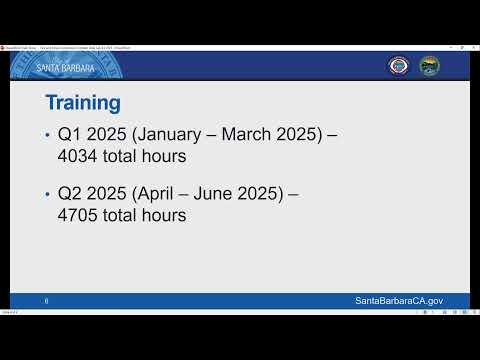
Operations Division Chief Brian Fetterman reported 2,956 calls for service in quarter 1 and 2,821 in quarter 2, consistent EMS volume, travel times within expected ranges and more than 4,000 training hours recorded across the department in the first half of 2025.
Brian Fetterman, operations division chief for the Santa Barbara Fire Department, presented incident reporting data for the first half of 2025 to the Fire and Police Commission on July 24.
Fetterman reported 2,956 emergency response incidents in quarter 1 (January–March) and 2,821 in quarter 2 (April–June). In quarter 1, the department logged 67 fires, 2,123 rescue and EMS calls, 130 hazardous conditions, 58 service calls, 444 good intent calls and 134 false alarms. Quarter 2 showed broadly similar percentages across call types, with EMS representing the majority of responses.
Fetterman reviewed turnout and travel times. Priority travel times averaged broadly in the four‑minute range for travel to incidents; recorded turnout (the time between dispatch and units going en route) varied by shift and showed a small improvement in quarter 2. "These are the metrics that we track... travel time is pretty consistent," he said, and noted safety priorities for apparatus driving.
The department logged over 4,000 training hours across operations in the reporting period, reflecting onboarding of new firefighters and promotional preparations, Fetterman said. He told commissioners that when broken down per FTE the department is ‘‘pushing over a hundred plus hours of logged training in a month for each one of the firefighters,’’ acknowledging the figure aggregates multiple training categories.
Commissioners asked about how the department interprets training hours relative to other agencies; Fetterman said the number represents state‑reportable hours and does not capture informal mentoring or ad hoc training that occurs in stations.