Get Full Government Meeting Transcripts, Videos, & Alerts Forever!
Get email alerts on the Operations Programs topic
No spam. Unsubscribe anytime.
SFHA operations: inspections, abatements and a rising CMAP score as leasing slowed by HAP shortfall
Summary
Housing authority operations staff reported higher inspection pass rates after scheduling annual bulk inspections by site, but persistent abatements still cost landlords hundreds of thousands in monthly HAP while HUD funding restrictions slowed new tenant-based lease-ups.
Housing authority operations staff told the board they have made process changes that have improved inspection pass rates and key quality-control metrics even while program leasing slowed because HUD restrictions prevented issuance of new tenant-based vouchers.
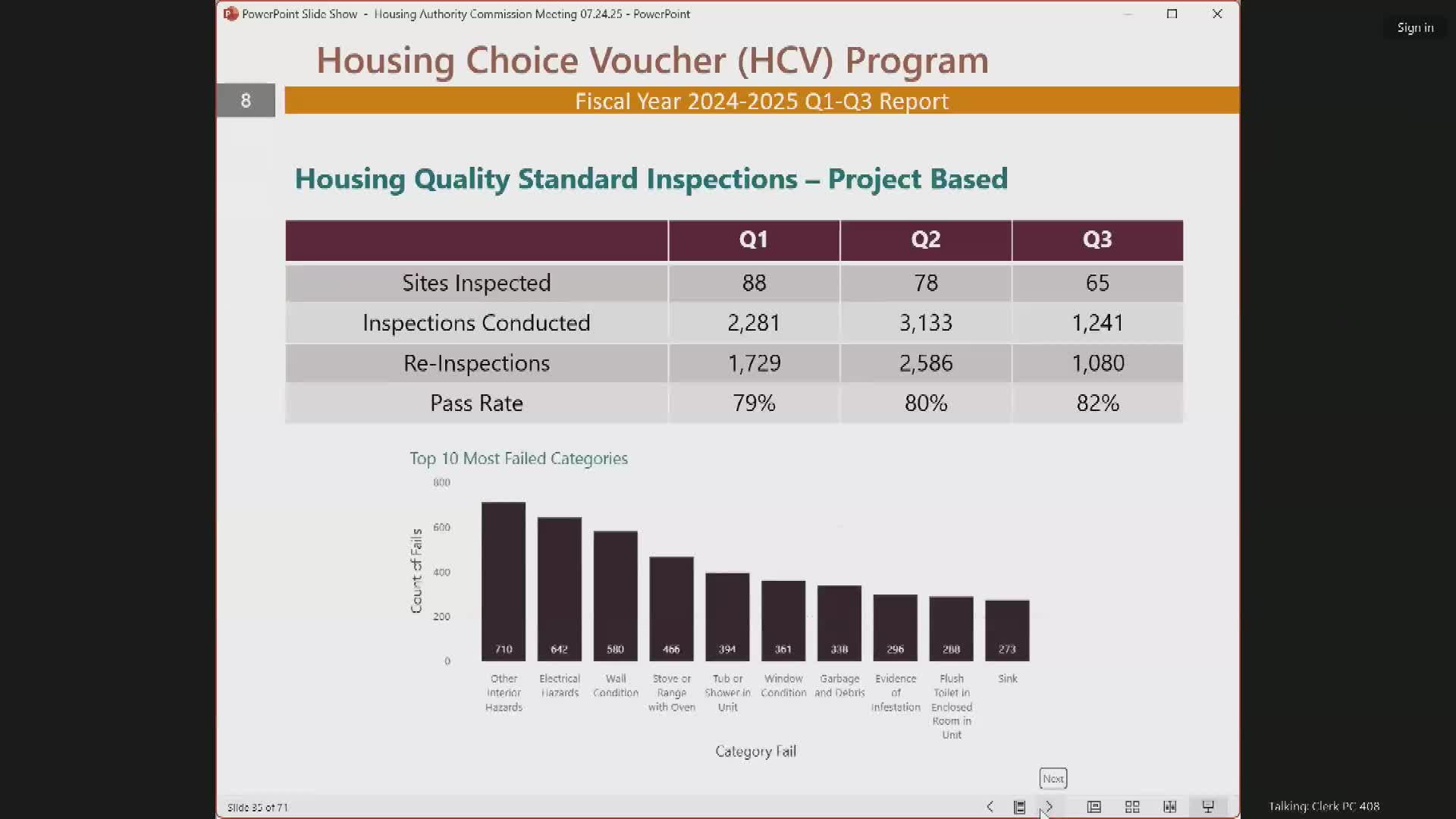
Operations presenters said the authority adopted bulk, site-based inspections starting November 1 and moved other process changes to reduce no-shows and increase pass rates. The authority reported overall greater pass rates for project-based voucher (PBV) inspections and said tenant-based (HCV) inspections were in compliance (96% on-time inspections for the tenant-based program reported to HUD).
Nevertheless, inspectors flagged many project-based units for health-and-safety issues. Staff reported 331 active abatements for PBV units (299 of those with large developers), with abatements averaging just over five months. Abatements stop Housing Assistance Payments (HAP) to owners; staff said that landlords are losing about $625,000–$732,000 per month while abatements remain unresolved. Inspectors described common problems behind long abatements: severe wall damage, leaks, electrical hazards and fire-system issues that require substantive repairs.
Operations staff said they have increased reinspection speed, adopted owner self-certification for routine repairs in some cases, and are providing weekly or biweekly partner calls with PBV owner–operators to coordinate repairs and documentation. Staff also noted that quarterly reconciliations with large developers have reduced year-end surprises and help ensure accurate HAP payments to owners.
On program indicators, the authority reported strengthening CMAP (Section 8 management) scores: from 55% in FY2023 (troubled) to 76% in FY2024 (standard), and internal reporting projects an 89.6% score for FY2025, on the cusp of a high-performing designation. Staff credited inspection scheduling changes, improved QC review of annual reexaminations and data-reconciliation efforts with HUD.
Operations presenters also reported a fall in new admissions across the last three quarters because the authority could not issue new tenant-based vouchers while in HAP shortfall. The board heard that numerous new units (particularly RAD and newly developed PBV buildings) have been leased up—more than 250 additional occupied units this quarter—but the agency could not issue tenant-based vouchers to respond to all leasing demand due to the funding restriction.
Staff said they will continue reconciliation and outreach to owners, roll out new administrative technology tools (a workflow tracker, inspections management, and quality control management) with appropriate data-security safeguards, and provide the board with additional trend data on CMAP indicators across multiple prior years at commissioners' request.