Get Full Government Meeting Transcripts, Videos, & Alerts Forever!
Get email alerts on the Public Safety Regulation topic
No spam. Unsubscribe anytime.
Abilene council tables first-reading BYOB ordinance after wide-ranging debate on scope and enforcement
Summary
On first reading the Abilene City Council discussed a proposed ordinance to regulate BYOB (bring‑your‑own‑beer/booze) establishments, hearing hours‑of‑operation, permit triggers and exemptions before voting to table the measure for revision.
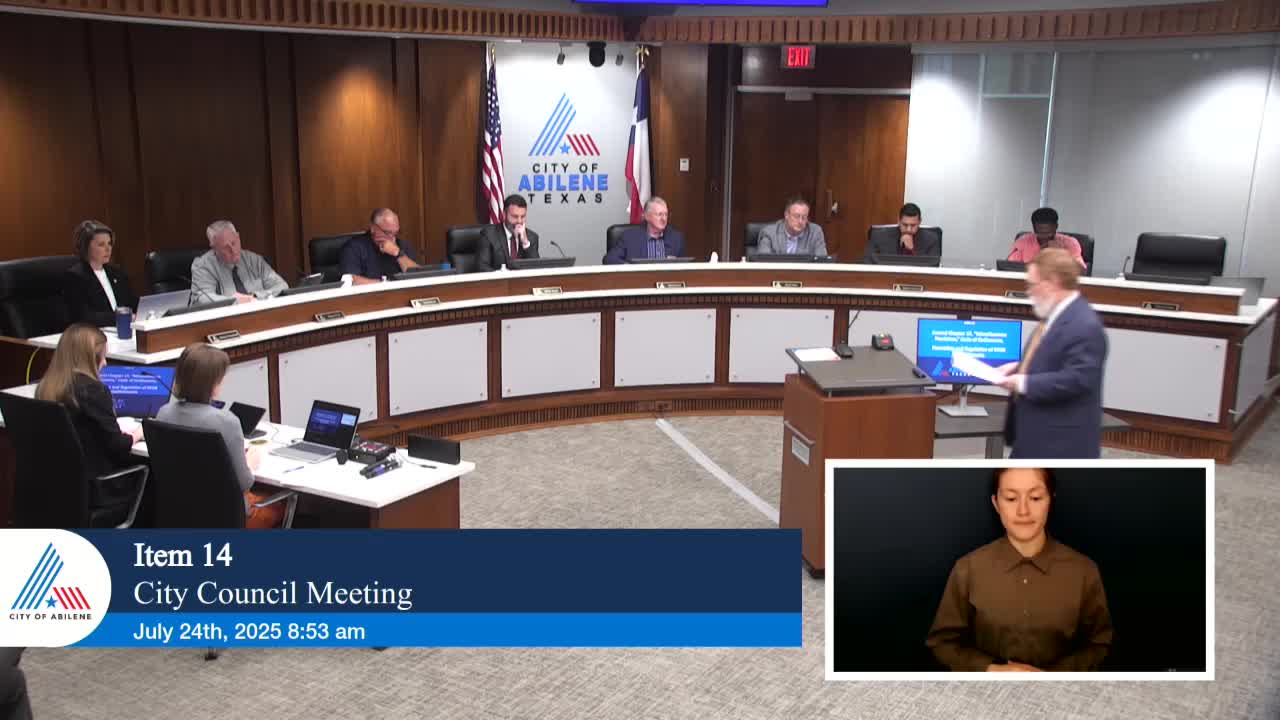
The Abilene City Council on Wednesday conducted a lengthy first reading and public hearing on a proposed BYOB establishment ordinance, then voted to table the measure so staff can return with a narrowed proposal focused first on hours of operation.
City Attorney Stanley Smith presented the draft ordinance as a locally enforced permitting and regulatory framework for businesses that allow patrons to bring alcoholic beverages, noting the ordinance would create a permit program, inspection authority and a heightened regulatory tier for establishments that have two corroborated incidents within 180 days.
The ordinance as drafted would require all BYOB establishments to display a permit, prohibit owners and staff from consuming alcohol during business hours, require consent to inspections, and — for establishments that meet the “two strikes” threshold — require on‑site presence of the permit holder or a listed designee, walk‑through metal detectors or wands, lighting of exterior areas, and security officers (one per 50 patrons) with level‑2 licenses and low‑light recording capability.
Council members repeatedly expressed concern the draft would cast too broad a net and impose heavy administrative burdens on many nonprofits, event venues and businesses that host private BYOB events. Council members and the police chief debated whether a universal permitting requirement was needed to give law enforcement tools to trace and regulate problem operators, or whether the city could instead start by restricting hours and trigger permitting only after incidents.
Police leadership told the council that, without a permitting list, officers lack a reliable way to identify responsible parties and prevent operators from moving problem events from site to site. The chief said past incidents often occurred after other bars close and after 2 a.m., which factored into the council’s discussion of whether a narrow hours restriction would address the problem.
Multiple members — including Mayor (identified in the transcript as presiding) and Councilman Price — favored starting with a targeted change limiting BYOB operating hours (proposed 2 a.m.–7 a.m., with a later Sunday start) and retaining the draft’s two‑strike enforcement tools to be applied only if incidents occur. Public commenters, including Tammy Fogle and Rochelle Johnson (representing the Expo Center of Taylor County), urged the council not to sweep well‑behaved nonprofits and event venues into a burdensome permitting regime and asked for clearer, narrower language.
After public comment, Councilman Price moved to table the ordinance; Councilman Beard seconded. The motion to table passed.
The council directed staff to return with a revised draft focused on hours of operation for BYOB establishments (with an ordinance narrowing or eliminating immediate permit requirements), plus a mechanism to trigger permitting and the additional security requirements only after corroborated incidents. The ordinance will return for further consideration at a subsequent meeting.
Proponents of a narrow approach said it would give police a clearer enforcement tool while minimizing compliance costs for community event venues. Opponents of a narrow approach said they feared problem operators would continue to relocate if the city lacked a broader permitting system to identify and bar repeat offenders.
The council did not complete a final reading or adopt the ordinance; the item was tabled to allow staff to craft the narrower, hours‑first ordinance and to address concerns raised by council members and members of the public.