Get Full Government Meeting Transcripts, Videos, & Alerts Forever!
Get email alerts on the Sustainability topic
No spam. Unsubscribe anytime.
Office of Sustainability pitches circular-economy innovation center, releases Cool Kit heat-mitigation guide
Summary
The Office of Sustainability proposed a Charlotte-style circular economy "innovation barn" for Richmond, targeting construction debris, food waste, textiles and plastics, and released a Cool Kit guide aimed at urban-heat mitigation for city projects and private property.
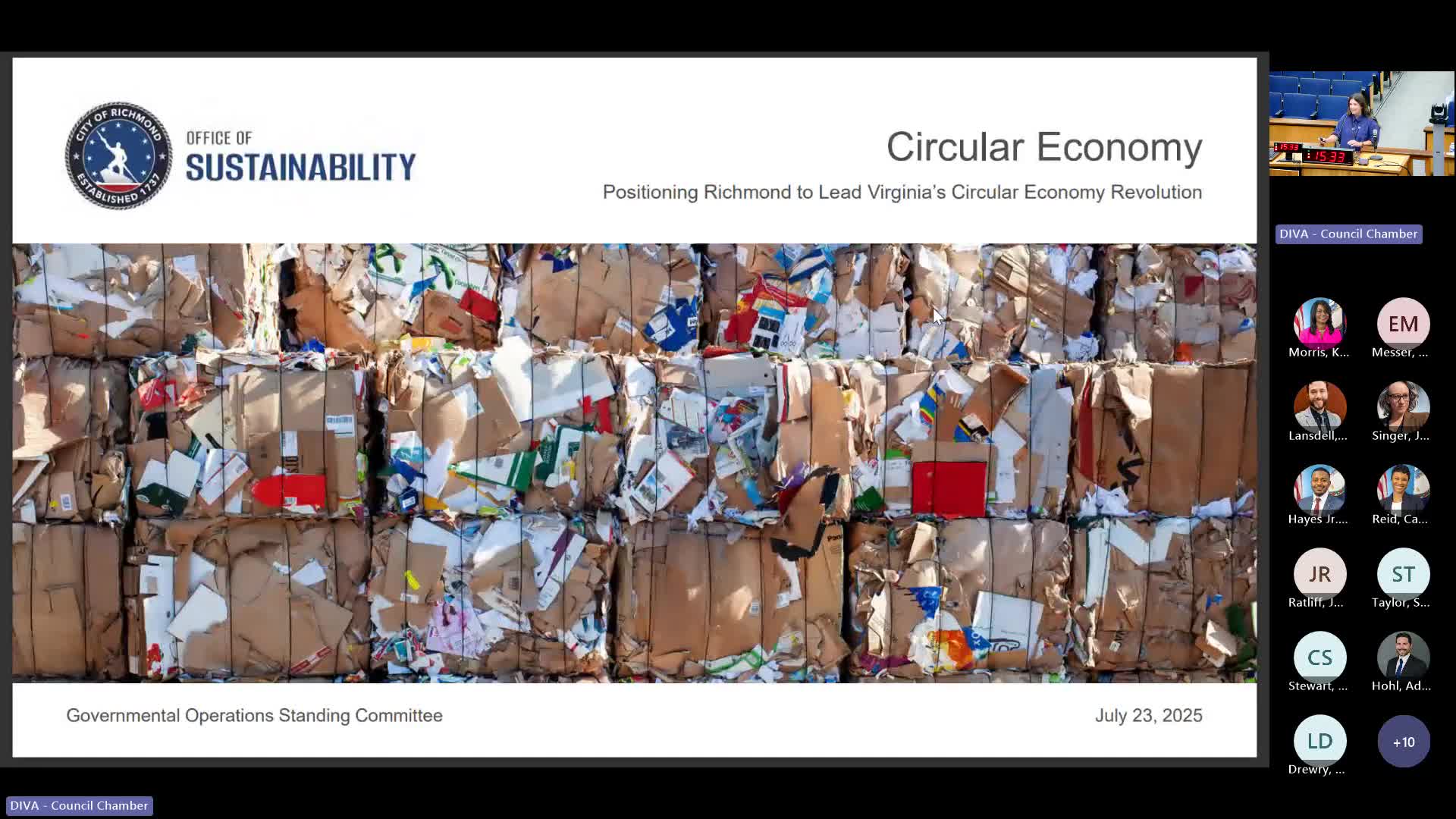
Tara Wharton, sustainability manager in the Office of Sustainability, told the Governmental Operations Standing Committee on July 16 that Richmond has the institutional and industrial assets to host a circular-economy innovation center that would turn waste streams into revenue and workforce opportunities.
Wharton described the model used in Charlotte's Innovation Barn—a city-owned building leased to a nonprofit for a nominal fee, supplemented by corporate sponsors, grants, tenant rent and earned revenue—and noted on-site amenities that Charlotte uses to incubate circular businesses: plastics processing, a glass crusher, an urban lumber mill, business incubation labs, workforce-development retail and cafe space, tours and educational programming. She said the city is conducting a materials-flow analysis focused initially on construction and demolition debris, food waste from large institutions, textiles and plastics and is engaging potential corporate and nonprofit partners.
The nut graf: Wharton argued Richmond could leverage local universities, manufacturing history, VCU research programs and an emerging maker and sustainability ecosystem to pilot a circular-economy hub that could divert hundreds of tons of waste from landfill while creating jobs and revenue streams.
Wharton identified local advantages: VCU research and student engagement, a growing tech and innovation sector, an existing textile and manufacturing base, local artisans doing urban wood reuse, Granova (a local firm working on washing and reusing plastics) and repair-pop-up activity such as Repair Cafe RVA. She said staff have begun seeking anchor partners and potential city-owned properties and noted real-estate constraints given limited industrial land.
At committee request Wharton agreed to provide additional detail on potential funding mixes, tax-impact questions and specific candidate sites for adaptive reuse. Committee members asked about revenue models, property-tax considerations for for-profit tenants, and how the city would balance preservation of industrial land with site selection.
Following Wharton, Daniel Klein, sustainability coordinator, presented the Richmond Cool Kit, an urban-heat mitigation guide the office released to help city staff, developers and residents reduce extreme-heat impacts. Klein described 25 strategies categorized as urban greening (street trees, green infrastructure), blue infrastructure (splash pads, fountains), shade (built shade structures) and smart surfaces (lighter pavements, white roofing) and depaving (replacing excess impervious surface with green space).
Klein said the Cool Kit is intended both as a design checklist for city capital and maintenance projects and as a public resource for businesses and homeowners. He linked the guide to the city's Sustainable Design Standards and said the guide supports four goals: cool neighborhoods, cool active-transport corridors, cool community spaces and increase climate resilience. Committee members noted the projected increase in extreme-heat days and urged integrating these approaches into project planning and community outreach.
Ending: Office of Sustainability staff said they will continue the materials-flow analysis and report back on partner development and site feasibility; they also plan workshops for city staff to apply Cool Kit strategies to pipeline projects.