Get Full Government Meeting Transcripts, Videos, & Alerts Forever!
Get email alerts on the Executive Search topic
No spam. Unsubscribe anytime.
Hospital Authority committee receives 10 search-firm proposals; legal counsel outlines Open Meetings Act limits
Summary
The Hospital Authority Board CEO Performance and Search Committee reported 10 proposals for an executive search firm and discussed how the Open Meetings Act constrains committee interaction with candidates. Members set a tentative October meeting schedule while the evaluation group begins scoring proposals.
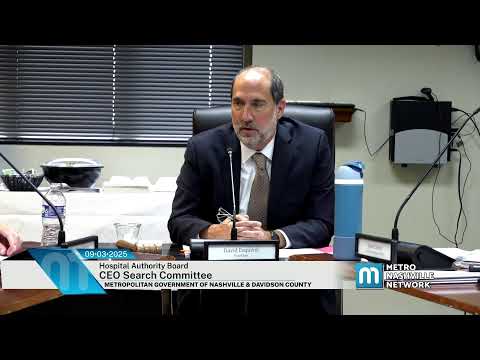
The CEO Performance and Search Committee of the Hospital Authority Board heard an update on its executive search procurement on Sept. 17, 2025, including that the hospital had received 10 proposals and that legal counsel warned the committee the Open Meetings Act restricts how members may interact with candidates.
Committee chair said the Request for Proposal (RFP) process produced a strong response: "on July 24, we received 10 different proposals to serve in that capacity," the chair told the committee. The committee designated a subset of members to score proposals; that evaluation team will meet next week to begin scoring and may hold multiple meetings before recommending finalists to the committee.
Derek Smith, Metro legal counsel, told the committee the law generally requires deliberations among multiple committee members to occur in public. "Anytime you're considering the candidates... those meetings... must be an open public meeting," Smith said, explaining that publicly deliberating candidates would normally require disclosure of candidate identities and that many executive-level candidates expect confidentiality until finalists are identified.
Smith recommended relying on the search firm and a delegated representative from the committee to perform much of the early screening and legwork. "They kinda act both as your shield and also in part, perhaps, a decision maker," he said, describing common practice in executive searches. He warned board members against individually contacting candidates or the search firm on a rotating or ad-hoc basis, saying that such contacts risk violating the Open Meetings Act or creating perceptions of an unfair process.
Committee members discussed practical approaches that search firms use, including: setting evaluation criteria in public meetings; having the search firm call down applicants who do not meet minimum qualifications; asking candidates to submit written responses to standardized questions; and conducting finalist interviews in public sessions with standardized questions and presentations.
Committee members and legal counsel also discussed logistics if negotiations proceed with a selected finalist, including keeping a second finalist available in case the first candidate declines and delegating negotiation authority within preapproved parameters so that salary discussions need not occur in repeated public sessions. The committee was told the RFP contemplates a contract term for the search firm limited to five years; committee members asked procurement staff to clarify whether any extension language in the RFQ permits extending without a new solicitation.
The committee did not change the RFP process or appoint additional delegates at the meeting; the evaluation subgroup will begin scoring next week, and the committee set a tentative next meeting for Oct. 15, 2025.
Votes at the meeting were limited to approval of minutes and adjournment. The committee approved the minutes of the CEO Search Committee meeting dated June 25, 2025, and the CEO Performance Review Committee meeting dated July 31, 2025, by voice vote; the minutes were accepted and "the motion carries" was recorded. A motion to adjourn passed and the meeting ended.