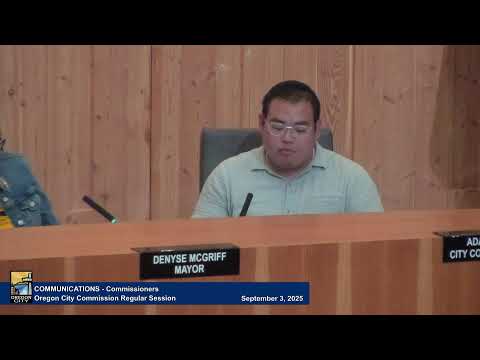
Oregon City amends sidewalk code, commissioners debate broader reimbursement program
Summary
The Oregon City Commission approved first reading of amendments to municipal code Title 12 to formalize notice and permit timelines for sidewalk repairs. Residents urged wider reimbursement for sidewalks damaged by roots; commissioners requested criteria and staff follow-up but did not expand the program tonight.
Oregon City commissioners approved first reading of an ordinance on Sept. 3 amending municipal code Title 12 to set formal timelines for notice, permitting and construction for sidewalk maintenance. The change establishes a 60-day window to obtain a permit after first notice, a 30-day follow-up notice if no permit is obtained, and a 180-day construction-permit period, replacing the prior 90‑day construction window.
The measure, Ordinance No. 25-10-10, was presented by Dana Webb, Public Works Director, who said the revisions reflect commission feedback received at earlier work sessions and alter the enforcement timeline to emphasize voluntary compliance and permit flexibility. “The code amendment provides 60 days from the first notice to get your permit,” Webb said, and the construction permit window has been increased to 180 days.
The revisions drew sustained public comment from neighborhood residents and a lengthy commission debate about the city’s existing sidewalk reimbursement program for damage caused by city‑planted street trees. Several residents asked the commission to expand the program beyond failures linked to street trees to cover other sidewalk replacements in older neighborhoods.
Tyson (who noted people sometimes call him Tyler), a McLaughlin neighborhood resident, asked the commission to “discuss and thoughtfully consider and vote on expanding the sidewalk reimbursement program, to include sidewalk replacements not just caused by city’s street trees.” Heather Krause, a Tower Vista resident, described receiving a registered notice requiring sidewalk repair and asked the city to “allow us to correct the violations before going down the path of immediate...you know, you've got to fix this, it's gonna be a $211 permit.”
Commissioners and staff described steps already taken: temporarily waiving permit fees for some residents (approved earlier on the consent agenda), extending timelines for compliance, and allowing limited temporary treatments (such as grinding) where appropriate. Commissioner Mitchell noted the city’s prosecutorial discretion: the city can extend deadlines for circumstances beyond an owner’s control, and Webb confirmed staff can make accommodations.
Several commissioners said they sympathize with residents’ financial concerns but worried that expanding a reimbursement program without clear, citywide criteria would create inequities. Commissioner Marl said any expansion “would have to be open to everyone” and suggested any broad program must be paired with defined eligibility criteria. Commissioner Wilson said he supported the program when it was designed to address failures clearly caused by city‑installed street trees and was reluctant to expand it to failures with no demonstrable city nexus.
On procedure, commissioners discussed seasonal constraints for concrete work and whether the extended permit window would still allow repairs in appropriate weather. Webb said paving work is often feasible in October and sometimes again in February; the revised timeline seeks to provide predictable structure for owners and contractors.
The first reading of Ordinance No. 25-10-10 passed on a roll-call vote (four in favor, one opposed). Commissioner Wilson, Commissioner Smith and Commissioner Marl voted aye; Commissioner Mitchell voted aye; Mayor Denise C. McGriff cast the lone no vote. The ordinance will return for a second reading.
Commissioners asked staff to return with refined options for implementation details and emphasized continued outreach to affected neighborhoods. Residents and commissioners repeatedly requested clearer, written criteria for any future expansion of financial assistance so the city can evaluate equity and budget impacts.
A timeline detail: the revised code package sets 60 days to obtain a permit after first notice, a 30‑day second notice if no permit is obtained, and 180 days for construction once a permit is issued (staff said the total potential period between first notice and completion can reach about nine months under the new structure).
The commission also reaffirmed that the city’s priority remains voluntary compliance and that staff retain discretion to make case‑by‑case accommodations for hardship or extraordinary circumstances.
AI generated
The text on this page is AI generated. Summaries, highlights, analysis, and video transcripts are all produced from the original source material.
AI can make mistakes, so if you spot one, and we will fix it for everyone.
Note: the source content is unaltered by us. Any content source we link to, be it a video, an audio recording, or a document, is presented exactly as its publisher released it. That publisher is usually a government body, sometimes an individual official or another organisation.