Get Full Government Meeting Transcripts, Videos, & Alerts Forever!
Get email alerts on the Agritourism topic
No spam. Unsubscribe anytime.
Skagit Planning Commission reviews agritourism code recommendations; public comment urges support for small farmers
Summary
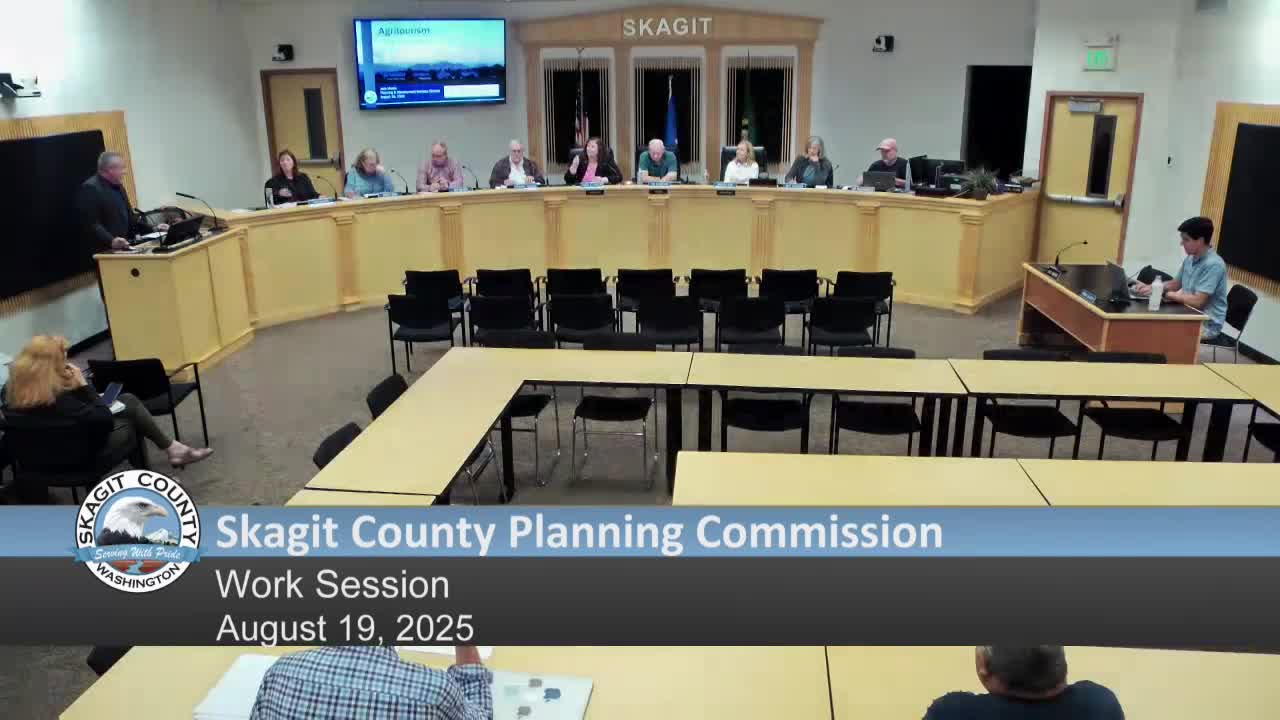
The Skagit County Planning Commission on Aug. 19 reviewed recommendations from advisory groups and staff on proposed agritourism code changes remanded by the Board of County Commissioners, including draft definitions, permit categories and rules for participation in the Skagit Valley Tulip Festival.
The Skagit County Planning Commission on Aug. 19 reviewed recommendations from a temporary Community Advisory Group and the Agricultural Advisory Board on proposed agritourism code changes remanded to staff by the Skagit County Board of County Commissioners.
The proposals, presented by Jack Lorum, Planning and Development Services director, aim to clarify what counts as agritourism on agricultural natural resource lands (Ag NRL), set measurable thresholds for different levels of agritourism, and address participation in the Skagit Valley Tulip Festival. Lorum said the draft code would require agritourism activities to be “conducted by a farmer on an actively managed, ongoing farm operation” and to remain “incidental to the site's primary agricultural use.”
The matter matters to Skagit County because the Board remanded the initial code amendments for more study and asked staff to examine five items: whether agritourism needs a separate code category; rules for participation in the Skagit Valley Tulip Festival; whether rules should differ by geography within the county; whether temporary-event standards are sufficiently detailed; and whether amendments would be consistent with recent state and judicial decisions.
Lorum summarized the background: county staff began an agritourism study in 2021, issued policy recommendations and public workshops in 2022, and advanced draft code amendments through 2023. The Board imposed a moratorium on new permit applications for agritourism on Ag NRL land in January 2024; the moratorium was extended by the Board to January 2026, Lorum said. He told commissioners that staff convened a temporary Community Advisory Group that met eight times and included large and small farm representatives, agritourism operators, and representatives of the Skagit Valley Tulip Festival, Skagit Festival of Farms and the Skagit Tourism Bureau.
The Community Advisory Group recommended a single agritourism definition that would require: operation by the farm operator on an actively managed farm; purposes tied to agricultural education, enjoyment or recreation; an activity that preserves rural character; and that agritourism remain incidental to the farm’s primary agricultural use. The advisory group proposed a participation window of March 15–May 15 for the Skagit Valley Tulip Festival and recommended that festival days not count against a farm’s annual agritourism-day limits under county approvals.
The Agricultural Advisory Board offered similar guidance. It recommended defining agritourism as “a common farm-based commercial activity serving the public that promotes agriculture, is directly incidental and subordinate to the working farm operation, and is operated by the owner or operator of the farm or family members.” The ag board recommended that temporary events require permits with clear limits on size, area of operation and number of events; one draft proposal the ag board reviewed limited temporary uses to 12 events per year.
Commissioners asked staff to clarify draft code language that replaces the existing “temporary events” label with “limited event venues” and to explain why draft sections on parking and ingress were removed from one proposed subsection. Robbie (staff member) said parking and access standards would be handled by other code sections and that staff was focusing the agritourism chapter on measurable limits—such as number of people, number of events or area used—rather than duplicating parking rules.
Commissioners also pressed staff on how the draft would distinguish small, intermittent family-farm activities from larger, commercial event operations and on the thresholds used to assign administrative or hearing-examiner special-use permit review. Lorum and Robbie said the draft will use a combination of modifiers—number of people, number of events, and intensity of use—to determine whether an operation requires an administrative special-use permit (Ag 2) or a hearing-examiner review (Ag 3).
A resident who identified herself as a farmer, Rachel Perlow of Bow, spoke during the public remarks period. Perlow said she supports keeping agricultural land in production but urged commissioners to consider how the new rules would affect farmers working to bring fallow land back into production. “Agritourism is a really important way for us to supplement the work that we're doing as farmers and to ensure that our community understands the work that we're doing,” Perlow said.
Commissioners and staff discussed enforcement and implementation. Lorum said the Board had directed planning staff to develop voluntary compliance agreements for existing operators that were in substantial and continuous operation before the January 2024 moratorium. He said staff had identified 18 existing businesses for follow-up and that the county recently filled a second compliance-officer position in Planning and Development Services to assist with code compliance.
Staff explained the process and tentative timeline: staff expects to present a revised draft to the Planning Commission on Sept. 16, hold a public hearing Oct. 14, deliberate Nov. 18 and, if the schedule holds, take recommendations to the Board of County Commissioners in December. Lorum cautioned that the drafts are preliminary and that staff anticipates public feedback and edits.
No final land-use rule or code amendment was adopted at the Aug. 19 meeting; the session was a work session for review and discussion. Commissioners requested more detailed rationale for numerical thresholds used in the draft (for example, why 50 people or 100 people per day were chosen for certain permit levels) and asked staff to document the basis for those numbers at a future meeting.
Votes at the meeting included the approval of the prior meeting minutes at the start of the session; the motion was moved and seconded and approved by voice vote, with commissioners responding “Aye.” The minutes-approval motion was procedural and not related to the agritourism code discussion.
Next steps: staff will revise the draft code based on Board guidance, comments from the Community Advisory Group and Agricultural Advisory Board, and Planning Commission feedback; the commission will review the updated draft on Sept. 16 and hold a public hearing in October.
(Reporting by the Planning Commission staff presentation and public remarks; quotations from Jack Lorum, Planning and Development Services director, and Rachel Perlow, Bow resident and farmer.)