Get Full Government Meeting Transcripts, Videos, & Alerts Forever!
Get email alerts on the Municipal Budget topic
No spam. Unsubscribe anytime.
Lakeville approves $27.67 million fiscal 2019 budget after debate over health benefits
Summary
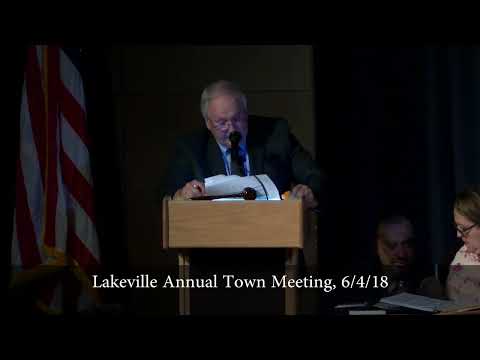
At the Town of Lakeville annual meeting, voters approved a $27,671,120 fiscal 2019 budget after questions about employee health insurance eligibility, contribution rates and an opt-out stipend. The measure passed by more than the required two-thirds vote.
Lakeville voters approved the town's fiscal 2019 operating budget, including a $2.22 million health insurance appropriation, after about an hour of questions and explanation about who is eligible for town health coverage and how much the town contributes.
The warrant motion, read by the moderator, asked the town to "raise and appropriate $27,370,280, transfer $5,415 from the Massachusetts Water Pollution Trust, transfer $25,000 from the sale of land proceeds, $200,000 from the Debt Service Capital Project Stabilization Fund, and $70,425 from the Stabilization Fund for a total of $27,671,120 to defray town expenses for the fiscal period 07/01/2018 to 06/30/2019," and referenced the handout titled "Town of Lakeville Fiscal Year 2019 Budget." The motion passed by a vote of 111 to 1, above the two-thirds threshold required because the budget uses stabilization and other reserves.
Why it matters: the budget sets spending for core town services and includes several large line items that town officials said required explanation for voters, notably the health insurance aggregate line and the use of one-time and stabilization funds to balance spending.
Town staff and voters pressed for and received clarifications during the budget reading. A town official explained that eligibility for town health insurance is determined by state standards and that employees who work 20 hours or more per week are treated as eligible for full-time benefits. The town official also described the negotiated cost-sharing for active employees: the most generous plan has the town paying roughly 75 percent of premiums, a common PPO plan is about 65 percent town-paid and 35 percent employee-paid, and new hires were negotiated to a 50/50 split. Responses at the meeting identified an opt-out stipend budgeted to encourage eligible employees to decline town coverage: $2,500 for employees on a single plan and $5,000 for family coverage.
During the discussion a resident and insurance professional questioned whether the town's plan really had no deductible, saying deductibles are common and can materially reduce cost. Town staff and the moderator said the town participates in a Gateway Group purchasing pool and is constrained by state rules that require benefits at least as good as the GIC state plan; staff offered to continue the conversation outside town meeting.
Budget detail and administration: town staff explained that the health insurance appropriation is presented as a single line rather than broken out by department because the town uses a single operational account to avoid repeated transfers between departments during the fiscal year. The accounting official said an exhibit could be prepared for future meetings showing departmental breakouts if voters want those details.
Other budget context raised during the vote: a finance committee member described the year's budget process and said the town began with roughly $1 million in department requests above revenue forecasts, that the assessors' overlay holdback was reduced this year because of a current-year surplus, and that no net new positions were requested beyond replacements and some promotions in public safety.
The meeting then proceeded to other warrant articles.