Get Full Government Meeting Transcripts, Videos, & Alerts Forever!
Get email alerts on the Redistricting topic
No spam. Unsubscribe anytime.
Assembly committee approves ACA 8 to let California voters decide on one-time mid-decade congressional maps
Summary
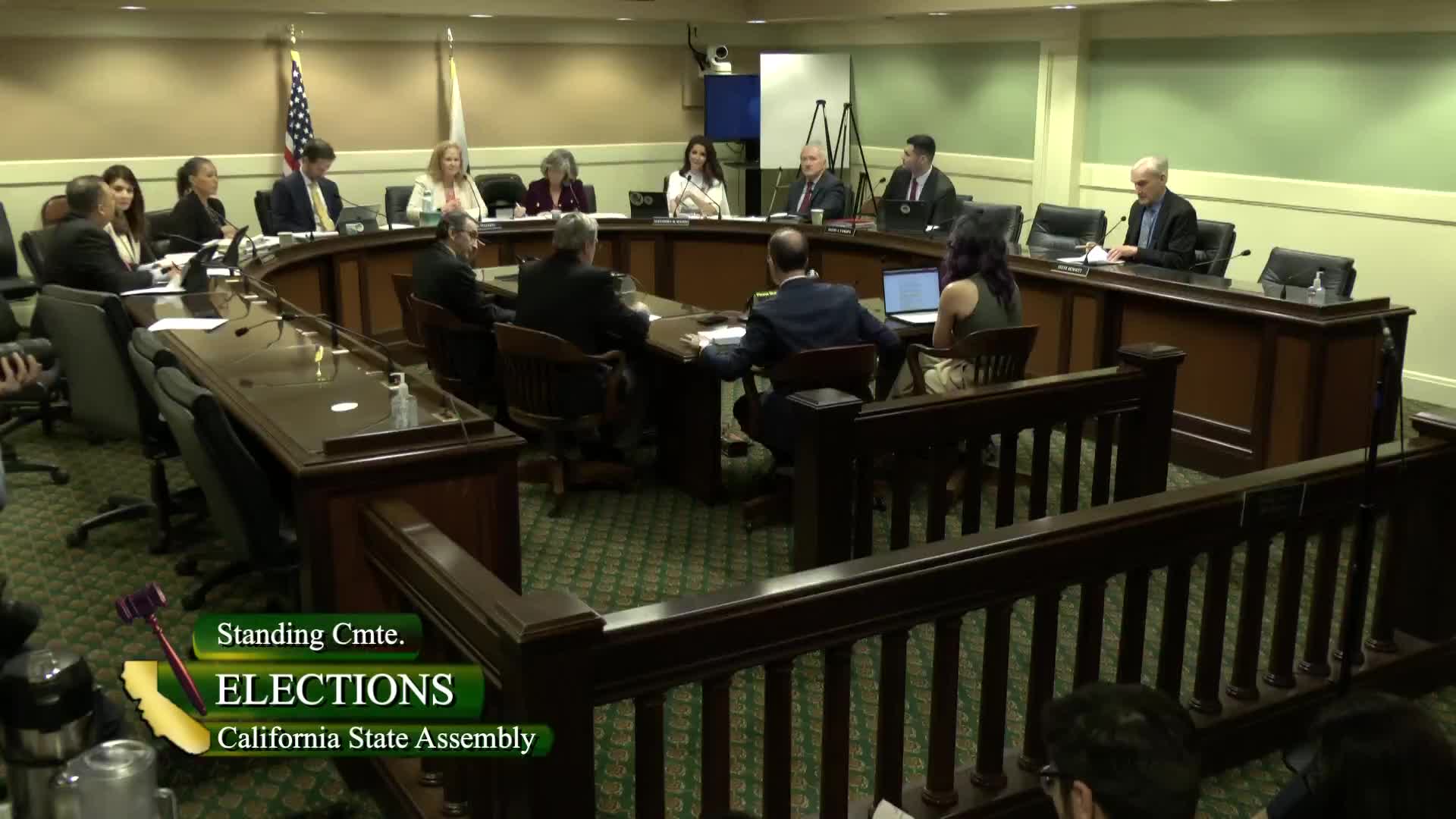
After hours of testimony and public comment, the Assembly Elections Committee approved Assembly Constitutional Amendment 8 (ACA 8), a proposed constitutional change that would let California voters decide in a special election whether to adopt temporary congressional district maps if other states adopt partisan mid‑decade redistricting.
The Assembly Elections Committee voted 5-2 on Aug. 19 to advance Assembly Constitutional Amendment 8, a proposed constitutional amendment that would allow California voters to approve temporary congressional district boundaries via a special election on Nov. 4, 2025 if another state enacts a partisan mid‑decade redistricting first.
The committee considered hours of testimony from the bill’s presenter, Assemblymember Bennett Berman, union leaders and former members of the Citizens Redistricting Commission (CRC), as well as dozens of members of the public both in support and in opposition. Chair Pellerin framed the legislation as a defensive response: “We aren’t asking Californians to rubber stamp maps drawn behind closed doors,” she said, adding that the package is designed to give voters the final say.
“Known as the Election Rigging Response Act, ACA 8 would allow for the temporary use of voter‑approved congressional district boundaries contained in AB 604,” Assemblymember Berman said while presenting the measure on behalf of Speaker Rivas and other leaders. Berman and supporters said the proposal is a narrow, one‑time tool that would only take effect if another state — they repeatedly cited Texas — redraws its maps in a partisan way before the 2030 census. “First and foremost, California voters will have the final say,” Berman said.
Supporters told the committee they view the measure as a defensive step against what they described as a nationwide push by Republicans in some states to redraw congressional lines mid‑decade. Witnesses who testified in support included Danny Curtin of the California Conference of Carpenters and Annie Chow of the California Teachers Association, who said federal policy shifts have practical impacts on local services and that California should be able to respond at the ballot box.
Opponents included former CRC chairs and commissioners who urged the committee to preserve the independent redistricting model. “The current CRC considered over 35,000 public comments to develop their maps, making difficult tradeoffs to protect communities,” Cynthia Dye, a former CRC chair, testified. Several witnesses and many public commenters said the Legislature should not pre‑empt the work of the independent commission by proposing legislative maps.
Members debated parliamentary motions during the hearing, including multiple attempts to amend the measure and a motion to read into the record more than 16,000 public comments that had been submitted via the committee’s online portal. Committee members declined several procedural motions to pause the hearing to allow more time to review filings and amendments; one motion to recess until all public comments were reviewed failed 2‑5.
The committee’s roll call on ACA 8 recorded the following votes: Ayes — Chair Pellerin; Assemblymembers Bennett, Berman, Salace and Stephanie (5). Noes — Assemblymembers Macedo and Tonguepa (2). The resolution now moves to the next committee steps required for a constitutional amendment to be placed before voters.
Clarifying details recorded during the hearing included the committee chair’s note that the committee’s public redistricting comment portal had received more than 16,000 submissions and multiple estimates from witnesses and members that a statewide special election to consider the measure would cost on the order of “about the same as the recall” — witnesses and members referenced a figure in the low hundreds of millions of dollars (witnesses used $200,000,000 as an illustrative figure during Q&A). Committee staff and authors said the Department of Finance would provide a formal cost estimate and the bill package (separately) included language that the Legislature intends to appropriate funds to reimburse counties for election administration costs.
Why it matters: ACA 8 would change how California responds to partisan mid‑decade redistricting in other states by putting a one‑time map change to voters rather than leaving all authority with the independent commission or with the Legislature. Supporters call it a defensive measure to protect federal‑level policy outcomes; critics say it undermines the independent redistricting system Californians adopted and risks high litigation and large election costs.
What’s next: Because ACA 8 is a proposed constitutional amendment, it must be approved by the Legislature and then by a majority of voters in a statewide election to become part of the state constitution. The measure moves forward in the legislative process and will be paired with related bills (SB 280 and AB 604) that address funding and the proposed district lines, respectively.
Sources: Committee hearing transcript (Aug. 19, 2025), witness testimony from Annie Chow (California Teachers Association), Danny Curtin (California Conference of Carpenters), Cynthia Dye and Jean Raya (former CRC commissioners), and recorded roll call votes.
Ending — The committee’s action advances a high‑stakes package of measures that would place an uncommon constitutional question before California voters: whether the state should adopt a temporary, voter‑approved congressional map only if other states first move to redraw their own districts mid‑decade.