Get Full Government Meeting Transcripts, Videos, & Alerts Forever!
Get email alerts on the Environment Brownfields topic
No spam. Unsubscribe anytime.
Cutler Bay outlines cleanup plan, tax-credit route after arsenic found at Blue Heron Park
Summary
Town staff described soil contamination at Blue Heron Park, a proposed Brownfield-area designation, planned excavation and monitoring, and how Florida's voluntary cleanup tax credit could offset costs. Two public hearings are scheduled in September.
Town of Cutler Bay staff described on-the-ground cleanup steps and a financing path using Florida's Brownfields program after soil testing found arsenic across much of Blue Heron Park, a roughly 5-acre park in the Lakes By The Bay community that has been closed since June 27, 2024.
At a community meeting, a town presentation lead (town staff) summarized the site history, the contamination findings and the next steps, and said the town intends to seek a Brownfield-area designation under the Florida Brownfields Redevelopment Act to access state incentives. "The primary contaminant that we see most often in South Florida is arsenic," the presentation lead said, describing arsenic'contaminated soils that range from just below residential criteria to slightly above commercial criteria at portions of the site.
Those results followed a background study done for the town's Legacy Park and Municipal Complex project. The presentation lead said the town then conducted a focused investigation that delineated the horizontal and vertical extent of the soil impacts and installed a groundwater monitoring well; no groundwater impacts have been identified to date.
The town has submitted a soil management and source-removal plan to Miami-Dade County for approval. The plan calls for excavation of impacted soil to a maximum depth of the water table or limestone, whichever is encountered first, with excavation depths varying between about 1 and 6 feet depending on contaminant concentrations. Excavated material would be disposed off-site and replaced with clean fill returned to original grade. The presenter said 296 trees were counted at the site and that tree protection buffers and limited soil removal around root zones will be used to avoid damaging trunks and roots.
After excavation and placement of clean fill, the town plans to monitor groundwater for at least four quarters to confirm there were no new impacts or disturbed neighboring plumes. The presentation lead said a dust-control plan would include silt fencing, wetting of stockpiles, and dust monitoring stations; work would pause if dust readings exceed thresholds.
Town staff described a renovation plan following site rehabilitation: reinstallation of nine outdoor fitness stations, a renovated rubber trail and walking path around the lake, and two new picnic pavilions to replace the existing ones. The presenter said work is expected to start no later than October 2025 and the park could reopen in late 2025 or early 2026, subject to permitting and approvals.
Council member Susie Lord asked for more detail about the voluntary cleanup tax credit program and how much Cutler Bay could expect to recover. Town staff said the Florida corporate income tax credit equals 50% of eligible cleanup costs incurred each calendar year, with a statutory cap of $1,000,000 of eligible costs per year (yielding up to a $500,000 tax-credit entitlement in a given year). Staff also described a site-rehabilitation-completion-order (SRCO) bonus credit equal to 25% of the town's total cleanup costs from project start to finish, with a statutory cap of $2,000,000 for that bonus.
Using the example provided at the meeting, staff said that if the town incurred $2 million in eligible cleanup costs from start to finish, the town could receive tax credits equal to about 75% of that total in the form of the annual credits plus the SRCO bonus; those corporate income tax credits can be sold to entities that owe Florida corporate income tax, and staff said tax credits typically sell at roughly $0.90 on the dollar. Staff presented an estimated net recovery to the town of about 67.5% of cleanup costs after sale of credits, but noted exact proceeds depend on market conditions and final eligible costs.
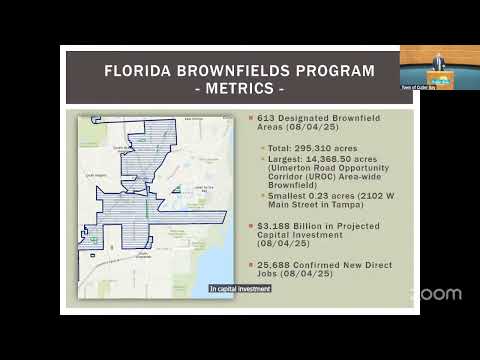
Staff emphasized that for publicly owned property the town must adopt a resolution to designate a Brownfield area and hold two public hearings; the town is holding this community meeting in advance of those hearings. The town said the first public hearing will be at the council meeting after the budget discussion on Sept. 11 at 6 p.m., and the second at the council meeting on Sept. 25 at 6 p.m. If council approves the resolution, the town could enter into a Brownfield site rehabilitation agreement with Miami-Dade County; entering that agreement by Dec. 31, 2025, would allow the town to claim voluntary cleanup tax credits for eligible work done earlier in 2025 as well as work done after the agreement is in place.
No formal council action occurred at the community meeting. Town staff said the meeting was recorded and the recording will be posted on the town's social media platforms by the next day, and invited residents to contact town staff with further questions.