Get Full Government Meeting Transcripts, Videos, & Alerts Forever!
Get email alerts on the Energy Storage And Procurement topic
No spam. Unsubscribe anytime.
Central Coast Community Energy outlines clean‑energy progress as local residents press safety, siting concerns over battery storage
Summary
Central Coast Community Energy told the Santa Cruz County Board of Supervisors it is expanding renewable generation and adding diverse storage projects; public speakers urged moratoria and stronger regulation for lithium‑ion battery facilities and pushed for alternates such as flow batteries and compressed‑air storage.
Central Coast Community Energy (3CE) reported to the Santa Cruz County Board of Supervisors on Aug. 5 that the community choice aggregator is expanding renewable generation and diversifying energy storage, while members of the public urged stricter rules and moratoria for lithium‑ion battery energy storage systems (BESS).
3CE CEO Robert (Rob) Shaw told the board the agency serves 30 cities and five counties and supplies power to more than 1.1 million people. He said 3CE has contracted new solar and storage projects and plans to supply 64 percent of its load with renewable energy by October 2028, with additional contracts under review. “We continue to develop new renewables,” Shaw said, adding the agency had “over a gigawatt” of new projects under contract and more than 500 megawatts of storage in its portfolio.
3CE’s community relations manager for the northern area, Sofia Schwartzke, highlighted storage’s role in shifting daytime solar production into evening peak hours and pointed to recent days when batteries reduced reliance on fossil‑fueled generation. She also described 3CE investments in alternatives to lithium batteries, including a 200‑megawatt Willow Rock compressed‑air energy storage project in Kern County, which 3CE says will be the largest of its kind when it comes online.
Why it matters: County supervisors and the public face two tensions — a policy push to electrify and decarbonize quickly while neighboring residents and environmental advocates worry about safety and siting of utility‑scale lithium battery installations. Those concerns have spurred requests to pause approvals until codes and oversight are strengthened.
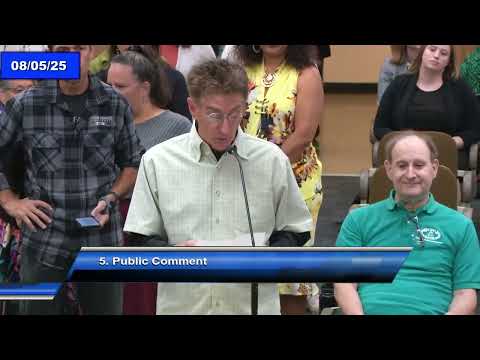
Public comment focused heavily on proposed or potential projects in the county and nearby communities. Multiple speakers, including Alex Miller (Aptos resident) and Gregory Audino (StopLithiumBESSinSantaCruz.org), asked the board to halt permitting for lithium BESS projects near homes, schools and hospitals. “I oppose the placement of lithium‑ion battery energy storage systems in residential neighborhoods, next to schools and next to hospitals,” Miller said, citing his support for state policy proposals that would require large setbacks for facilities larger than 200 megawatt‑hours.
Other speakers pointed to the 2023 Moss Landing fire as a cautionary example. Becky Steinbrunner and several speakers urged a moratorium until the California State Fire Marshal and other state agencies update standards. Steinbrunner also called on the board to support AB 434, a state bill that she said would pause approvals until revised fire codes are in place.
3CE staff said the authority purchases generation and storage at scale but does not build indoor, utility‑scale installations like the Moss Landing Vistra facility. Schwartzke stressed that 3CE’s contracted battery projects are containerized systems that comply with current fire and building codes and noted the agency also has contracts for vanadium flow batteries, pumped‑hydro and compressed‑air projects. Rob Shaw said 3CE’s portfolio purposefully includes a range of technologies to reduce costs and reliability risks.
A few board supervisors thanked 3CE for its programs, including rebates for residential batteries and electrification incentives that 3CE staff said had put more than $43 million back into the Central Coast and helped low‑income customers.
What’s next: Supervisors discussed the federal and state policy risks Shaw mentioned — including uncertainty over federal tax credits — and said they expect 3CE to continue outreach as projects and contracts move from procurement to construction. Several supervisors encouraged 3CE to prioritize non‑lithium long‑duration technologies where feasible and to keep the board and county staff informed about local siting for future projects.