Get Full Government Meeting Transcripts, Videos, & Alerts Forever!
Get email alerts on the Transportation Rail Safety topic
No spam. Unsubscribe anytime.
Cheyenne staff say Reed Avenue revitalization depends on BNSF approval; railroad seeks additional street closure
Summary
City staff reported that advancing the Reed Avenue Corridor project depends on BNSF Railroad approvals and that BNSF has requested the closure of 20 First Street —a condition staff said the project cannot proceed without.
City staff reported that the Reed Avenue Corridor revitalization — a West Edge redevelopment effort in Cheyenne — has advanced to a 30% design but that the project will not move forward without railroad concessions, including the closure of 20 First Street.
Tom (City Engineer) said the project traces to planning work beginning in 2014–2018 and a 2017 voter-approved 6p ballot measure that provided $4 million. He told the council the corridor has attracted about $17,000,000 in external state and federal grant funding since those early plans and that a later, separate $3,000,000 stage for 20 Sixth Street is not part of that total.
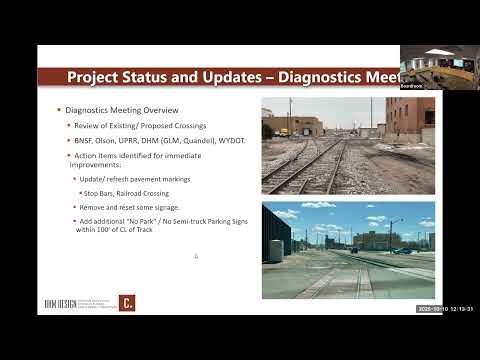
The update described a multiyear timeline. City staff signed a Preliminary Engineering Agreement (PEA) with BNSF in June 2023, submitted 30% design plans to BNSF on Jan. 17, 2025, and completed a BNSF field diagnostics meeting on April 30, 2024. Staff received a BNSF diagnostics report and 72 formal comments in September 2025 and held a follow-up meeting shortly before the work session.
Why it matters: the railroad’s safety-driven requirements affect where the city can place pedestrian and landscaping amenities, require design changes that increase cost and complexity, and could force full street closures that would disrupt vehicle and truck access for nearby businesses.
Tom summarized the railroad’s priorities from the diagnostics: refreshed pavement markings and signage, removal or relocation of certain signal “bungalows,” restricted parking near the corridor, and clearer separation between railroad operations and public access. He said BNSF originally sought to eliminate passenger-car parking within 100 feet on each side of the track but agreed instead to restrict semi-truck parking within those zones after local negotiation.
The city’s submitted concept included a pedestrian promenade on the east side of the corridor and a BNSF maintenance road on the west side. Tom said BNSF would not allow mixed pedestrian and operational access on the same side of the track: "The railroad will not allow us to mix their operations with people," he said. That restriction reduces the area where public amenities can be placed and increases the need for fencing and controlled access features.
BNSF identified several major items that require redesign or clarification, Tom said: detailed grade-crossing exhibits, lane and sidewalk widths, gate lengths and device placements, signing and striping plans, explicit property boundaries showing BNSF right-of-way and utilities, detectable warning surfaces at pedestrian approaches, and queuing analyses to evaluate traffic stacking at Nineteenth and 20 Second streets.
Most consequential for the project’s schedule and feasibility, Tom said BNSF requested an additional public crossing closure. "This project will not go off the ground without the closure of 20 First Street," he told the council, adding that the railroad had asked for an alternative public crossing if 20 First is not feasible.
City staff described direct impacts to two businesses that rely on truck deliveries. Warehouse 21 uses large single-unit trucks (30–40 feet) and semi-trailers up to about 67 feet and typically needs those large trucks three to four times a month, requiring maneuvers that can encroach on railroad right-of-way. MediGold receives deliveries about four times a day using 30-foot single-unit trucks and semitrailers up to about 62 feet; staff said those operations often occur early in the morning and rely on an east–west approach and backing maneuvers that would become more complicated under a closure.
To reduce near-term disruption and show visible progress, staff proposed a pilot project outside the BNSF right-of-way on the north edge of the corridor between 20 Third and 20 Second streets. That area is not within BNSF property, which would allow the city to use remaining 6p ballot funds (about $1,400,000) to install interim right-of-way improvements, landscaping and a small pocket park. Tom warned the pilot cannot be separated from the overall railroad submittal if it touches BNSF property: "If we were going to do this pilot project, I can't break it out as a separate component of the bigger picture with the railroad," he said.
Cost estimates: the design consultant’s preliminary cost for the north segment alone came in at about $12,400,000 at the 30% level, and staff added a 20% contingency to account for design uncertainty, market volatility, unforeseen conditions and inflation, producing a planning estimate of about $14,900,000 for that North component.
Funding and grants: staff reported the city received a Federal Railroad Administration (FRA) grant awarded in January 2025 of $2,500,000 with an $853,500 city match to support crossing-elimination safety improvements (roughly $3,353,500 total). Staff said some fencing work (42-inch steel fencing) will be covered by that FRA grant. The city retains roughly $1,400,000 from the 6p ballot funding to consider for a pilot project.
Steering committee and public process: Mr. Layborn, chair of the steering committee, told the council the committee of seven met recently; a quorum of four members approved the basic concept unanimously. Layborn urged continued pursuit of the long-range vision, saying the plan is a potential "game changer" for the West Edge and that private investment to date shows market confidence.
Council questions and next steps: Councilwoman Aldrich thanked staff and asked whether the proposed steel fencing would match the fencing on Fifteenth Street; Tom said yes, and that fencing is included in the FRA-funded scope. She also asked for a digital copy of the full BNSF report; staff agreed to provide it.
Tom outlined next steps for staff: finalize street-closure and access modification proposals, coordinate lighting, queuing and pedestrian studies with BNSF and the Wyoming Department of Transportation, incorporate BNSF comments into a 60% submittal (targeted for March next year), obtain railroad cost estimates for required signal and bungalow work, and schedule follow-up diagnostics and public meetings (a second public meeting proposed for mid-January and a steering committee follow-up scheduled for Nov. 12).
Tom also discussed a land-use idea to offset closure impacts: purchase or lease of a parcel owned by WyoLotto to create a public parking lot and a pedestrian spine that would provide alternate connectivity if 20 First Street must close.
The presentation emphasized that the railroad is "process oriented," and that BNSF’s safety-driven demands constrain where the city can locate pedestrian amenities and that some design and cost items (for example, moving signal bungalows) will be priced by the railroad and are not yet known. Staff recommended pursuing the pilot outside BNSF right-of-way while continuing negotiations and design work for the broader corridor.