Get Full Government Meeting Transcripts, Videos, & Alerts Forever!
Get email alerts on the Public Safety Responses topic
No spam. Unsubscribe anytime.
City council agrees to study community responder model after LEAP presentation
Summary
After a 90-minute presentation from Law Enforcement Action Partnership consultants, Ypsilanti council instructed city staff to begin a six- to eight-month assessment of a community responder program to handle select nonviolent 911 calls.
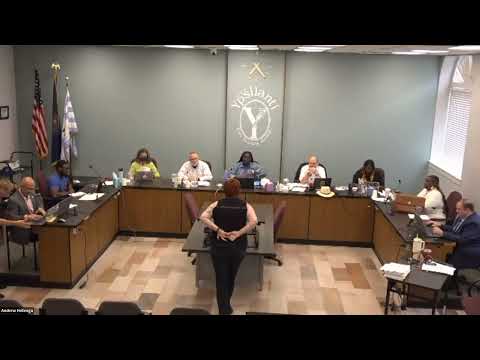
Ypsilanti city council asked the city manager to start a consultant-led assessment of a community responder model after a presentation by Law Enforcement Action Partnership (LEAP) representatives on Aug. 12.
The council heard from Tom Thompson, a retired police chief now working with LEAP, and Amos Erwin, a LEAP consultant, who described unarmed, trained responders that handle low‑risk 911 calls for issues such as homelessness, behavioral health crises and nonviolent public‑order incidents. Thompson said the programs free sworn officers to focus on violent crime while offering “specialized compassionate care” for people with mental‑health or substance‑use needs.
LEAP told council members the model has grown rapidly across the country; the presenters said they identified 88 operating programs and that programs typically dispatch community responders only after dispatch triage and screening for weapons, violence or emergent medical needs. Erwin said most programs call police for backup in fewer than 2 percent of responses and for officer involvement in roughly 2 percent of calls.
Why it matters: Council members framed the proposal as a possible answer to recurring calls about homelessness and behavioral health that many said can escalate when an armed officer is the first responder. Supporters said community responders can connect people to long‑term services rather than defaulting to arrest or hospital transport.
Discussion and next steps: Council members asked about safety, dispatch integration and funding. LEAP described typical deliverables for an assessment: 911 call‑type data analysis, stakeholder engagement, community input and a preliminary report around six months after work begins. Presenters said designs vary — programs have been housed in city departments (fire, health, community services) or contracted to social‑service providers. Cost estimates provided to council noted that LEAP typically seeks about $15,000 for a virtual assessment, though other studies elsewhere cost much more.
Council members, including Council member Simmons and Council member Fellows, pressed on dispatch logistics, noting Washtenaw County dispatch is a separate entity and confirming that county dispatch leadership would need to participate. City staff reported conversations have already begun with the county sheriff and local police chief.
By the end of the discussion, council members expressed a desire to proceed. The city manager said staff would start the engagement process the following day and pursue the consultant contract and stakeholder outreach described by LEAP.
The presentation materials will be posted publicly. Council did not adopt an ordinance or budget appropriation at this meeting; the action taken was a council direction to the city manager to initiate the assessment described by LEAP.