Get Full Government Meeting Transcripts, Videos, & Alerts Forever!
Get email alerts on the Land Use topic
No spam. Unsubscribe anytime.
Commissioners direct staff to draft sample ordinance on retail liquor stores, consider location criteria
Summary
The Nolensville Board of Commissioners reviewed examples of municipal approaches to retail liquor (off-premise) regulation and asked staff to prepare a sample municipal-code amendment reflecting possible location criteria, separation distances and numeric limits for future deliberation.
The Town of Nolensville Board of Commissioners discussed expanding and clarifying regulations for retail wine and spirit shops in town limits at their July 28 work session and asked staff to prepare a draft ordinance for future consideration.
Why it matters: the town currently has municipal-code language that does not reflect updated zoning nomenclature, and commissioners said they want clearer rules about where off-premise alcohol retailers can locate in relation to schools, places of worship and other public gathering places.
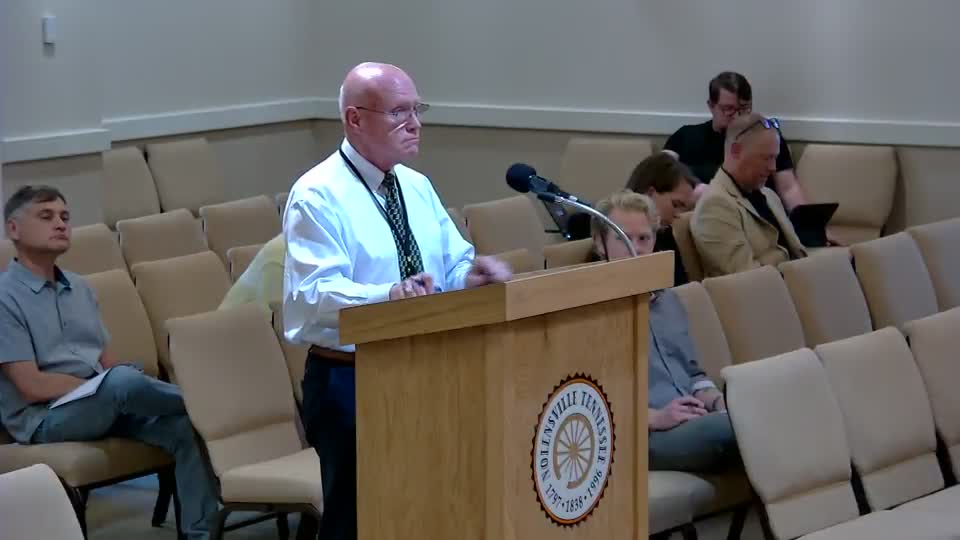
What staff presented A staff member (identified in the transcript as Chuck) presented an expanded outline of municipal practices from other jurisdictions that range from no numeric limits on stores to rules that limit the number of stores by population or by explicit enumeration. The materials also highlighted common location criteria such as minimum separation from schools, churches and public places and provisions that limit proximity to other similar stores.
Board reaction and direction Commissioners responded with a mix of views. One commissioner asked staff to research the historical reasons communities adopt separation standards; others said the town should consider both market-based options (no numeric cap) and more restrictive approaches. Commissioners agreed there was a need to reconcile the municipal code with the town's current zoning classifications before adopting any new limits.
Next steps Staff offered to compile a sample municipal-code amendment, similar to the approach used for the town's food-truck regulations, and to solicit commissioner input by email. Commissioners asked for a draft ordinance to be prepared and brought back for discussion at a future meeting.
Ending No vote was taken; commissioners asked staff to draft sample ordinance language and to return with an updated municipal-code proposal that reflects the town's zoning nomenclature.