Get Full Government Meeting Transcripts, Videos, & Alerts Forever!
Get email alerts on the Adams Hemphill Detention topic
No spam. Unsubscribe anytime.
Parks board recommends City Council approve dual‑use detention basins at Adamson/Hemphill Park to cut flood risk
Summary
After a multi‑part presentation and public comment, the Parks and Recreation Board voted 8–1 (1 abstention) to recommend City Council approve use of 138,136 sq ft of parkland (plus temporary work areas) for two dry detention basins; mitigation and park improvements are estimated at $2,980,911.
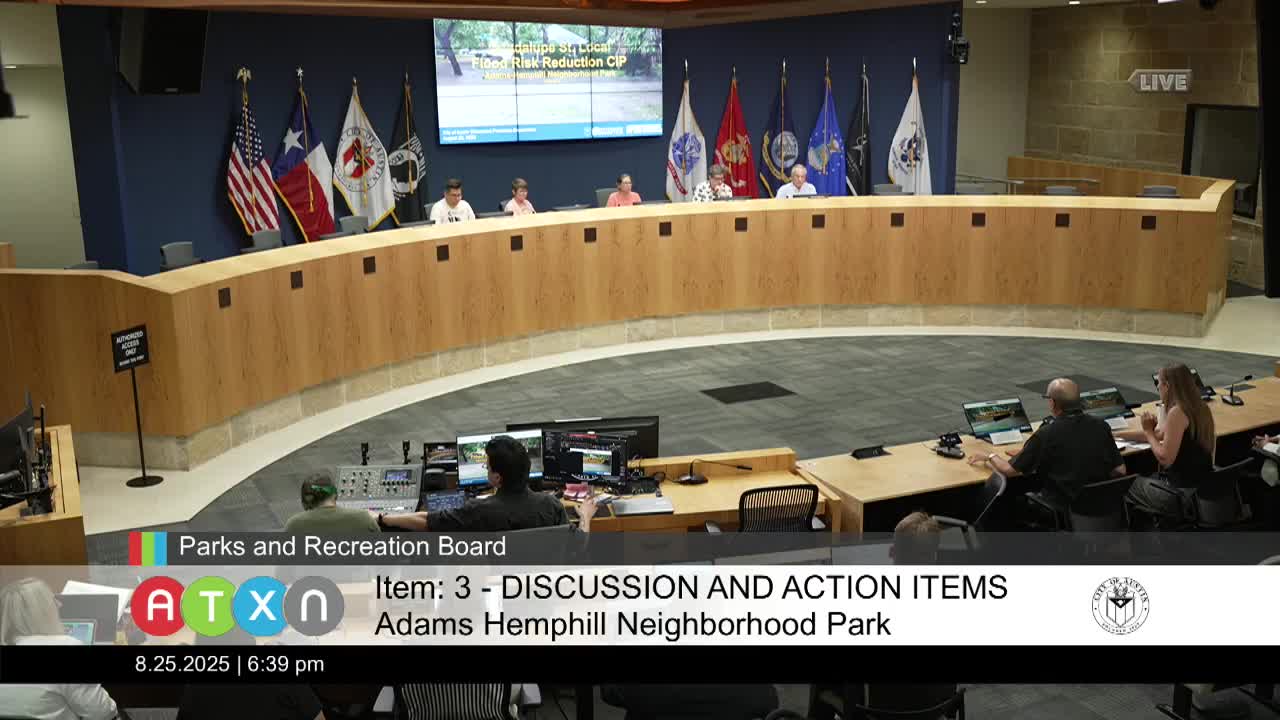
On Aug. 25, 2025, the Austin Parks and Recreation Board voted to recommend City Council approve a permanent change of use for 138,136 square feet of Adamson/Hemphill Neighborhood Park and a temporary change of use for 11,997 square feet (not to exceed 120 calendar days) to construct two dry detention basins intended to reduce downtown flooding.
Board Member Villalobos moved the recommendation; Vice Chair Flowers seconded. The motion passed 8–1 with one abstention. Staff said the mitigation cash payment to the Parks department, after credits for on‑site park amenities and infrastructure work, is $2,980,911. Construction is contingent on Chapter 26 approval at Council and on external funding; construction is anticipated in 2028.
Watershed Protection project sponsor Christina McLaren presented the design and flood‑modeling results. The project proposes two dry detention basins: a smaller, fenced upper basin with plantings and a larger lower basin designed as an open, low‑slope grassy field available for recreation most days but able to hold stormwater for up to 24 hours after large storms. McLaren said the team evaluated alternatives, including channel upgrades and buyouts, and concluded parkland dual‑use basins were necessary to meet the city’s drainage criteria without moving flooding downstream.
McLaren showed model results for a 25‑year storm event and said the project removes roughly 80% of previously modeled localized flooding extents; the presentation cited 224 structures affected in the pre‑project 25‑year scenario and noted 43 structures removed from the 2‑year event and 170 removed from the 10‑year event. She also described related work: relocating a 30‑inch wastewater line to the street right‑of‑way and bank stabilization downstream of Thirtieth Street to address failing walls.
Watershed staff explained how the dual‑use area was calculated and categorized: areas that will be open grassy field most days were modeled as 50% disturbed, the upper basin as 80% disturbed, and some areas as 0% disturbed where no physical changes are proposed but a drainage easement is requested to allow maintenance of existing storm infrastructure. Staff showed examples of similar dual‑use basins in Austin (Quail Creek Neighborhood Park and Tillery Fields) and a non‑local example to illustrate slopes and multi‑use lawn areas.
A neighborhood speaker, Madeline Maxwell, thanked staff for outreach but urged more clarity about appearance and maintenance. “There’s a lot of risk here for an eyesore and just sort of an insect‑infested horror where we now have a pleasant place to walk,” Maxwell said, asking whether steep walls, fencing and planting maintenance would be defined and protected.
Board members pressed staff on historic park protections and long‑term maintenance responsibilities. Board Member Eubanks noted the park’s historic elements and compared the proposal to earlier dual‑use work at Pease Park; Watershed staff said maintenance is typically shared: regular mowing and day‑to‑day park upkeep is a parks responsibility while more substantial maintenance (sediment removal, pump or outlet repairs) typically falls to Watershed, with a joint agreement spelling out responsibilities in final design.
Staff characterized the requested area as a permanent drainage easement but emphasized the space will remain accessible to the public as a multi‑use field most days. Outreach included multiple public meetings and three consecutive council notifications required under Chapter 26; Watershed said the Council public hearing is scheduled during the Council meeting on Sept. 11, 2025.
The board’s recommendation will be transmitted to City Council with the meeting record. If Council approves Chapter 26 and funding is secured, Watershed expects to deliver new park amenities (play areas, pavilion, fitness equipment, concrete loop trail) as mitigation credits alongside the monetary mitigation payment.