Get Full Government Meeting Transcripts, Videos, & Alerts Forever!
Get email alerts on the Therapeutic Recreation Services topic
No spam. Unsubscribe anytime.
Parks board approves letter supporting therapeutic recreation services for people with disabilities
Summary
The Parks and Recreation Board unanimously approved a letter of support for the department’s Therapeutic Recreation Services, commending year‑round adult and youth adaptive programs and endorsing continued funding and facility expansion.
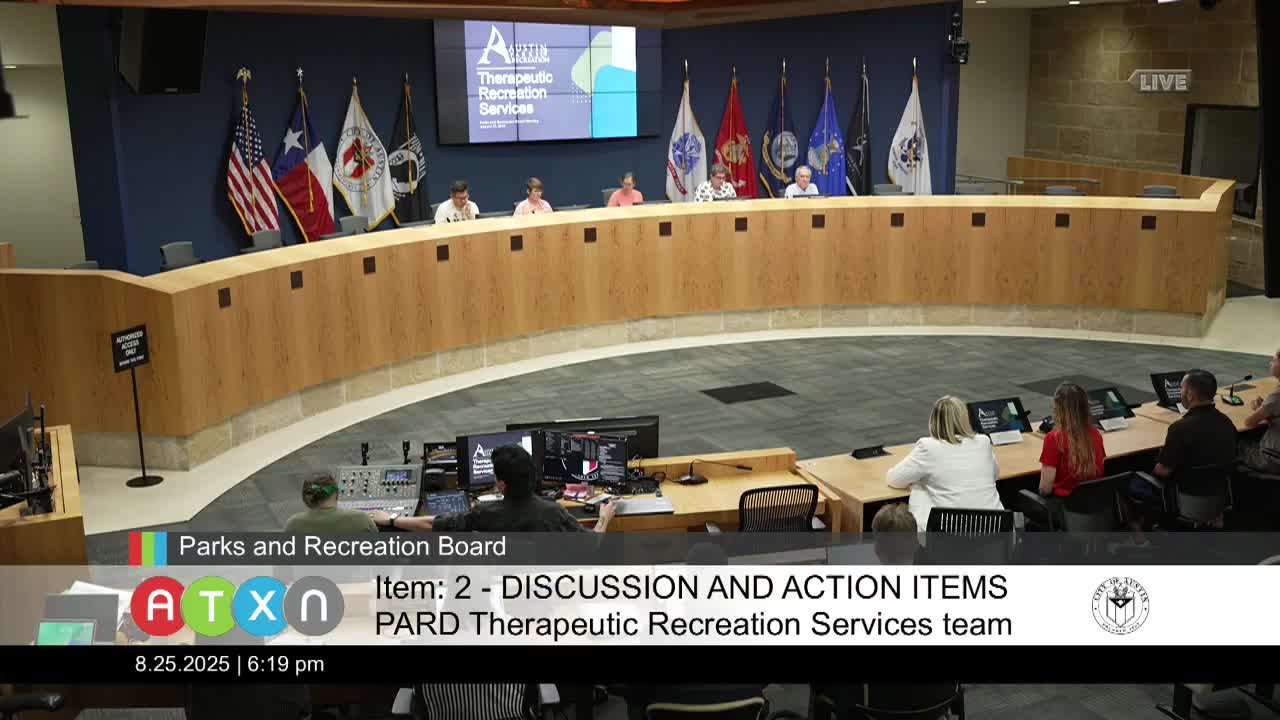
On Aug. 25, 2025, the Austin Parks and Recreation Board voted unanimously to approve a letter of support for the department’s Therapeutic Recreation Services, which provides adaptive and inclusive programming for people with disabilities across four city facilities.
Board members said they wanted to publicly recognize the division’s work and encourage continued funding. Vice Chair Flowers moved to approve the letter and Board Member Eubanks seconded; the motion passed unanimously.
The board’s letter thanks staff for programs at Macbeth, Alamo, Dottie Jordan and Parque Zaragoza recreation centers and for the department’s Modifications and Support Services unit. Krista McCarthy, division manager for Therapeutic Recreation Services, told the board the department fields a mix of year‑round adult programs, youth camps and Special Olympics offerings. “We do have four facilities that provide adaptive programming,” McCarthy said during the presentation.
Emmanuel Turner, Modifications and Supports Coordinator, described the unit’s service levels: “This year we served over 104 participants in our various different programs that we support,” he said, and added that the unit provided more than 256 hours of inclusion staff trainings and coordinated American Sign Language interpreters for department programs.
Program counts presented to the board included: Good Neighbor Adventure Club at Macbeth (58 unique participants), Capital City Explorers at Dottie Jordan (25), a Healthy Aging program for ages 55+ at Alamo (17), a Hangout program at Alamo for higher‑need participants (13), an adult job skills class (40 participants) and a free social club at Parque Zaragoza (16). Therapeutic summer camps served about 30 participants per week, with participants rotating week to week. The department also lists nine Special Olympics sports offered citywide (volleyball, softball, swim team, basketball, powerlifting, soccer, tennis, golf and bocce) and said it hopes to add pickleball in the future.
During public comment and Q&A, Diane Curran asked about budget and service hours. Staff said no new program funding was added in the most recent budget cycle aside from a contract for ASL interpreters; expanding hours for adult day programs (for example, past 5 p.m.) would require additional full‑time staff and facility capacity. Staff said waitlist numbers and unduplicated annual enrollment could be provided to board members on follow up.
The board’s approved letter commends the division’s individualized assessments, support staff and interpreter services and expresses appreciation for inclusive programming citywide. The board asked staff to share further data on unduplicated participants and waitlists for future budget planning.