Get Full Government Meeting Transcripts, Videos, & Alerts Forever!
Get email alerts on the Jail Construction topic
No spam. Unsubscribe anytime.
Cochise County officials outline $100 million jail plan, ask voters to approve half‑cent sales tax
Summary
County supervisors, the sheriff and justice officials described plans for a new jail they say is needed to meet modern health, safety and operational standards. The project team proposes a $100 million bond covered by a half‑cent sales tax, with a promised state match and a plan to accelerate repayment.
Cochise County supervisors, the sheriff and county justice officials detailed a plan to build a new county jail financed by a $100 million bond and a half‑cent county sales tax that would restart if voters approve it in November.
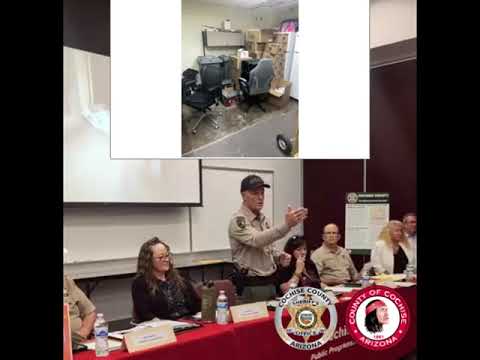
Supervisor Frank Antsmar, speaking at a Sierra Vista town hall, said the existing jail — built in 1986 and expanded without full remodeling — does not meet modern standards for inmate or officer safety. “It’s time. We have to come together as a community to do this,” Antsmar said, urging voters to support the funding plan.
The proposal as described by county staff and law‑enforcement officials calls for bonding $100 million to cover construction, plus about $10 million in design and site costs, with an anticipated 20 percent state match that county officials described as roughly $20 million. Officials said about $14 million already sits in an isolated account derived from a prior half‑cent tax. The county plans a 15‑year bond but said it will attempt to accelerate principal payments so the debt could be retired in about 10 years if revenues permit.
Why it matters: County leaders said the present jail’s condition creates safety, health and liability risks and that a new facility would improve capacity for medical and mental‑health care, reduce inmate transports and lower operating costs over time. County Attorney Laurie Zuko described the jail as a “temporary detention facility” where modern space for medical care and for pretrial processing can reduce lengths of stay and save taxpayer dollars.
Project scope and cost: County officials said the physical plant is budgeted in the $90 million to $100 million range for the building itself, with an overall planning figure of about $130 million when state match and reserves are included. The new facility would be built to sustain support services for up to 600 inmates (kitchen, medical, administration) but initially provide housing for roughly 400 inmates; modular expansion would allow additional housing later if needed. The county said it intends to hold $10 million in contingency for inflation and unforeseen costs and to apply any remaining reserves directly to the bond.
Funding mechanics and timeline: Supervisor Kathleen Gomez explained that Arizona counties are limited to a 1¢ local sales tax cap and that the half‑cent under consideration would be a temporary increment earmarked to repay the jail bonds. Gomez said the half‑cent would not restart immediately if voters approve in November; she told attendees the tax would restart July 1 following certification and Department of Revenue processing. Only then, the county said, could it secure the bond under terms the market requires. The county expects the sales tax to generate roughly $9 million to $10 million per year and said the bond issuer expects a minimum payment of about $7 million annually on a 15‑year amortization schedule. County leaders said they would accelerate additional receipts to principal to reduce total interest paid.
Operational goals and design priorities: Jail officials and the county’s detention health director described three priorities drawn from earlier public input: (1) inmate safety and officer safety; (2) improved mental‑health housing and services; and (3) maintaining community quality of life. Meghan Kennedy, director of detention health services, said the existing medical clinic is too small to meet constitutional obligations for care and to safely manage substance‑withdrawal and other medical needs. Jail commander Kenny Bradshaw and others described cramped officer stations, blind spots in camera coverage, exposed cabling in housing areas and insufficient dedicated control rooms — items they say a modern design will correct.
Courtroom and processing: County leaders said the new facility will include a courtroom and adjacent spaces intended for detention‑related hearings such as early resolution court and arraignments. Presiding Judge David Thornton and others explained the courtroom is intended for processing incarcerated defendants (arraignments, early resolution appearances) and not as a full replacement courthouse. Officials said that colocating limited courtroom functions in the jail reduces daily inmate transports to and from off‑site courthouses and lowers liability and transport costs.
Alternatives considered: Officials said a citizen advisory committee reviewed renovation versus new construction and recommended building a new facility. The county said renovation would require moving inmates off‑site (incurring multi‑million‑dollar annual housing costs) and would likely take 18–24 months while only extending facility life for a limited period. Supervisor Antsmar said county staff evaluated those options and that building new was the recommended course.
Contracting and oversight: The board has hired an owner’s/“buyer’s” representative and will use that firm to assist architect selection, procurement and project management. The county said it will hold public design reviews as the project progresses and that the board, county staff and the owner’s rep will oversee design‑to‑cost objectives. Officials said one emergency expense — a contractor‑installed fire alarm — was paid from the general fund and that roughly $14 million of prior sales‑tax revenue currently sits in a restricted account for the jail project.
What is not decided: County leaders said many details — final site, detailed design, exact staffing needs and final contract prices — remain under development. They told residents preliminary work such as architect selection and public design review will proceed if voters approve funding; full construction cannot begin until the bond and sales‑tax revenue stream are secured.
Who said it (selected quotes): Sheriff Hartehouse: “I control the public safety and have a mandate to ensure I run that jail to make sure the inmates are safeguarded.” Meghan Kennedy: “We are required to provide constitutionally adequate health care.” County Attorney Laurie Zuko: “The jail is a detention center. It’s supposed to be a temporary housing for people who are arrested and charged.”
Ending: County officials urged voters to review posted materials on the county’s project page, attend forthcoming public design meetings and study the amortization schedules the board said it will include in election materials. If the ballot measure passes, officials said, they expect a multi‑stage design and procurement process before construction begins.