Get Full Government Meeting Transcripts, Videos, & Alerts Forever!
Get email alerts on the Artificial Intelligence Workforce topic
No spam. Unsubscribe anytime.
Workforce board plans two-part AI deep dive and hears EDD may seek up to $8 million in federal AI funding
Summary
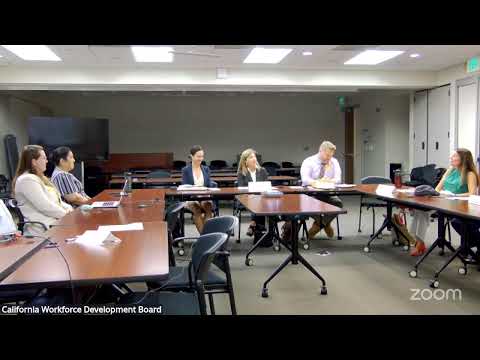
The California Workforce Development Board Executive Committee set the eighth meeting to include a two-part deep dive on artificial intelligence and heard that the Employment Development Department (EDD) is preparing to apply as a pass-through for a federal workforce grant that could fund AI infrastructure and training.
The California Workforce Development Board Executive Committee set the eighth meeting to include a two-part deep dive on artificial intelligence and heard that the Employment Development Department (EDD) is preparing to apply as a pass-through for a federal workforce grant that could fund AI infrastructure and training.
Committee members said the AI session will begin with a moderated online panel of three to four experts — including economists and private-sector technology leaders — followed by in-person presentations from representatives of the governor’s office and related state initiatives. The goal, members said, is to combine a broad industry perspective with updates on statewide programs and open the discussion to committee members for questions and dialogue.
EDD staff told the committee the federal opportunity stems from a recent training-and-employment guidance letter. If awarded, the pass-through application would request up to $8,000,000; staff estimated the funds could be distributed across roughly seven or eight local areas at about $850,000 per region. Staff noted the application deadline is Friday, Sept. 5. Committee members framed that potential funding as a way to support AI infrastructure, advanced manufacturing or other regionally determined priorities.
Members discussed expected topics for the two-part meeting: where job displacement from AI is likely to occur, the skills employers will demand, and how public and private organizations are managing transitions. Members said the session should cover both the risks (for example, data privacy and proprietary information when employees experiment with AI tools) and potential benefits, such as improving access to tutoring, medical information and other services for underserved communities.
Committee planning aims to avoid single-company-focused panels; members said they want a range of perspectives and emphasized keeping the conversation practical for workforce development — for example, how K–12 and postsecondary systems can prepare students and displaced workers. Staff and members discussed inviting both state officials and private-sector executives; one member noted possible speaker outreach to executives of several major technology firms.
The committee did not take a formal vote on the grant application or on the meeting agenda during the session covered by the transcript. Staff said EDD would pursue the grant application as appropriate and that further details would be shared with the committee as the application progressed.