House Education and Labor Committee approves Modern Worker Empowerment Act after partisan debate
Get AI-powered insights, summaries, and transcripts
SubscribeSummary
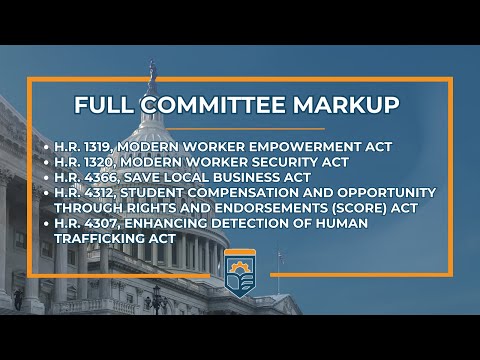
The House Education and Labor Committee on Tuesday voted 19–16 to report HR 1319, the Modern Worker Empowerment Act, which narrows federal tests used to classify workers as employees or independent contractors.
The House Education and Labor Committee on Tuesday voted to report HR 1319, the Modern Worker Empowerment Act, to the full House after a prolonged markup that included multiple amendments and recorded votes. The committee approved the bill as amended by a recorded vote of 19 yeas to 16 nays.
The Modern Worker Empowerment Act would amend the Fair Labor Standards Act and the National Labor Relations Act to clarify the standard for determining whether an individual is an employee or an independent contractor. Representative Kiley of California, the bill’s lead sponsor, described the measure as restoring “the common law, common sense, intuitive standard” and said it would give “workers more predictability and job creators more certainty.”
Supporters framed the bill as a fix for regulatory uncertainty caused by shifting administration rules. “Tens of millions of Americans choose to be independent contractors. They do so because they value the flexibility,” Kiley said while explaining an amendment in the nature of a substitute. Committee proponents argued the legislation would prevent state and agency rulemaking from creating a patchwork that undermines independent contracting.
Ranking Member Representative Scott (the committee Democrat leader) and other opponents argued the change would narrow protections and make it easier for employers to misclassify employees as contractors, stripping workers of wage-and-hour and labor protections. “When workers are misclassified as independent contractors rather than employees, they’re denied a host of workplace rights and protections,” Scott said during debate, listing protections he said would be at risk, including minimum wage, overtime, unemployment compensation and the right to organize.
Members offered and debated multiple amendments. Notable proposals that were rejected included measures to (1) clarify that flexible work arrangements could not be used as conclusive evidence of independent-contractor status (Ansari amendment), (2) bar enforcement of the bill’s narrower test in child-labor cases (Bonamici amendment), and (3) ensure workers covered by the bill would retain access to a court rather than forced arbitration (Lee amendment). Recorded votes on those amendments were postponed during the markup and ultimately failed in the roll-call sequence; committee records show final amendment votes mostly failed on margins of roughly 16–19.
The committee’s action sends the bill to the full House with the committee’s recommendation that the amendment in the nature of a substitute be adopted and that the bill pass. The committee also recorded and preserved members’ rights to submit supplemental and minority views before the report is filed. The transcript indicates the chair and ranking member both reserved the right to enter additional materials in the record.