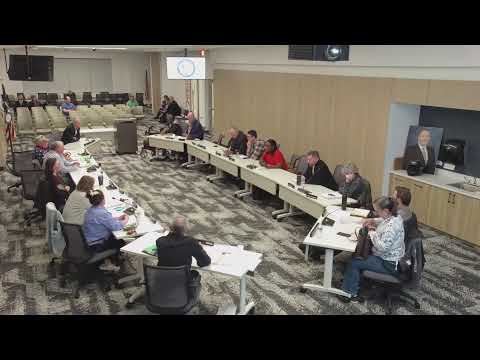
Champaign County Board narrowly approves special-use permit for Mahomet solar farm after contentious debate
Loading...
Summary
After lengthy public comment and board debate, the county board adopted Ordinance 2025-11 granting a special-use permit for the Mahomet Solar 1 LLC photovoltaic farm (zoning case 162S25); the vote was close and divided along lines reflecting resident objections and legal concerns about county zoning rules.
The Champaign County Board voted to adopt Ordinance 2025-11, granting a special-use permit for a photovoltaic solar farm proposed by Mahomet Illinois Solar 1 LLC (care of Summit Ridge Energy LLC) under zoning case 162S25. The board approved the ordinance by a narrow margin after extended public comment from residents living near the proposed site, a contested committee recommendation and prolonged procedural debate.
The permit covers a solar photovoltaic (PV) installation and includes a decommissioning and site reclamation plan presented by the developer. The Zoning Board of Appeals had held a public hearing and forwarded a recommendation for denial; the environmental land use committee also discussed the proposal. The project drew organized opposition from nearby Spring Lake residents who raised concerns about proximity to homes and lake water quality; several residents asked for written assurances on protections and decommissioning. Public commenters repeatedly said they supported solar in principle but opposed placement adjacent to their neighborhood.
Paul Slazak, who identified himself as a Mahomet resident with a house on Spring Lake, said he was "concerned about lake quality" and worried migrating geese and the size of the field would affect the lake. Other residents said they feared noise from inverters, decommissioning footprints and that panels discarded decades later would go to landfills. Supporters of the project, including the landowners and some board members, argued the project met zoning criteria and that farmland owners have a right to pursue lawful uses of their property.
Board debate included procedural disputes over whether the motion before the board continued the "motion to deny" that had been tabled at the prior meeting, and multiple members sought clarification from legal counsel on the proper order of motions. After the parliamentary confusion was resolved — the original motion to deny was rescinded and a motion to adopt the ordinance was made — board members engaged in policy arguments. Opponents emphasized neighborhood impacts and urged the developer to find a location farther from residences; proponents, including members familiar with planning and county practice, said denying the project despite state zoning rules could expose the county to litigation and expenses.
The board approved the ordinance; the clerk's roll call produced a narrow margin (motion carried). The adopted ordinance grants the special-use permit and incorporates the decommissioning and reclamation plan that the developer submitted to county planning staff. The board recorded a mix of "yes" and "no" votes during roll call; the chair confirmed the motion passed.
The vote resolves the long-running local debate over whether large-scale solar arrays should be allowed on agricultural parcels near established subdivisions in the county. Several board members said the county's zoning rules do not currently allow more restrictive local limits than state law permits, and they cited the likelihood of legal challenges if the county attempted to bar a project that otherwise complies with statute and ordinance. Opponents said the existing zoning classifications and oversight process should better protect residential areas.
The ordinance includes project conditions as presented to the board, including the developer's submitted decommissioning and site-reclamation plan and proposed mitigations for noise and screening. The county will now process required permits and inspections consistent with the ordinance and the developer's site plan. Residents and the developer indicated at the meeting that discussions about additional mitigations and written protections (for example, commitments related to lake protection) could continue as implementation unfolds.
The Mahomet solar permit was one of the most substantive and divisive items on the agenda and drew the lengthiest debate of the evening, including procedural questions and multiple motions before the final adoption.