Get Full Government Meeting Transcripts, Videos, & Alerts Forever!
Get email alerts on the Utility Rates topic
No spam. Unsubscribe anytime.
PURA encourages settlement talks in Yankee Gas rate case; commissioners say statute does not bar settlement
Summary
After oral arguments in the Yankee Gas Services Co. rate case, PURA commissioners said their preliminary reading of Connecticut law does not prevent a settlement and encouraged parties to continue talks and file a settlement schedule.
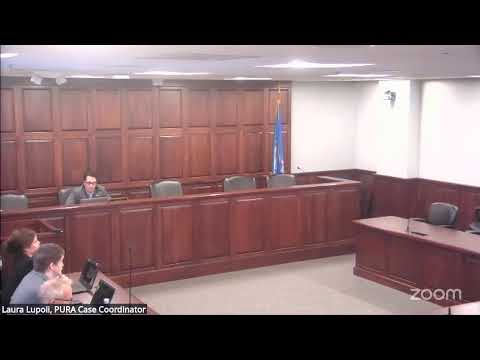
The Public Utilities Regulatory Authority encouraged parties to pursue settlement talks in the Yankee Gas Services Co. rate case after oral arguments on the company’s proposed 2024–25 rate change, saying a preliminary reading of Connecticut law does not bar a settlement and that the existing record could satisfy the statutory four‑year review requirement. Vice Chairman David Arcanti delivered the authority’s instruction at the end of the hearing, noting both he and Commissioner Karen had conferred and would encourage parties to submit a settlement filing and schedule.
Why it matters: Yankee Gas, doing business as Eversource Energy, requested $193 million in additional annual revenue in its application. Counsel for the company said the draft proposed decision makes large disallowances and reflected bias, while the Office of Consumer Counsel and the attorney general defended the authority’s discretion to cut elements of Yankee’s request. The commissioners’ decision to invite settlement talks sets a process path that could resolve disputed issues without further immediate litigation, but it does not itself change the draft decision’s findings.
During two rounds of oral argument, counsel for Yankee Gas said the draft proposed decision contained numerous legal, factual and mathematical errors and was tainted by prejudgment. Vincent Pace, representing Yankee Gas, told the authority the company "fully supports any type of constructive discussions offline between the parties to achieve a consensus resolution" but said a settlement would need to be structured so it also satisfies statutory requirements governing periodic reviews. Pace asked the authority at the end of argument to signal openness to settlement so the company could negotiate in good faith.
The Office of Consumer Counsel, represented in oral argument by Claire Coleman, said the office is open to settlement talks but cautioned that statutory constraints could make a settlement inefficient if it requires an immediate separate four‑year periodic review. "We do think oral argument should proceed this morning," Coleman said earlier in the hearing, urging the authority not to preclude finalizing a decision while parties continue to confer.
The attorney general’s office and other interveners urged the authority to ensure the record and any final decision are transparent and legally robust. The attorney general’s office told the authority it had "no objections to the draft decision" and urged the commission to retain some of the adjustments in the draft — including denial of the company's requested regulatory risk premium — to protect ratepayers.
Substantive disputes identified during argument included: - Size of the request: Yankee sought roughly $193 million in additional revenue; counsel for the company said the draft permitted only about 20% of the requested amount. The Office of Consumer Counsel and the attorney general noted the request represented an unusually large increase and supported significant reductions to protect affordability. - Procedural and bias claims: Yankee argued the draft decision was affected by bias and that certain procedural rulings (including time to respond to a long draft) were inadequate. Other parties and the attorney general said the record was extensive and that the authority’s staff and commissioners have the tools to correct mathematical or drafting errors in a final decision. - Major disallowances alleged by the company: Pace cited several line items the company sees as unjustified, including a $101 million "cost of removal" disallowance, a roughly $37 million reduction for completed plant additions, a $34.3 million depreciation-related adjustment, a $3.2 million environmental remediation math error, and a roughly $2.7 million write‑off on hardship uncollectibles. He said some disallowances lacked a specific finding of imprudence and therefore were unlawful as reductions to rate base or expense. - Transparency of staff calculations and work papers: Yankee asked for the authority’s underlying work papers that produced certain calculations, saying the company had no ability to replicate PURA’s numbers before filing exceptions. OCC and other parties supported correcting math errors but said PURA is not necessarily required to produce every internal calculation so long as the final decision explains conclusions sufficiently for judicial review. - Treatment of state‑mandated programs: Yankee said increases in hardship arrearage and other costs are driven by state policy (for example, Department of Social Services hardship classifications and COVID-era shutoff rules) and argued those costs should be recoverable subject to prudence review. The draft decision’s treatment of those costs was a point of dispute.
The hearing closed with Vice Chairman David Arcanti stating a preliminary agency view: "our preliminary assessment is that 16 dash 19 JJ does not bar, a settlement in this proceeding proceeding. And it would appear to satisfy the requirement for a periodic review. So, we're going to encourage parties to discuss, to continue to discuss and submit a filing, with a schedule for submitting a settlement." Arcanti said the authority would accept a post‑hearing settlement filing and schedule from the parties.
What’s next: The authority recessed during the hearing and set a reconvening; after conferring the commissioners asked parties to continue settlement negotiations and to file a schedule for submitting any proposed settlement. If parties do not reach an agreement, the authority may proceed to finalize a written decision, which the company has said it will appeal if the final decision is similar to the draft. The authority and intervenors emphasized that numerical and drafting errors in the draft can be corrected in the final decision and warned that appeals carry their own risks for ratepayers.
Ending note: The authority’s invitation to negotiate a settlement is procedural direction, not a change to the draft proposed decision. Any settlement must be filed with PURA and, depending on its terms and the authority’s findings, could affect whether a separate four‑year periodic review must follow.