Get Full Government Meeting Transcripts, Videos, & Alerts Forever!
Get email alerts on the Stormwater Drainage topic
No spam. Unsubscribe anytime.
Eagle Pass council pauses drainage-fee increase as staff wins approval for regional stormwater program
Summary
City staff proposed raising the monthly stormwater/drainage utility fee for residential customers and increasing nonresidential rates; council tabled the fee increase for further analysis. Separately, council approved an ordinance establishing a regional stormwater management program allowing developers to pay a fee in lieu of on‑site detention.
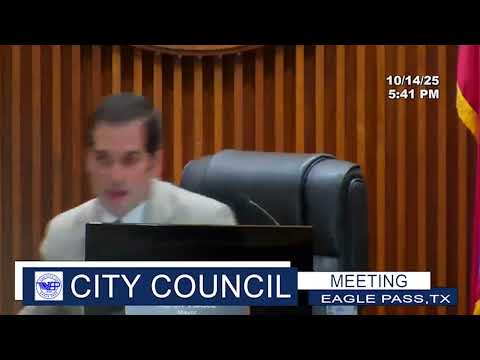
City of Eagle Pass officials on Oct. 14 paused a proposed increase to the city’s monthly stormwater (drainage) utility fee after questions from council members and a staff request for more detailed revenue projections, but approved a separate program allowing developers to pay fees in lieu of on‑site detention.
City engineers proposed raising the flat residential drainage utility fee from $5.00 to $7.50 per month and revising the non‑residential rate schedule so larger commercial lots would pay higher acre‑based charges. Staff said the change would increase revenue available for maintenance and capital drainage projects and to meet Municipal Separate Storm Sewer System (MS4) obligations to the Texas Commission on Environmental Quality (TCEQ).
The city engineer and assistant public‑works staff outlined that the current fee structure (residential $5; nonresidential $8 per acre/lot tiers) had not been updated since 2016, that the city currently projects roughly $576,000 in annual collections under the existing charge, and that a 2018 certificate of obligation already draws about $383,498 from the stormwater fund each year. Staff said project cost estimates from the city’s adopted master drainage plan have risen since 2020 — for example, a project previously estimated at $1.1 million could now cost closer to $6 million because of post‑pandemic construction inflation.
“Maintaining a safe, sustainable drainage system, reducing flood risks that threaten homes, and preserving economic growth are the reasons we’re proposing the revision,” the city engineer said during the presentation. Staff also said the city will soon register for an MS4 permit with TCEQ because of urban area population thresholds, and that MS4 compliance work (inspections, plan review, outreach) will require funded staff and program resources.
Council members pressed for a clearer projection of how much additional revenue the change would yield and for a breakdown showing the share that would come from residential versus commercial payers. One council member asked staff to run jurisdictional zoning data against the proposed fee table so the council could see an itemized calculation rather than a back‑of‑envelope estimate. Staff said a more detailed zone‑by‑zone revenue projection could be provided at the second reading.
Separately, council approved an introductory ordinance establishing a regional stormwater management program that lets developers pay a calculated fee in lieu of constructing on‑site detention in certain circumstances. Under that program, developers would pay per square foot (or per percentage of additional impervious cover) into a fund the city could use to build or upgrade downstream conveyance or regional detention facilities. Staff said the program includes safeguards: a developer seeking a fee‑in‑lieu must demonstrate there will be no adverse downstream impacts, and the city can deny the option where downstream infrastructure is known to be deficient.
Councilmember discussion around the regional program stressed safeguards for nearby residents and an annual review of fees. One council member asked that an annual fee review be written into the ordinance so the rates and the program remain responsive to changing costs.
The fee increase ordinance (Item 5) was tabled on a motion by Councilman Diaz, seconded by Councilwoman Ramon; the motion to table passed. The regional stormwater management ordinance (Item 7) received unanimous approval at the same meeting and will advance to subsequent readings for final adoption.
Planning staff said the stormwater fee changes and the regional fee program would both be used only for drainage‑related projects and stormwater program costs, with parkland and other dedicated funds left intact. Staff also recommended clarifying whether and how the fees should be applied to properties in the city’s extraterritorial jurisdiction (ETJ), and the city attorney indicated that language to include ETJ properties could be proposed on second reading.
Council signaled a preference for more detailed, zone‑level revenue projections, specific project lists tied to any new revenue, and a written schedule for annual reviews before final adoption of the fee ordinance.