Get Full Government Meeting Transcripts, Videos, & Alerts Forever!
Lake City reviews draft 25-year mobility plan and proposed mobility fee for new development
Summary
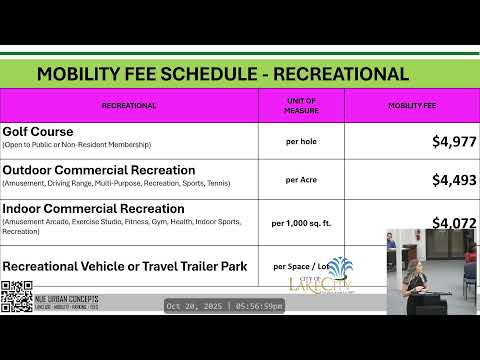
At a council workshop Lake City planners presented a draft 25-year mobility plan and a companion mobility fee that would charge one-time fees to new development to fund multimodal projects and programs. City staff and council debated where to prioritize projects, especially north of the railroad tracks; the fee would not apply to existing homes.
Lake City council members heard a workshop presentation on a draft 25-year mobility plan and a companion mobility fee meant to fund multimodal transportation projects through one-time charges on new development and redevelopment.
The mobility plan sets a 2050 horizon and recommends 184 project actions — roughly half on state or county roads — including 6 miles of downtown street upgrades, 15 miles of multi-use trails, 13 miles of neighborhood greenways, 9 miles of roadway widening, a half-mile of curbless shared street, and 63 intersection improvements. Lauren Rushing, a transportation planner with New Urban Concepts, told the council the fee is intended as an alternative to roadway impact fees or transportation concurrency and "is not a fee that is assessed on existing homes. It is not an additional tax on existing residents. It is a one-time fee that is paid by new development and redevelopment."
Rushing said the plan aims to shift Lake City's street network from vehicle-throughput focused corridors to a more multimodal, safety-focused system and to give the city a locally controlled funding source that can also strengthen grant competitiveness. She described project typologies in the draft plan, including a Lake DeSoto Promenade (a multimodal lakefront promenade), curbless shared streets (proposed for Marion Avenue from Franklin Street to U.S. 90), primary commercial streets (examples on Main Boulevard and north Marion Street), neighborhood greenways (low-volume, traffic-calmed streets…
Already have an account? Log in
Subscribe to keep reading
Unlock the rest of this article — and every article on Citizen Portal.
- Unlimited articles
- AI-powered breakdowns of topics, speakers, decisions, and budgets
- Instant alerts when your location has a new meeting
- Follow topics and more locations
- 1,000 AI Insights / month, plus AI Chat