Get Full Government Meeting Transcripts, Videos, & Alerts Forever!
Get email alerts on the Transportation topic
No spam. Unsubscribe anytime.
Lake City reviews draft 25-year mobility plan and proposed mobility fee for new development
Summary
At a council workshop Lake City planners presented a draft 25-year mobility plan and a companion mobility fee that would charge one-time fees to new development to fund multimodal projects and programs. City staff and council debated where to prioritize projects, especially north of the railroad tracks; the fee would not apply to existing homes.
Lake City council members heard a workshop presentation on a draft 25-year mobility plan and a companion mobility fee meant to fund multimodal transportation projects through one-time charges on new development and redevelopment.
The mobility plan sets a 2050 horizon and recommends 184 project actions — roughly half on state or county roads — including 6 miles of downtown street upgrades, 15 miles of multi-use trails, 13 miles of neighborhood greenways, 9 miles of roadway widening, a half-mile of curbless shared street, and 63 intersection improvements. Lauren Rushing, a transportation planner with New Urban Concepts, told the council the fee is intended as an alternative to roadway impact fees or transportation concurrency and "is not a fee that is assessed on existing homes. It is not an additional tax on existing residents. It is a one-time fee that is paid by new development and redevelopment."
Rushing said the plan aims to shift Lake City's street network from vehicle-throughput focused corridors to a more multimodal, safety-focused system and to give the city a locally controlled funding source that can also strengthen grant competitiveness. She described project typologies in the draft plan, including a Lake DeSoto Promenade (a multimodal lakefront promenade), curbless shared streets (proposed for Marion Avenue from Franklin Street to U.S. 90), primary commercial streets (examples on Main Boulevard and north Marion Street), neighborhood greenways (low-volume, traffic-calmed streets posted at about 20–25 mph), and downtown context-sensitive upgrades for core blocks.
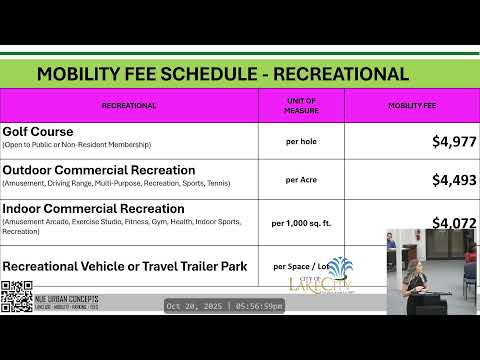
The draft includes programs and policies the council could adopt alongside infrastructure, such as a downtown parking management program, wayfinding, a sidewalk improvement program, a micromobility/low-speed electric vehicle policy, tactical urbanism pilots, and the potential for a microtransit circulator pilot. Rushing described the fee methodology as based on the cost of plan projects, estimated capacity added by those projects, and trip-generation characteristics of land uses; projects on state or county roads are included at 10% of their cost when calculating the fee.
The presentation included quantitative details the council discussed: the plan lists 184 recommended projects (about half on state or county roads), a recommended curbless shared-street segment of roughly one half-mile, and an estimated implementation cost for curbless shared streets of "about $12,000,000 per mile," a figure Rushing offered to explain why such treatments are typically localized. The consultant recommended a single citywide assessment area and one citywide benefit district so collected fees can be spent on any project in the plan, a citywide approach Rushing said fits Lake City's size and current data.
On the draft fee schedule, the consultant proposed two residential categories: an "affordable residential" rate (precalculated at roughly half the general residential rate if applicants satisfy locally defined affordability criteria) and a single flat residential rate for other housing types. Rushing said the recommended flat residential rate is about $1,800 (her slides described assessing residential uses on a per-1,000-square-foot basis rather than by dwelling unit to align with building practice and to better account for unit size differences). She also said the team will prepare a technical report (roughly 150–200 pages) documenting methodology and analysis to support a legally defensible fee and that the mobility plan and fee would be implemented via an ordinance and incorporated into the comprehensive plan per Florida statute.
Council members and staff raised local priorities and implementation questions. Councilmember Harris said the area north of the railroad tracks is "underserved" and urged the council to prioritize revitalization there rather than concentrating solely where downtown has already received investment: "it seems like we're bringing up an area that's already been cleaned up. I feel like the north of the tracks needs to be revitalized." City Manager Rosenthal noted privately initiated development on the north side of the tracks — "another development coming up on the north side of the tracks... 23 town homes, 2 commercial buildings... a multimillion dollar development" — and said staff is balancing private investment with the plan.
Councilmember Carter praised the concept as a long-term investment: "this, in general, feels like the sort of thing that requires us to all to have a little bit of imagination and vision," and emphasized that starting in a core area can catalyze broader investment. Several council members asked about the legal and policy environment: Rushing said her team has not yet seen Florida Senate Bill 180 (SB 180) affect mobility fees and that the consultants are moving forward with clients statewide but acknowledged that future legal challenges could be a consideration: "we have not seen senate bill 180 affect mobility fees yet. We haven't seen any lawsuits or any challenges against adopting these."
Staff stressed implementation mechanics: the growth department told the council the mobility fee cannot be used simply to repave a road without an enhancement; funds must be used to add or enhance capacity or multimodal features. The consultant recommended updating the plan and fee every five years. Staff also announced a related Community Redevelopment Area (CRA) workshop for public input on Oct. 29 at the Richardson Community Center; growth department staff encouraged public participation.
No formal action or vote was taken at the workshop; the presentation was paused so the council could resume a regular meeting and the mobility discussion will continue at a follow-up workshop. Rushing and staff said next steps include revising the draft based on council feedback, producing the technical report supporting the fee, drafting implementing ordinances, and bringing the plan and fee back for formal adoption and for incorporation into the city comprehensive plan.