Get Full Government Meeting Transcripts, Videos, & Alerts Forever!
Get email alerts on the Glen Lake Restoration topic
No spam. Unsubscribe anytime.
Lake City hears Glen Lake restoration plan; $4.1 million Hazard Mitigation grant submitted
Summary
Engineers presented a Glen Lake restoration plan that would deepen the lake, replace a failed outfall control structure and limit sediment. The city submitted a $4.1 million Hazard Mitigation Grant Program application with a 25% city match; permitting with the Suwannee River Water Management District is next.
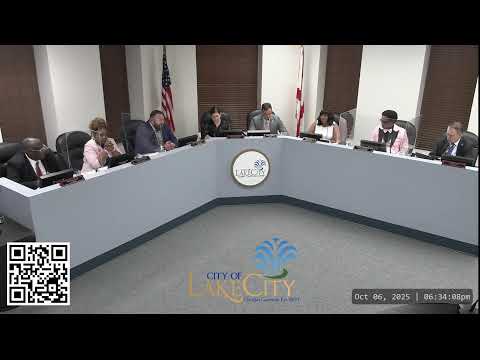
At its Oct. 6 meeting, the Lake City Council received a progress report on a proposed restoration of Glen Lake from Michael Klink, a project engineer with 4 Waters Engineering.
Klink said the project aims to restore a 7.4-acre lake by dredging accumulated sediment, removing excess vegetation and replacing a failed outfall control structure. “The soil samples that were taken from the lake are not contaminated, which is great because that they can go the dredging can go to land a normal landfill and it reduces costs quite a bit,” Klink said.
The consultant told the council the conceptual design would increase the lake’s water volume by about 41,000 cubic yards and set a normal water level at elevation 123 feet with a lake bottom at 116 feet, providing roughly 7 feet of depth. The plan calls for a replacement outfall control structure roughly 15 feet wide with about 200 square feet of flow area and a 12-inch steel pipe and gate valve to allow dewatering during storms or maintenance.
Klink said hydrologic and hydraulic modeling is being used to keep permanent drainage easement needs small and to avoid triggering a separate Federal Emergency Management Agency (FEMA) permitting process. He also said the project would include curb-and-gutter and inlet sumps on adjacent roads to trap sediment before it reaches the lake; the city would clean those sumps, likely about once a year.
The city submitted a Hazard Mitigation Grant Program application through Columbia County in July, Klink said. The submittal seeks approximately $4,100,000 with a 25% city match; award determination was estimated at about six months. “The award determination is about 6 months. So that'll be maybe December, January when we find out,” Klink said.
On schedule, Klink said the team expects to file permit applications with the Suwannee River Water Management District after completing a 90% design, with a 90% design review planned in November. He said permitting comments could add about 90 days to the schedule, and, depending on the grant and permitting timelines, construction could begin as early as spring or extend into late summer.
When asked whether the grant was likely to be funded, a meeting participant identified as Mr. Johnson said he had met with the county about the application and “it seems like this is a sure fit for it. So I don't see anything that's hampering the progress of it.” Klink and council members added that the schedule depends on the timing of the grant award and the permitting review.
Council members asked whether the project would affect existing private bulkheads and whether dredging would impact a spring reported at one residence; Klink said the project would not touch the higher bulkhead on the north side and that separate site-specific work would be required to address a backyard spring.
The consultant said dredged material can go to a normal landfill because samples showed no contamination, and estimated maintenance actions (sump cleaning) are equipment- and staff-level tasks the city already performs.
Klink said the project also requires a dam analysis and final drainage report for permitting and that the Army Corps of Engineers permit would not be required for this design. City staff and the consultant said they had conducted permitting pre-application meetings to coordinate modeling and reduce the chance of lengthy FEMA permitting.
The council did not take formal action on the project at the meeting; the presentation closed with the consultant and staff indicating next steps were completion of the 90% design and submittal to the Water Management District.