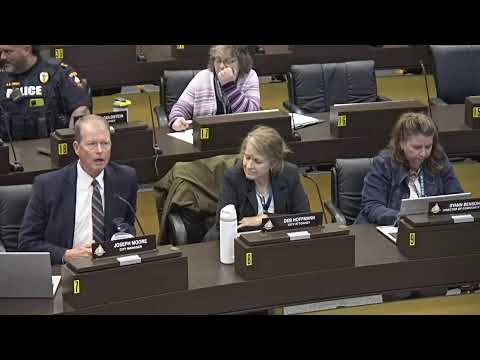
City hears water supply service-area plan; consultants report adequate supply through 2035 with monitoring of aquifer stress
Loading...
Summary
City water staff and consultants told the council the current well and storage system should meet projected demand through 2035 but recommended continued monitoring and planning to manage aquifer stress during maximum-day pumping.
Consultants and city water staff presented the Water Supply Service Area Plan (required under Wisconsin DNR procedure NR 854) to the Fond du Lac City Council on Oct. 22, 2025, concluding that existing deep groundwater sources and storage provide adequate supply through the planning horizon if current demand trends hold, but that the city should monitor aquifer stress and consider additional sources if pumpage approaches aquifer capacity.
Travis Kletzke, Water Works general manager, and Steve Klessner of Strand & Associates reviewed system capacity and demand projections through 2035. Presenters described existing firm well capacity of roughly 7,000+ gallons per minute and total well capacity over 9,000 gpm, storage of approximately 10 million gallons (about two average days), and aquifer capacity estimates in the range of 6'8 million gallons per day (MGD) depending on studies and well fields. Average-day demands were projected around 4.6'4.9 MGD and maximum-day demands around 8+ MGD in the planning scenarios.
The consultants said the city currently has a surplus of well capacity and storage for the planning horizon but that maximum-day pumping can stress the aquifer and requires operational balancing between the north and south well fields. The presentation noted prior studies of a possible East Side well field and that Lake Winnebago surface-water treatment is a feasible but more expensive and complex alternative. Strand recommended continued well maintenance, monitoring of water-level response to pumping, and preparing a more detailed water system plan for distribution and capital improvements beyond the NR 854 service-area document.
Councilmember Schisler asked about long-term aquifer stability and threats; the consultants identified drought as the primary near-term risk and said further study and monitoring would refine capacity estimates. Council discussion also covered the relative cost and operational implications of adding an east-side well field versus a surface-water (lake) connection.
No council vote was required on the plan itself; presenters said the NR 854 service-area plan only needs to be submitted to the Wisconsin Department of Natural Resources if an additional or expanded Great Lakes Basin withdrawal requires a new or increased permit.