Get Full Government Meeting Transcripts, Videos, & Alerts Forever!
Get email alerts on the School Finance topic
No spam. Unsubscribe anytime.
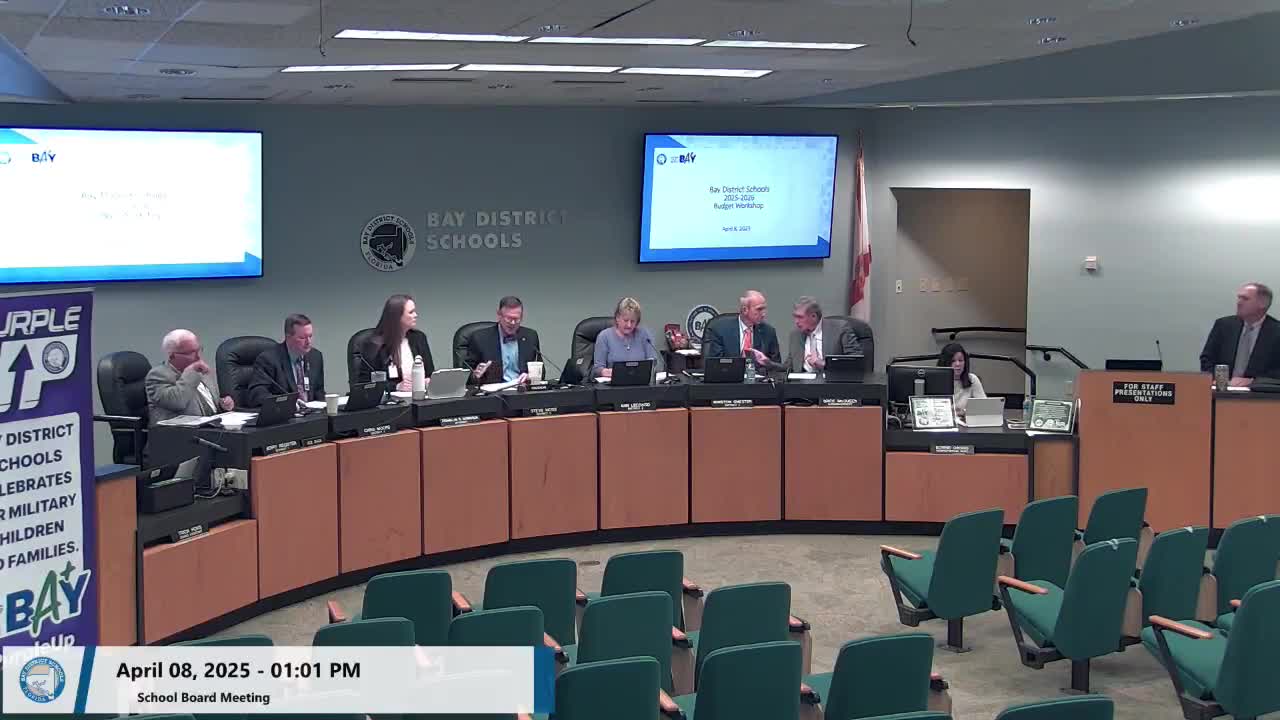
Bay District budget workshop: state opportunity scholarships led to $2 million prorated holdback, staff says
Summary
At a Bay District Schools budget workshop, staff said a statewide true-up of Opportunity Scholarship payments produced a roughly $2 million prorated holdback against the district’s FY balance. Officials also flagged enrollment shifts, uncertainty about federal ARP carryover and pending state legislation as risks for next year’s budget.
Bay District Schools staff told the school board at a budget workshop that a statewide true-up of Opportunity Scholarship payments produced about a $2,000,000 prorated holdback against the district’s fund balance, reducing the district’s year-end reserves and prompting plans for a budget amendment.
The presentation, led by Jim, a district staff member, explained that the state Department of Education (DOE) performed a post‑enrollment “true up” and prorated base student allocations after counting students for full‑time‑equivalent (FTE) funding. Because the state had earlier distributed about $230,000,000 in Opportunity Scholarship money to families, then counted those children in public‑school FTE totals, the state averaged the shortfall across districts; Bay District’s share of that statewide proration was about $2,000,000, staff said.
Why it matters: the holdback and related enrollment shifts reduce available appropriations and pressure the district’s fund balance in a year when the Legislature and DOE are still finalizing education funding. District officials said some of the shortfall will be reflected in a year‑end budget amendment and that the board had previously reserved portions of fund balance to absorb part of the hit.
District explanation and figures Jim, the presenting staff member, said the state’s method is to prorate the base student allocation when available revenue cannot cover the level of FTE the DOE ultimately counts. He told the board the state’s 2024/25 calculations included roughly $230 million tied to Opportunity Scholarship recipients who later appeared in public‑school classrooms. “The money’s been given away, but now they’re counted in our FTE,” Jim said, describing the mechanics that led to the prorate.
The district presented a breakdown showing traditional schools’ revenue declines and charter movements: traditional schools’ revenue fell by about $4.3 million, charter schools by about $800,000 and Opportunity Scholarship‑related allocations rose roughly $1.3 million, producing a net FTE revenue change of about $3.8 million. After the state proration (about $2.08 million in the district’s calculation), total estimated revenue decreased by roughly $5.9 million; the district said it had reserved roughly $3.8 million of appropriations and other reserves to offset part of that loss, leaving approximately $2.04 million to come from fund balance.
How the counting mismatch occurred Staff explained the practical cause: Opportunity Scholarship checks go directly to parents for homeschooling or other uses and are recorded in a separate state system; when parents who received scholarship funds later enroll their children in district classrooms, the DOE and local roster systems were not cross‑checked in time to prevent double counting. Jim said the October FTE headcount showed those children physically in classrooms, but the DOE’s earlier payments had already been distributed.
The presentation noted there is currently no automatic clawback mechanism to recover scholarship funds from parents who later enroll their children in public schools, a point board members and staff said lawmakers and DOE are now reviewing.
Board reaction and communications A board member characterized the situation bluntly: “We were penalized for something we didn’t do,” and asked whether the district could clearly communicate to voters how the $2 million was lost. Jim said he expected the specific adjustments to appear in the district’s year‑end budget amendment and that staff would present those details at the upcoming board meeting.
Federal and other funding pressures The district also flagged uncertainty about federal American Rescue Plan (ARP) carryover funds. Staff said roughly $1 million remained in ARP balances, including about $250,000 in encumbrances for contracts such as construction and professional development; DOE has asked districts for information after the federal timeline and allowable‑use guidance changed. District staff said contracts already obligated against ARP carryover were expected to be honored, but that those funds will not be available for next year’s base budget planning unless DOE confirms the expenditures as allowable.
Legislative uncertainty Presenters warned that the state legislative session remains unsettled and several proposals in Tallahassee could affect district revenues and programs. Jim noted a large gap between House and Senate budget positions and that proposals under discussion include reductions to the school recognition (A+) program, cuts to funding tied to industry certifications, and possible changes to the education enrollment stabilization fund. The district’s lobbyist, Miss Timmons, and Representative Griffiths were said to be engaged on the issue; Jim encouraged continued outreach as the Legislature finalizes budget decisions.
Next steps District staff outlined the board’s calendar for finalizing the tentative and final budgets in July and September and said the July 24 workshop would include a tentative budget the board could advertise. Jim said staff would refine revenue projections as additional state information becomes available and would include the Opportunity Scholarship proration and ARP clarifications in the budget amendment to be presented to the board.
The board did not take a formal vote during the workshop. Staff characterized the session as an early stage in the budget process and urged board members to provide direction and questions before formal budget adoption.