Get Full Government Meeting Transcripts, Videos, & Alerts Forever!
Get email alerts on the Medicaid Works topic
No spam. Unsubscribe anytime.
DMAS outlines Medicaid Works program, cites low enrollment and pending application changes
Summary
Department of Medical Assistance Services staff described the Medicaid Works benefit, eligibility rules and recent and pending changes to simplify applications after a General Assembly directive and new law (HB 1804).
Sarah Cariano, director of eligibility, policy and outreach at the Department of Medical Assistance Services, gave an overview of Medicaid Works, a state coverage group intended to help people with disabilities who are working keep Medicaid benefits while earning higher incomes.
Cariano said the program was established at the federal level in 1999 and adopted by Virginia as an optional coverage group in 2007. She said the program covers standard Medicaid benefits and an alternative benefit package that includes personal care services that are otherwise typically available only through waiver programs. "Medicaid Works is 1 of our kind of smaller programs, within the Medicaid program," Cariano said during the stakeholder session.
Cariano and DMAS staff emphasized that enrollment in the program is very low: about 94 people are currently enrolled, compared with nearly 2,000,000 people in Virginia Medicaid overall. She described eligibility rules, the program's distinctive financial rules and a required work incentive account (referred to in the session as a WIN account) that lets enrolled individuals set aside earned income without that money counting against resource limits.
Why it matters: Advocates and DMAS staff said the program can help people with disabilities keep health coverage while working, including access to personal care services that can support employment. DMAS staff also described legislative and administrative steps underway to reduce barriers to enrollee uptake.
Key details provided by DMAS
- Eligibility and benefits: Cariano said enrollees must meet a disability definition (they do not all have to be receiving Social Security Disability or SSI), be earning income or have a job offer at enrollment, and be age 16–65. Medicaid Works covers the standard Medicaid benefit package and, as an "alternative benefit package," includes personal care services, Cariano said. She noted that people enrolled in community long-term services waivers (such as CCC Plus or DD waivers) cannot be enrolled in Medicaid Works at the same time.
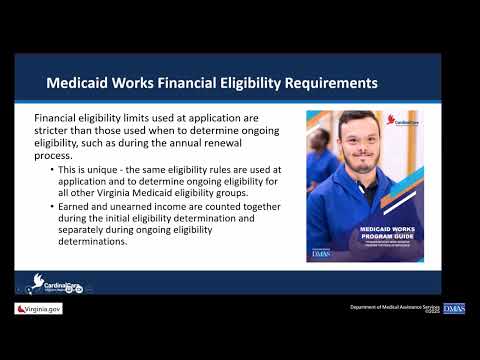
- Financial rules: Cariano said initial income eligibility is set at 138% of the federal poverty level, matching Virginia's Medicaid expansion threshold. The program uses a $2,000 resource limit for individuals and $3,000 for couples at application; resources held in the WIN account are disregarded for that resource test. DMAS said enrollees may accumulate funds inside a WIN account without those funds counting against the $2,000/$3,000 limit, and that the WIN account balance remains disregarded if the person later transitions to another Medicaid category.
- Earnings and WIN account: DMAS said the program separates earned and unearned income for ongoing eligibility. Cariano described a cap on the amount of earned income that may be set aside in the WIN account; she said the program allows substantial earned-income accumulation while preserving Medicaid eligibility. (Transcript referenced an annual figure of "$75,000 a year" for earned income put into the WIN account; that monthly equivalent was misstated in the session. The monthly equivalent of $75,000 per year is $6,250.)
- Administrative and legislative context: DMAS said the 2024 General Assembly directed the agency to form a work group to identify barriers to enrollment. The work group reported several barriers, including low initial financial limits compared with permitted savings after enrollment, limited residential supports available only through DD waivers, hesitance of some waiver participants to change programs for fear of losing services, low awareness of Medicaid Works among providers and local agencies, and application complexity.
- Recent legislative change: Cariano said Delegate Cohen carried House Bill 1804 during the 2025 General Assembly session; the bill was approved unanimously by both houses and signed by Governor Youngkin. DMAS said HB 1804 directs the agency to simplify the application so more applicants can indicate interest in Medicaid Works up front and reduce back-and-forth with eligibility workers. DMAS said the law will take effect July 1, 2025, and the agency is already working to incorporate changes into its application processes.
- Enrollment identifier and MCOs: In response to a question, Cariano said Medicaid Works cases will appear in the eligibility system under aid category 59 and that most enrollees will be enrolled in managed care organizations.
What DMAS said it will do next: Cariano said DMAS is working to implement HB 1804's direction by changing the application to collect WIN account information up front and to issue the Medicaid Works agreement more promptly. She encouraged questions after the session and provided contact information to attendees.
Ending: DMAS staff said outreach and clearer application steps are priorities to increase enrollment. Cariano asked stakeholders to share questions and suggested improvements through the agency's stakeholder channels.