Get Full Government Meeting Transcripts, Videos, & Alerts Forever!
Get email alerts on the Entertainment Zones And Legislation topic
No spam. Unsubscribe anytime.
Entertainment Commission reviews state and local efforts to expand entertainment zones, tracks two bills
Summary
Commission staff and the city—s nightlife director summarized state bills and local ordinances aimed at expanding "entertainment" and hospitality zones, described how zones would work, and promoted the commission—s upcoming Nightlife and Entertainment Summit.
The San Francisco Entertainment Commission heard updates on state and local legislation that could expand where and when alcohol-linked outdoor activity and late-night service are allowed, and on the city—s continuing rollout of entertainment zones.
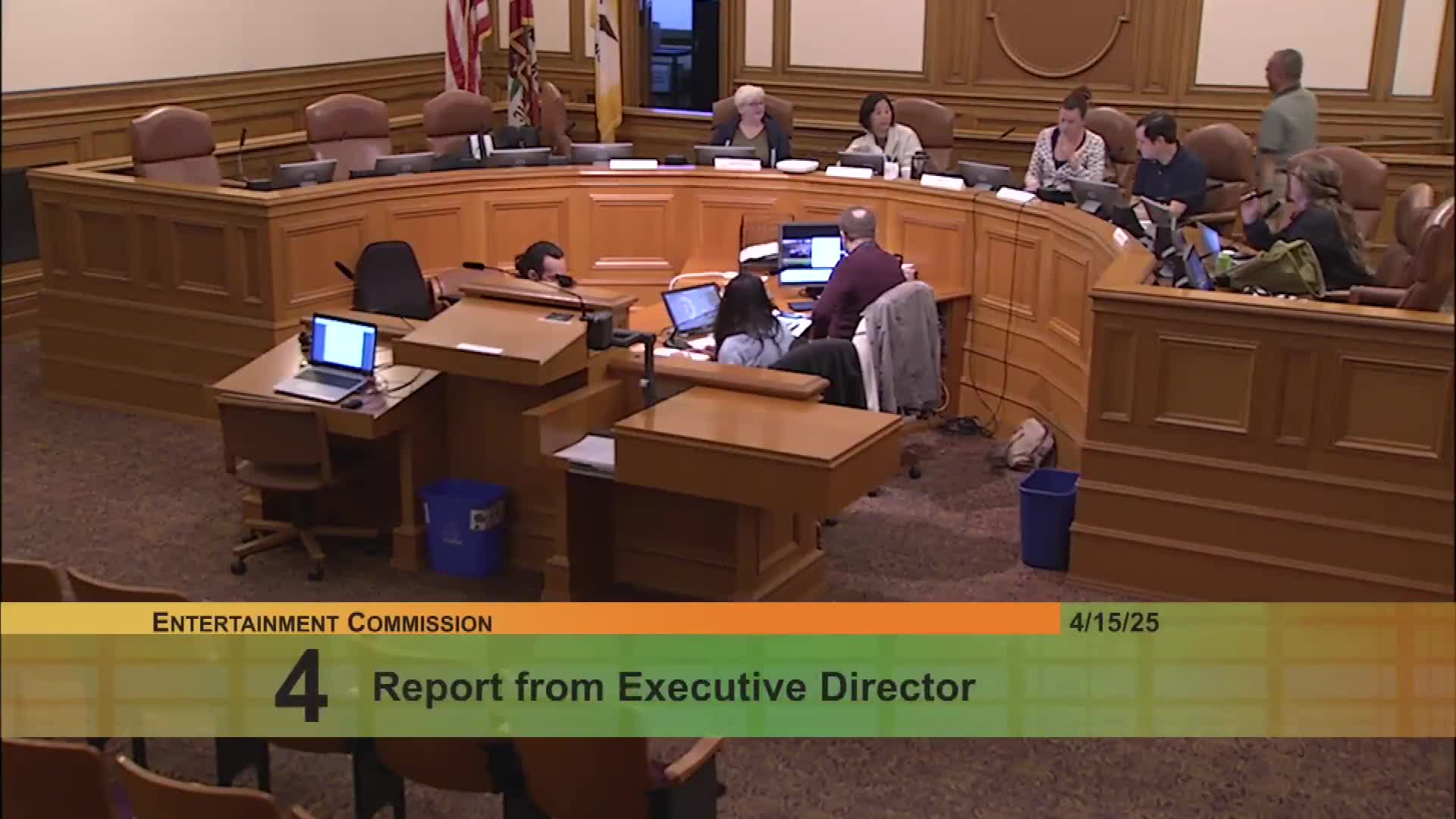
Commission Vice President Xin Wong opened the discussion and the executive director described a piece of legislation sponsored by Supervisor Matt Dorsey that cleared the Planning Commission and would remove a 200-foot buffer in parts of South of Market that currently limits some nighttime and general entertainment uses. The executive director said the change "opens up the ability for a couple of addresses to come forward and get permits from us directly if this passes." The executive director also pointed commissioners to an executive summary and the board file number in the meeting packet.
Ben Van Houten, Director of Nightlife Initiatives at the Office of Economic and Workforce Development, briefed the commission on state bills and local efforts. He summarized Assembly Bill 342, saying AB 342 "would allow local governments to designate hospitality zones, within which businesses could potentially offer extended alcohol service hours on Fridays, Saturdays, and on state holidays," and noted that local action would require a resolution, findings and transportation and public safety plans. He also described SB 395, which he said would allow San Francisco to issue up to 20 new nontransferable restaurant liquor licenses over three years to support business in a downtown hospitality zone; Van Houten said the bill passed its first committee hearing unanimously.
Van Houten outlined Mayor-sponsored legislation to designate five new entertainment zones (Valencia Street, Pier 39, Folsom Street, Yerba Buena Lane and Ellis Street) and said stakeholders are also pursuing the Castro and Union Street zones. He said 21 zones are now either adopted or pending and that the city is still working with stakeholders on implementation and management plans.
Explaining how an "entertainment zone" functions, Van Houten said, "Entertainment zone is the term used in state law... but really, what it means is that, within areas designated by the board of supervisors during days and times designated, restaurants, bars, breweries and wineries can sell to-go beverages for consumption in a common outdoor space." He added the program is intended to create shared outdoor space that lets businesses directly generate revenue and participate in funding events.
On operational details, Van Houten said management plans for each zone will nominate a lead convener (often a merchant association or community benefit district), include a security plan and be coordinated with the local SFPD district station. He said plans are custom and that "there's no one size fits all" for security staffing; SFPD provides recommendations for each management plan. He also said the zones have mostly focused on one-time events so far, but stakeholders are discussing more regular activations when capacity allows.
Commissioners asked about enforcement and whether restaurants are responsible for keeping drinks inside the zone. Van Houten said the lead convener and management plan are central to monitoring and that the city consults with police on preferred security approaches. Commissioners also asked whether extended-hours proposals would effectively redirect prior efforts to expand late-night liquor licenses; Van Houten said the hospitality-zone approach is targeted to locations such as hotel and event-concentrated corridors rather than broad, citywide license changes.
The executive director and Van Houten also promoted the commission—s Nightlife and Entertainment Summit, scheduled for Monday, May 12, noon to 4 p.m. at 49 South Van Ness, with an optional 21+ happy hour afterward. The summit was described as free and open to the public; registration and additional materials were posted by staff.
Why it matters: AB 342, SB 395 and the local entertainment-zone ordinances would change where alcohol-linked outdoor activation and extended hours are legally feasible, affecting downtown economic activity, neighborhood management plans, and public-safety coordination. Commission staff said they will continue to track the legislation through the Planning Commission and Board of Supervisors and return with updates.