Get Full Government Meeting Transcripts, Videos, & Alerts Forever!
Get email alerts on the Small Business Protections topic
No spam. Unsubscribe anytime.
Planning Department, small‑business groups propose relocation payments, micro‑retail and early notification to limit business displacement from rezoning
Summary
Planning staff and small‑business advocates presented policy options April 17 to reduce displacement risk from a citywide rezoning, including relocation payments modeled on AB 2011, micro‑retail set‑asides, early notification and good‑neighbor construction rules.
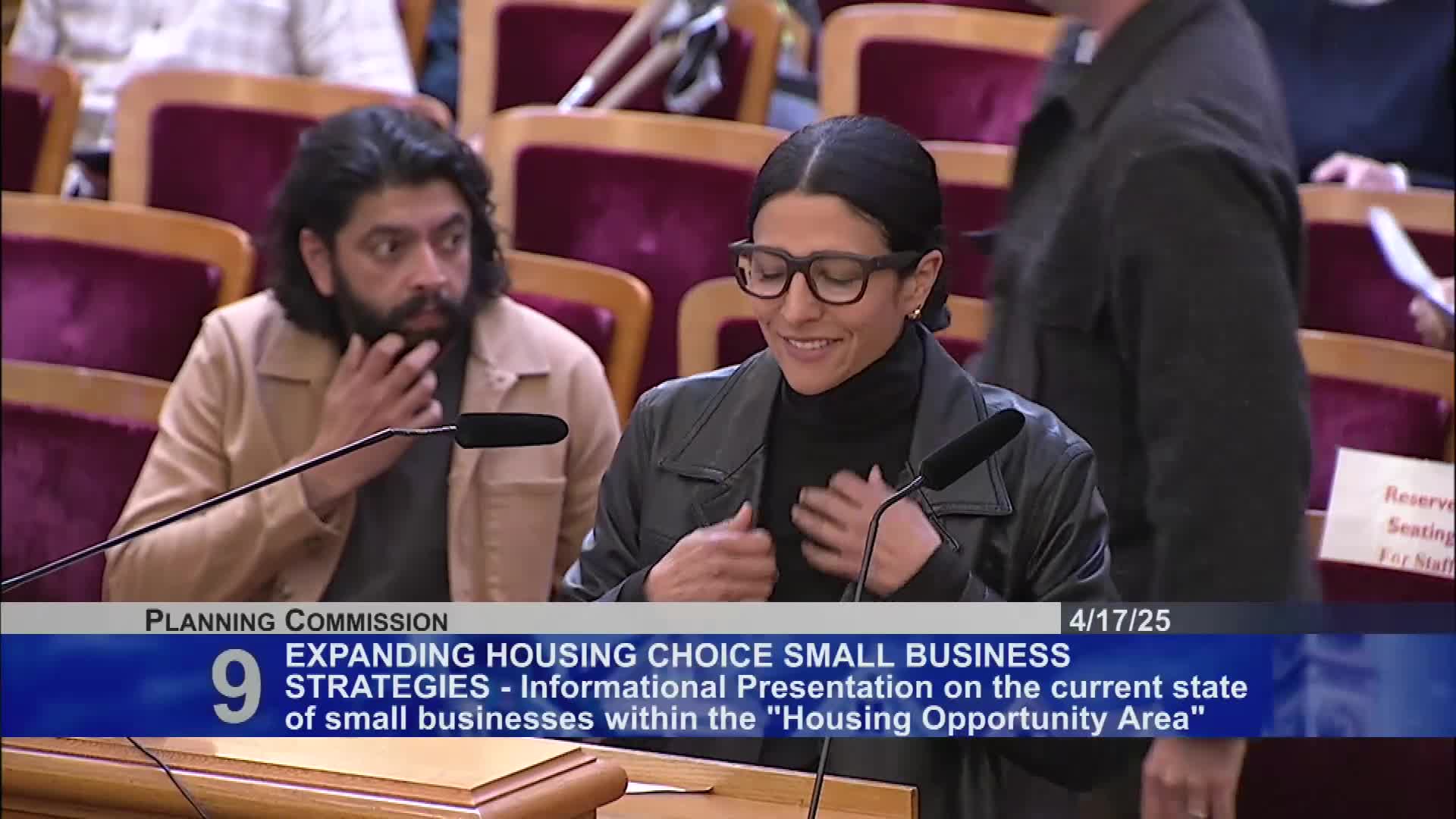
The Planning Department and community groups on April 17 focused an informational hearing on potential protections for neighborhood‑serving small businesses as the city pursues its proposed rezoning to expand housing choice.
Staff research and community proposals: Planning staff summarized research showing the rezoning area contains roughly 5,600 registered businesses, and estimated that approximately 1,000 businesses sit on sites more likely to be developed (sites with zero or one residential units). Under a working assumption that roughly 5% of those sites might redevelop per year, staff estimated about 53 businesses per year could face displacement pressure — a scale intended to guide planning for mitigation and services.
Small Business Forward and community proposals: Small Business Forward presenters and a coalition of neighborhood groups urged stronger, permanent protections. Their priority recommendations included: - Relocation assistance scaled to length of tenancy and modeled on AB 2011 (state law providing relocation payments for certain commercial tenants), - Tenant/owner consent for demolition or negotiated right‑to‑return agreements, - Developer‑funded grants/loans or housing set‑asides for displaced workers, and - “Good neighbor” construction rules and stronger enforcement to limit sidewalk obstruction, dust and multi‑year vacancies.
City staff proposals and tools: Planning staff outlined draft recommendations they are refining with community partners: early notification and referral to the Office of Small Business, relocation payments modeled on AB 2011, micro‑retail requirements to reserve small, lower‑cost retail spaces within large new commercial areas, a new zoning district allowing ground‑floor commercial uses in more locations, and incentives to help displaced businesses locate in new spaces. Staff noted some policies might require additional legislation or funding and stressed continued legal review on measures that may be constrained by state law.
Public comment and concerns: Dozens of small business owners, legacy business representatives and neighborhood groups testified. Speakers cited recent examples of rent hikes, lease nonrenewals and construction disruption; many urged binding requirements and developer responsibility for relocation costs and right‑to‑return options. Some speakers asked the commission to pursue stronger legislative avenues and to ensure affordable housing for small‑business workers near their jobs.
Next steps: Staff will continue meetings with Small Business Forward and coalition partners, refine draft ordinances and continue legal review. Commissioners encouraged continued community engagement and asked staff to evaluate case studies (e.g., soft‑story retrofit effects) and to detail enforcement, funding and administration of proposed relocation and “good neighbor” measures.
No binding policy was adopted at the informational hearing; the item is part of the broader rezoning planning process.