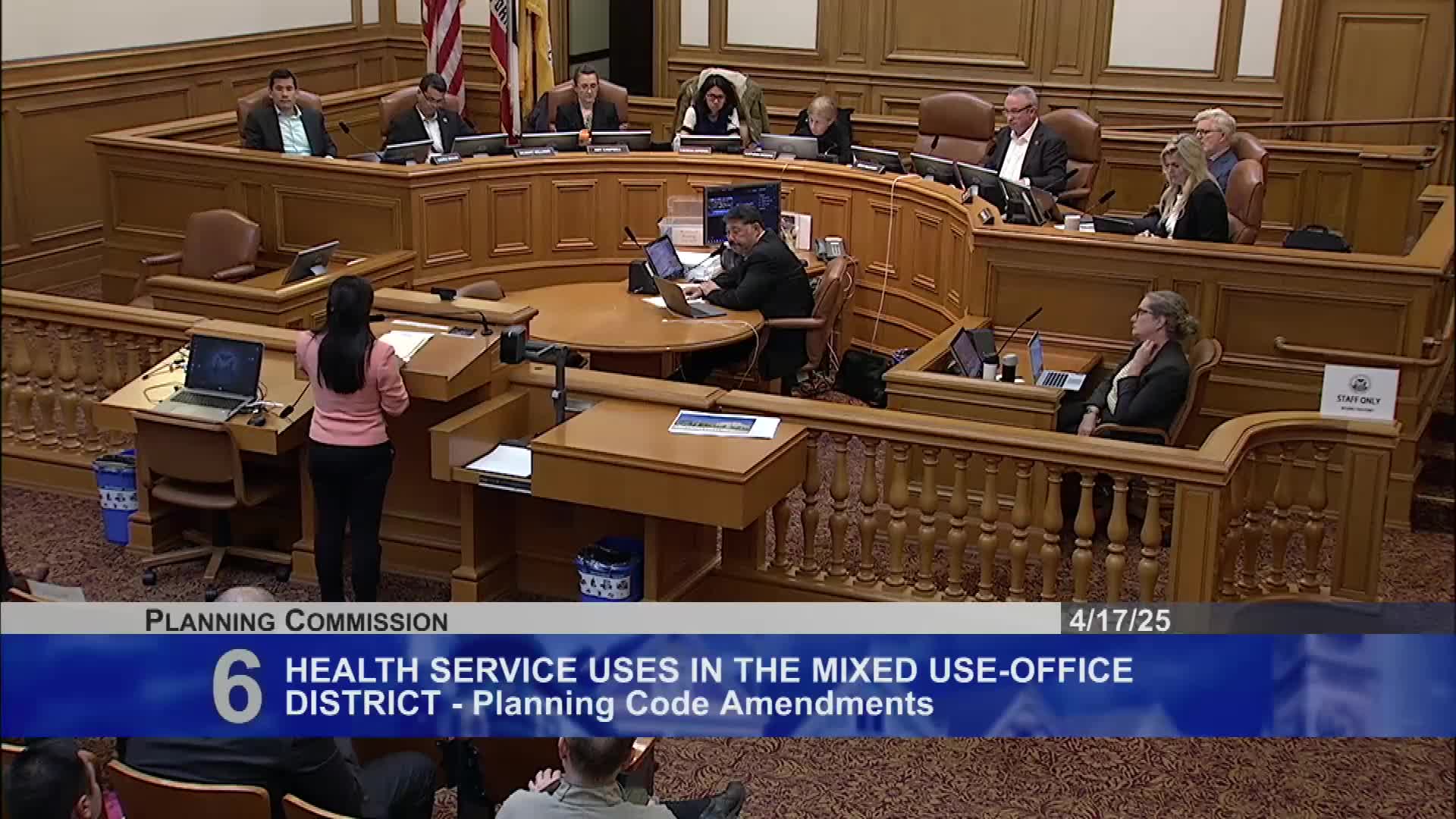
Planning Commission advances MUO code changes to ease health‑service sites, approves narrower review of Mission Street corners

Loading...

AI-Generated Content: All content on this page was generated by AI to highlight key points from the meeting. For complete details and context, we recommend watching the full video. so we can fix them.

Summary

The Planning Commission debated and ultimately approved staff recommendations to exempt health service uses — including reproductive health clinics — from large-use limits and retail-ratio requirements in the Mixed Use Office (MUO) district, while asking staff to study whether the change should exclude MUO parcels west of Seventh Street.

The San Francisco Planning Commission on April 17 advanced changes to the MUO (Mixed Use Office) zoning district that would exempt health service uses — including reproductive health clinics — from existing retail-size limits and the MUO retail‑ratio requirement.

Planning Department staff told the commission the amendments were intended to grant flexibility for health service providers to occupy large vacant retail and office spaces in the MUO, an area that includes parts of the Second Street/Townsend corridor, South Beach and the Embarcadero. Madison Tam of the Planning Department said the change would prevent health service uses from triggering conditional use authorization solely because of size and would lift the hard cap on use size that now applies in MUO.

Why it matters: Commissioners and members of the public said many MUO blocks still carry high vacancy rates and that health-service anchors can generate foot traffic and neighborhood activity. Several commissioners, however, raised concerns that the proposed citywide change ought not to be applied uniformly across all MUO parcels without additional study of local impacts, particularly on Mission Street west of Seventh Street.

What the commission discussed and decided - Staff presentation: Planning staff recommended (1) exempting health services and reproductive health clinics from use‑size limits and (2) removing the MUO retail‑ratio requirement for those uses. The department said the retail‑ratio, originally intended to prioritize office and housing, is less necessary on already‑built MUO parcels. - Public comment: A few property owners and industry speakers supported the changes, noting vacancy challenges. Commissioners asked for maps and further clarification about the affected areas; staff displayed MUO maps and said the MUO district is primarily within Supervisor Dorsey’s district. - Commissioner concerns: Commissioners Campbell, Imperial and Williams raised specific concerns about the breadth of the change and potential impacts along Mission Street west of Seventh Street, including street‑level activation, loading and parking for medical uses, and the character of small parcels. - Motions and votes: An initial motion to adopt staff recommendations with modifications failed 3–3 (Commissioners Williams, Imperial and Chair Moore opposed). A subsequent motion to adopt staff recommendations with the requested staff modifications and to direct staff to examine whether to exclude the MUO area west of Seventh Street from the changes passed 5–1, with Commissioner Williams dissenting.

Implementation and next steps: Staff and the sponsor said they will continue refining the ordinance language and report back with the requested study of the Mission Street/West of Seventh parcels and with proposed implementing language for reproductive health clinics (noted as related to Proposition O and state law). The commission’s action sends the proposal forward in the legislative process with the added direction to study a geographic carve‑out.

Speakers quoted in this article are identified in the commission record and in staff materials. No final code text was adopted on April 17; the vote authorized a recommendation for approval with modifications and a study of West of Seventh MUO parcels.