Get Full Government Meeting Transcripts, Videos, & Alerts Forever!
Get email alerts on the Water Infrastructure topic
No spam. Unsubscribe anytime.
Cherokee Nation releases biennial water-infrastructure report under Mankiller Safe Water Act
Summary
Department of Transportation and Infrastructure presented a multi-year audit of reservation water and sewer systems under Act 1521, highlighting a mapping project, federal grant wins and remaining infrastructure needs including a former 70% water loss in Cherry Tree Rural Water District.
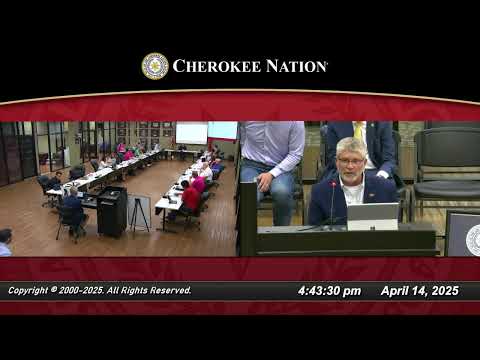
Principal Chief and Michael Lynn, of the Department of Transportation and Infrastructure(Water and Sanitation), presented the department's biennial report on the law the meeting identified as Act 1521, commonly referred to during the presentation as the Mankiller Safe Water Act, and described results of a multi-year effort to assess and repair water and wastewater systems across the Cherokee Nation reservation.
The report said the council's annual appropriation of $2,000,000 under Act 1521 helped the department leverage roughly $6,000,000 in federal funds and other grant awards. "The $2,000,000 that the council allocates under this law every year goes to good work and makes a difference," the Principal Chief said, adding the chief supports increasing the annual allocation to $2,500,000, subject to appropriation.
Why it matters: the inventory and analysis aim to show where reservation residents lack safe, reliable public water or are served by aging systems so tribal leaders can prioritize repairs and seek outside funding. Michael Lynn told the committee the department has combined resident survey responses, GIS mapping and third-party technical reviews to identify priority areas and to apply successfully for federal grants.
Key findings and actions
- Census and survey: The department collected about 1,900 survey responses spanning 86 ZIP codes to document household access and water quality concerns.
- GIS mapping and system inventory: Using a GIS service (Diamond Maps), the department has begun mapping service lines and infrastructure for public systems across the reservation; 32 systems were GPS-mapped so far and a total inventory of 121 water systems and 53 public sewer systems was cited.
- Small systems and technical capacity: Oklahoma Rural Water Association (ORWA) performed on-site assessments of the nation's water and sewer districts for technical, managerial and financial (TMF) capacity. ORWA scored districts on a 0—00 scale; the report gave an average TMF score of about 73 with a range from 33 to 96, and noted many districts are "very small" by EPA definitions (serving fewer than 3,300 people).
- Cherry Tree Rural Water District study: The department completed a comprehensive infrastructure analysis of Cherry Tree Rural Water District. The data presented said the district serves about 1,122 homes, roughly 837 of which were identified as Cherokee citizens (about 75%). The district had extensive aging mains, pressure imbalances and, at the time of the study, an undocumented water loss of about 70 percent; staff said the loss has declined since remediation work began.
- Grants and federal awards: Staff reported $8,380,000 invested since 2021 (department figures). Using findings funded by Act 1521, the department said it executed a lead service line pilot and later received an EPA lead-service-line verification award of about $5,200,000 and an earlier $811,000 pilot; the Bureau of Reclamation awarded roughly $400,000 for drought-risk assessment and resilience mapping.
What officials said and next steps
Michael Lynn credited his team, the communications office and partners for producing the report and dashboards. He described a live GIS dashboard that can display lines, pipe material and meter reads for district staff and said the mapping helps both planning and property-level decisions.
"There's a lot in this report," Lynn said, noting the department will continue GIS mapping, TMF-strengthening work with ORWA, and seeking grant funding. The Principal Chief said the nation will consider increasing the Act 1521 annual allocation to $2.5 million to expand that work, subject to council appropriations.
Questions from council members focused on practical outcomes: whether meter replacement or service-line repairs would be funded for households, how line-sizing and pressure issues are addressed when installing hydrants, and whether the nation will maintain public-facing maps. Lynn and staff said meter upgrades and service-line work are among funding priorities and that mapped data will be maintained in the Diamond Maps dashboard.
Ending
Council members thanked staff and partner organizations, including Oklahoma Rural Water Association, for work on the mapping and district assistance programs. Officials said they will return with further dashboards and a demonstration of the drought-resilience metrics at a future meeting.