Get Full Government Meeting Transcripts, Videos, & Alerts Forever!
Get email alerts on the Urban Trees topic
No spam. Unsubscribe anytime.
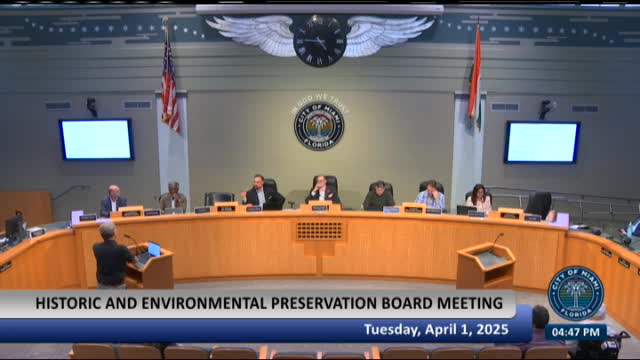
Historic board denies appeal of after-the-fact tree removals at NE 70th Street site; mitigation required
Summary
The Historic and Environmental Preservation Board denied an appeal of after-the-fact tree removals on property at 679 NE 70th Street and directed mitigation under City of Miami tree rules (Chapter 17). The board voted unanimously to uphold staff’s mitigation requirement.
The Miami Historic and Environmental Preservation Board on Wednesday denied an appeal by the property owner of a required mitigation for trees removed without a permit at 679 Northeast 70th Street. Staff had recommended denial of the appeal and the board agreed, voting unanimously.
City staff told the board the demolition of the original structure and subsequent site work resulted in the removal of 13 trees totaling roughly 135 inches DBH (diameter at breast height). Under the city’s Environmental Preservation Ordinance (Chapter 17), after-the-fact removals trigger a replacement obligation: either planting 92 two-inch replacement trees (12-foot height) or 46 four-inch replacement trees (16-foot height) on-site or a financial contribution of $1,000 per required two-inch tree into the city’s tree trust fund if on-site planting is not feasible.
Appellant Ori Darman and the project’s landscape representative explained that demolition subcontractors removed trees the owner expected to protect; the owner said they reported the removals promptly and have been pursuing remedies. “It was just a matter of months,” the owner’s representative said, describing the removals as unintentional and saying the team had attempted to resolve the issue with the contractor.
Staff and board response City environmental staff explained the ordinance’s mitigation requirement and that the applicant must plant what can reasonably fit on the site; any shortfall can be satisfied by planting off-site in coordination with the city or by paying into the tree trust fund. Board members expressed sympathy but emphasized the city’s code is designed to preserve tree canopy and that property owners are responsible for their contractors’ compliance with permitted protections.
Outcome and practical effect The board’s denial means the owner must meet Chapter 17 mitigation requirements. Staff noted options include planting reasonably-sized trees on-site where possible, coordinating with city resilience/public-works staff to plant in public spaces in the same commission district, or paying the trust fund for any shortfall. The board’s decision was unanimous; members recorded yes votes from all present.
What the owner said The appellant said they informed city staff when they discovered removals and pleaded for leniency because the work was done by a demolition contractor who did not follow the agreed demolition protections. The owner asked the board to reduce the after-the-fact mitigation requirement or to permit a different calculation because the large site is being subdivided into three parcels for future construction and the owner argued that the mitigation obligation as written is impossible to satisfy on a single resulting lot.
Appeals and next steps The board noted its decision can be appealed to the Hearing Boards Division within 15 days. Separately, the owner may pursue civil remedies against the demolition contractor for damages incurred.