Get Full Government Meeting Transcripts, Videos, & Alerts Forever!
Get email alerts on the Historic Preservation topic
No spam. Unsubscribe anytime.
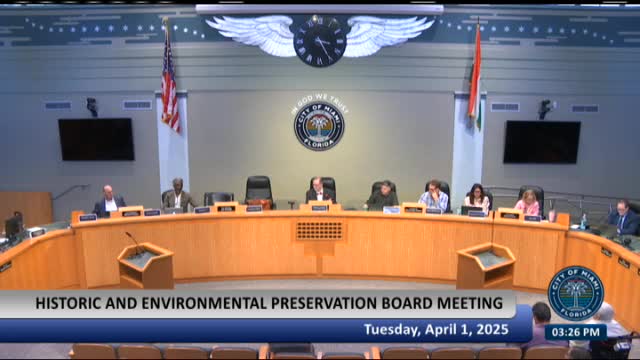
Historic board approves drainage work at Marjory Stoneman Douglas House but removes proposed driveway and path
Summary
The Miami Historic and Environmental Preservation Board approved landscape and stormwater work for the Marjory Stoneman Douglas House in Coconut Grove, including drainage trenches and removal of a deteriorated black olive tree, but denied the applicant’s proposed driveway and front path and waived parking requirements. The vote was unanimous.
The Miami Historic and Environmental Preservation Board on Wednesday approved a special certificate of appropriateness to allow grading, buried drainage (exfiltration) trenches and planting around the Marjory Stoneman Douglas House in Coconut Grove, while removing a proposed turf-grid driveway and a new brick pathway from the project.
Board members said the measures approved are intended to stop stormwater from washing into and undermining the 1926 structure. The board’s action requires the applicant to complete the drainage and landscape work under staff conditions; it also granted a waiver so the site will not be required to provide the otherwise-required on-site parking. The approval passed unanimously.
The decision addresses longstanding community concern that rain-driven erosion and runoff have damaged the house’s foundation. “The root of this application is for preservation of the property to make sure that there is no further degradation based on rainstorms,” Kristin Nowicki of WGI, the applicant’s representative, told the board. She described the work as regrading the site to direct storm drainage away from the house, installing buried exfiltration trenches and planting native trees and shrubs.
Why it matters: The Marjory Stoneman Douglas House is an individually designated historic resource and a National Historic Landmark. Neighbors and preservation groups have pressed for action to protect the house from ongoing water damage and from dead or failing trees that threaten the structure. The board’s approval aims to reduce immediate risks while leaving open later planning steps for any change in use.
What the board approved and what it removed - Approved: underground drainage/exfiltration trenches, regrading to direct water away from the foundation, removal of a nearby black olive tree identified by the applicant as undermining the house and HVAC equipment, and replanting with native trees and shrubs in a mitigation plan accepted by staff. - Denied as part of the final motion: the proposed 20-by-20 turf-grid driveway and the brick pathway that would have created a formal parking/approach in front of the house. The board also granted a waiver of the parking requirement for this site.
Public comment mixed preservation and neighborhood concerns. Friends of the Everglades, the Land Trust of Dade County and other preservation advocates urged the board to allow the work so the house would not suffer further structural damage. As Dolly McIntyre, a longtime preservationist, put it: “These proposed changes have been in the works for years… I urge you to pass this so the work can get done.” Several immediate neighbors said they support preserving the house but objected to the applicant’s outreach process and warned that adding formal parking and a visible approach could alter the character of the narrow residential street.
Contractor testimony and staff recommendation Philip White, the general contractor on the structural stabilization, told the board crews found water scouring and damage to the foundation and floor framing; he said clearing runoff paths and improving the site grading were necessary to protect the repairs already completed. City staff recommended approval of the drainage and landscape measures with conditions; staff also noted that the removal of the olive tree could be approved given the proposed mitigation.
Board action and next steps A motion to approve staff’s recommendations while removing the driveway and pathway passed unanimously. The roll-call vote in the record showed all present board members voting yes (Powers, Collie, Galvez Trujos, O’Dell, Brito y Munoz, Campbell, Trachtenberg, Hopper). The board noted appeals of HEPB decisions must be filed in the Hearing Boards Division within 15 days.
The applicant must complete the work under the board’s conditions; any later proposal that would change the property’s use or add formal parking would require separate approvals and a return to the board and likely additional city approvals.