Get Full Government Meeting Transcripts, Videos, & Alerts Forever!
Get email alerts on the Municipal Budget topic
No spam. Unsubscribe anytime.
Richmond mayor’s proposed FY2026 budget projects $1.1 billion general fund; council presses for more time, detail
Summary
Mayor Avila’s administration presented a proposed FY2026 operating budget that includes a $1.1 billion general fund and $54.6 million in projected revenue growth, while warning that the city faces a tight 2027 because of an assessment‑cycle alignment that will effectively freeze reassessed values for a year.
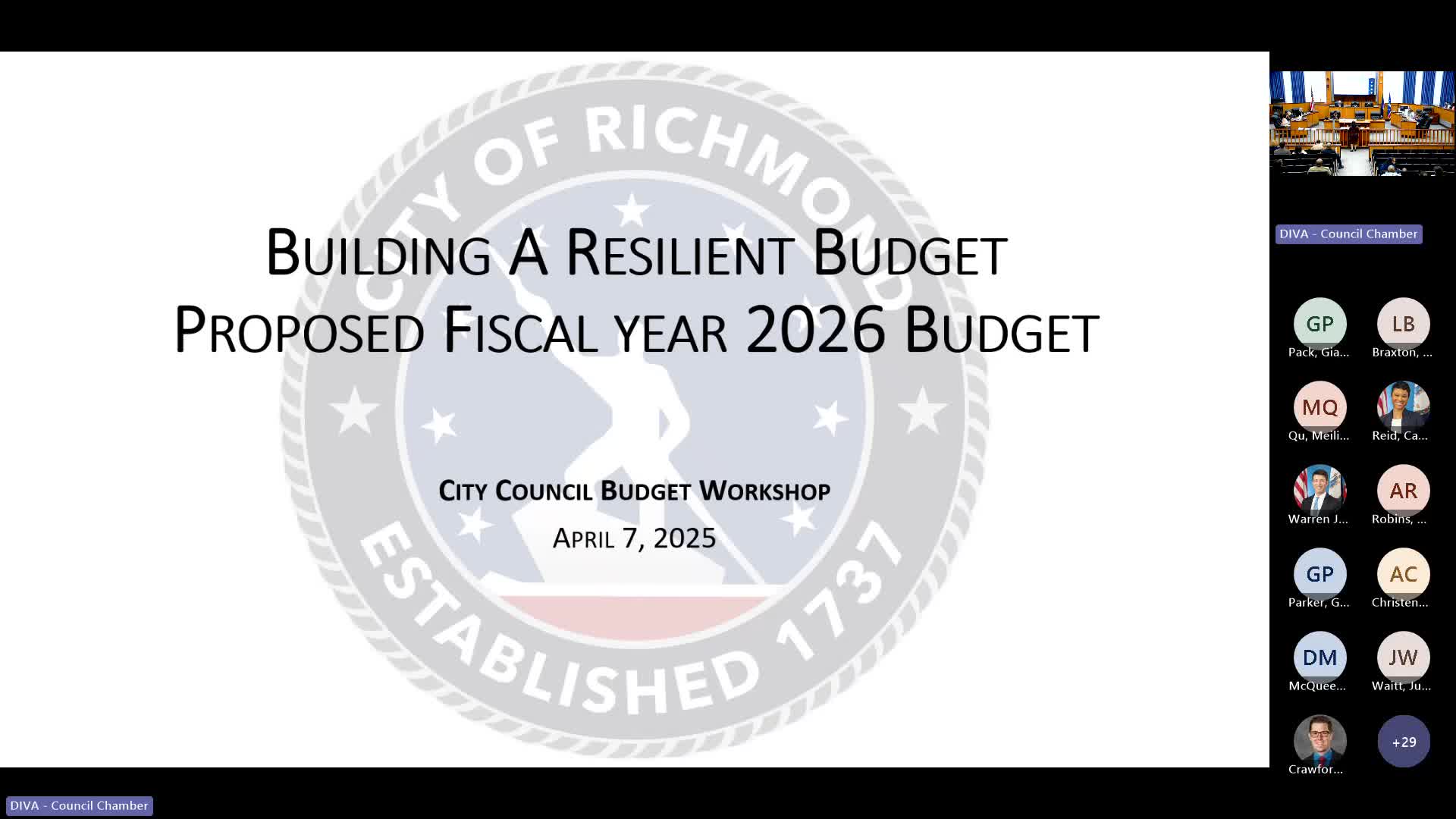
Mayor Avila’s administration on Monday presented its proposed fiscal year 2026 revenue and operating budget to the Richmond City Council, laying out a $1.1 billion general fund proposal and warning of a multi-year gap between revenues and expenditures that will make fiscal 2027 especially difficult without additional reserves or revenue.
Sabrina Joy Hogg, the city’s interim chief administrative officer, said the city’s budget “is a budget built on resiliency,” and walked council members through a five‑year revenue forecast, the effects of a recently adopted assessment‑cycle change, and key operating and personnel drivers in the mayor’s proposal.
The administration framed the budget as constrained but forward‑looking: general fund revenues are projected to increase by $54.6 million (about 5.5%), producing a $1.1 billion general fund. That growth is driven mainly by real estate tax revenue (about $41.3 million, roughly 76% of the increase). The proposed budget packages a 3.25% across‑the‑board pay increase for general employees, a 3% increase for constitutional officers, and an average 10.3% increase for sworn police and firefighter employees; personnel changes account for about $37.9 million of the revenue growth.
Why this matters: Hogg told council that an alignment of the city’s property assessment cycle with the fiscal year will produce an “assessment freeze” effect in 2027 because the 2026 land book values will also be used for 2027 tax bills. The administration said that 1 penny on the real estate tax rate equals roughly $4.2 million in general fund revenue, and urged a combined strategy of raising revenue, increasing efficiency, and reducing expenditures to manage the forecasted gap.
Key budget details and proposals
- Aggregate size: The administration described the FY2026 all‑funds budget as roughly $3.0 billion (about $2.6 billion net of transfers). The general fund proposal is $1.1 billion.
- Revenue mix and drivers: Real property taxes remain the largest general fund source (about 57% of the general fund). Other local taxes, state and federal funding, and charges for services were discussed; meals, lodging, business license and charges for services are projected to grow at modest rates in the coming year.
- Assessment‑cycle change: Hogg explained that the city realigned its reassessment calendar so the 2026 reassessment will be used for both tax years 2026 and 2027, creating a biennial assessment period and leaving little projected incremental real‑estate revenue for FY2027 unless reserves or offsets are available.
- Personnel and compensation: Personnel costs account for the majority of the budget’s growth. The budget assumes a 3.25% raise for general employees (the administration said this reflects collective bargaining agreements), a 3% increase for constitutional officers, and an average 10.3% increase for sworn police officers and firefighters (the latter figure includes a step increase and a market adjustment calculation). The budget also continues a $20 minimum hourly wage and ongoing employer health‑care and retirement cost increases.
- Public safety: The budget folds 72 firefighter positions previously supported by a FEMA SAFER grant into the general fund at an estimated $6.6 million annual cost. Hogg said Department of Emergency Communications and Preparedness personnel previously funded by a telecom fee are moved to the general fund because fee revenue no longer covers salary increases.
- Schools and partner agencies: The proposal includes a $9.6 million increase in the city’s local contribution to Richmond Public Schools (RPS). Hogg said the city’s local contribution is about $249 million—roughly $76 million (44%) above the state’s required local effort under the SOQ model. The administration proposed reducing contributions to outside partner agencies (formerly “charitable organizations”) by about $4.1 million for FY2026 while redesigning contracting and oversight processes.
- Housing and homelessness: The proposed budget includes more than $49 million in housing services, continued funding for eviction diversion (including $800,000 for the eviction diversion program and $500,000 for preventative eviction services), an additional $7.9 million for the Creighton Court redevelopment project, and the third installment of a $10 million capital investment for affordable housing. Hogg said the city expects approximately $14 million in HUD formula funding for FY2026.
- Utilities and fees: The budget proposes modest fee increases for solid waste (about $1/month per household), recycling, parking (monthly and hourly rates), and utility rate adjustments intended to support capital investments in gas, water, wastewater and stormwater systems. The administration estimated average utility increases of $12.83 per month.
Council response: process and transparency concerns
Several council members praised the staff work but pressed the administration for more time, clearer documentation, and more accessible data so the council can evaluate priorities and tradeoffs.
Councilmember Gibson said she was “frustrated” that a large packet of answers to council questions arrived late, leaving little time to review a voluminous budget document. Gibson asked that future presentations occur earlier in the calendar, that documents and Q&A be posted to the public record promptly, and that trend and contract data be made accessible through the city’s data portal.
Councilmember Aberbacher asked whether the city faces a “budget crisis or a budget cliff” in 2027; Hogg responded that FY2027 will be “tough” if current revenue and expense trends continue and that the city should be setting aside funds now to cover that transition. Multiple council members urged the administration to identify possible 1% savings and to return with detailed program metrics so council can compare programmatic outcomes to personnel and operating cost increases.
Operational follow‑ups and next steps
Council and administration agreed on these immediate next steps: departments will provide requested follow‑up data to individual council members (the administration and council staff will compile and deliver a question list to staff), and an additional budget work session(s) will be scheduled to allow more time to review responses and deliberations before the May 15 budget adoption deadline. Hogg and budget staff committed to provide the specific line‑item and program information requested by council, including details on the items cited in the presentation (personnel changes, the $5 million IT operating increase, the $4.6 million identified departmental reductions, and the composition of federal funding included in the budget).
What the presentation did not decide
No final votes were taken during the work session. The council did not adopt changes to the proposed budget; formal adoption remains subject to future meetings and any amendments the council chooses to make by the May 15 deadline (the city may separate the school vote if necessary to meet adoption timelines).
Selected quotes
“This year’s budget is a budget built on resiliency,” said Sabrina Joy Hogg, interim chief administrative officer.
“I’m frustrated… I planned on asking questions. Then I go to work this morning, and I find out that at 8:00 last night some questions were answered,” said Councilmember Gibson, describing concerns about late delivery of requested materials.
“The assessment freeze for 2027 means we should be putting away money now,” Hogg told the council.
Ending
Council members and staff agreed to continue detailed follow‑up work: the administration will provide the requested line‑item and program detail, procurement and finance staff will supply contract and revenue‑trend data, and the council will schedule additional sessions to review the materials. Adoption of the FY2026 budget remains pending council action before or by the May 15 statutory deadline.