Get Full Government Meeting Transcripts, Videos, & Alerts Forever!
Get email alerts on the Outdoor Lighting topic
No spam. Unsubscribe anytime.
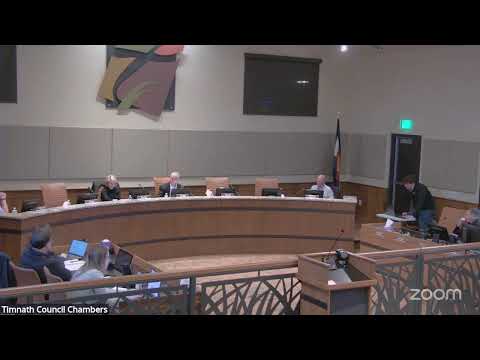
Timnath planning commission approves outdoor lighting code update, asks staff to add agricultural exemption language
Summary
The Planning Commission voted 4-0 to approve a land-use code amendment to update outdoor lighting standards with dark‑sky principles, motion‑sensing and dimming provisions and warmer color temperatures, conditional on staff returning with clarified language addressing agricultural lighting.
The Timnath Planning Commission on a 4-0 vote approved an amendment to the town's land use code that tightens outdoor lighting rules to reduce light pollution, require shielding, limit blue‑rich “cool” lighting and encourage motion sensors and automatic dimming for nonessential fixtures, with a condition that staff return with a clear provision addressing agricultural lighting.
Staff presented the code changes as a modernization intended to “comply with dark‑sky standards while ensuring public safety, functionality of commercial and residential outdoor lighting systems, and improving visual comfort,” saying the update would require fully shielded outdoor fixtures in most cases, encourage warmer color temperatures (about 2,700–3,000 Kelvin) and add motion sensors and automatic dimming for parking and business lights after hours.
The commission heard public comment in favor of the draft from John Garvey, chair of Dark Sky Colorado, who praised staff work and said the proposal is “an economic win, a public health win, a quality of life win, an ecological win, and even a public safety win.” Garvey also cautioned that an exemption for the public right‑of‑way and a 90‑degree cutoff allowance could undermine some of the proposed protections and recommended tightening those items.
Commissioners and staff discussed enforcement limits for existing private holiday and decorative lighting, possible amortization or replacement schedules tied to maintenance cycles, and special‑use lighting such as ballpark or stadium fixtures. Staff said the amendment would provide a clearer seasonal definition for holiday lighting and that enforcement of many private situations would be complaint‑driven; code enforcement would primarily rely on light‑trespass complaints for preexisting private fixtures because inspectors cannot routinely enter private property.
Staff described ongoing technical work: a public feedback session on March 5; a consultant‑assisted feasibility study of town‑owned fixtures; and a separate review of the town’s 10‑criteria manual that governs street and public lighting. Staff said an inventory found more than 500 fixtures already at about 4,000 K and that the town will present a budget request to the Town Council for sample LED conversions downtown.
On specific technical points, the amendment as presented would: - Require fully shielded fixtures except for a small number of specified exceptions. - Favor warmer color temperatures (approximately 2,700–3,000 K) and limit high‑Kelvin (blue‑rich) lighting. - Require motion sensors for security lights and automatic dimming for parking and business lights after hours. - Add clearer language on holiday/seasonal lighting (enforceable on complaint) and allow for amortization/replacement through normal maintenance rather than immediate retrofit requirements. - Continue to allow limited exemptions but direct staff to return with clarified language on agriculture.
Commission debate focused on how the new dark‑sky language aligns with the town’s comprehensive plan, practical enforcement and cost. Commissioners asked staff whether existing town‑owned or utility‑owned lights can be converted easily; staff said many downtown fixtures appear convertible and conversion costs will be part of the feasibility study. The commission asked staff to return with clarified agricultural lighting language at a future meeting; staff proposed returning with that clarification by mid‑April.
After deliberation, a commissioner moved to approve the land‑use code amendment for outdoor lighting “with the condition to add a provision regarding agriculture, subject to approval that comes before us.” The motion was seconded and carried on a 4‑0 vote.
What the action does and does not do: The approval adopts the updated standards and gives staff direction to refine agricultural exemptions and related language. It does not itself adopt any budgetary appropriation for fixture replacement; staff said conversion and cost estimates will be presented separately. Staff also said previously approved plats and projects will remain subject to prior approvals and that the new rules would apply to new plats and future development reviews as written unless otherwise specified in a subsequent amendment.
Commissioners and staff said public safety remains the primary goal of any lighting standard; the amendment is intended to balance safety and visibility with reduced glare, skyglow and ecological impacts.