Get Full Government Meeting Transcripts, Videos, & Alerts Forever!
Get email alerts on the Statelegislation topic
No spam. Unsubscribe anytime.
Senate State Agencies committee advances several measures, rejects wrestling reinstatement
Summary
The Senate State Agencies & Governmental Affairs Committee passed a slate of election, procurement and administrative measures — and rejected a high‑profile bill to return professional wrestling to the state athletic commission — after hours of testimony and debate.
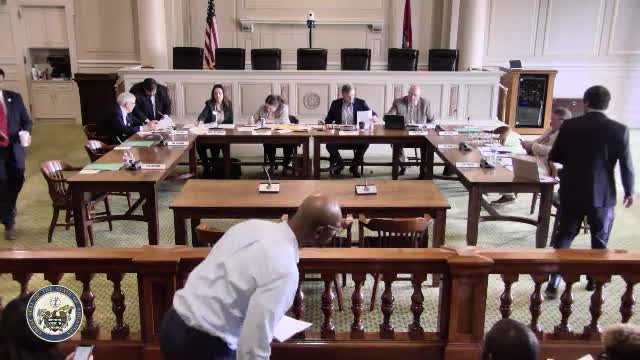
The Senate State Agencies & Governmental Affairs Committee met for a lengthy hearing that produced a mix of unanimous voice votes and a high-profile defeat.
Representative David Ray, introducing House Joint Resolution 1018, told the committee the proposed constitutional amendment “would ensure that only United States citizens citizens can vote in our state and local elections,” saying the change would make eligible-voter language “absolute, exclusive and unambiguous.” The committee passed the resolution by voice vote.
The committee also approved a set of bills ranging from procurement changes for Arkansas State Parks to new requirements for absentee ballots. Lawmakers debated and defeated a contentious measure to return professional wrestling to the state athletic commission’s regulatory authority after extended discussion about public-safety inspections, fees and whether the change primarily addresses a budget shortfall at the commission.
Why it matters: several measures adopted by the committee would change how state and local governments buy services, manage elections and staff certain boards. One defeated bill — to reauthorize sanctioning of professional wrestling for larger events — drew sustained attention because proponents said it would restore a revenue source for the Arkansas Athletic Commission and opponents feared new fees and regulatory reach.
What the committee did (Votes at a glance) - HCR 1018 (House joint resolution) — Constitutional amendment to specify that only U.S. citizens may vote in Arkansas elections. Outcome: Passed (voice vote). Sponsor: Representative David Ray. Action: Motion to pass by Senator Payton; second by Senator Sullivan.
- HB 1524 — Amendment to procurement/finance code to exempt certain Arkansas State Parks maintenance projects from architectural and engineering design requirements up to $150,000 (was $50,000). Outcome: Passed as amended (voice vote). Sponsor: Senator Gilmore. Agency witnesses: Jeff King, deputy director, Division of State Parks; Mike Wilson, assistant director, Arkansas State Parks.
- HB 1925 — Changes to absentee/ballot statutes: requires a witness age 18+ for absentee ballots with enumerated exceptions for military and hardship voters and adds a sworn attestation in the ballot affidavit. Outcome: Passed (voice vote). Sponsor: Senator Gilmore (running Secretary of State bill).
- HB 1952 — Proposal to return professional wrestling to the Arkansas Athletic Commission for events above a 1,500-attendee threshold and to allow the commission to set fees and inspector rates to cover costs. Outcome: Failed (committee voice vote after extended debate). Sponsor: Representative (Senate floor sponsor was identified in committee as Representative Jonathan Duffield in discussion). Key debate: supporters said reinstating sanctioning helps the commission recoup inspector and travel costs and preserves the possibility of large events (WWE) in Arkansas; opponents called the measure a de facto fee increase and expressed concern about applying a regulatory model intended for combative sports to what some lawmakers characterized as an entertainment industry.
- SB 640 (as reported in committee) — Reconstitution of the State Library Board with staggered gubernatorial appointments subject to confirmation. Outcome: Passed (voice vote). Sponsor: Senator Jonathan Dismang (identified in committee as Senator Dismaine in the transcript). Committee discussion focused on perceived dysfunction on the existing board and the policy choice to reappoint a new board by the governor.
- HB 1706 — Prohibits ranked-choice voting in Arkansas jurisdictions. Outcome: Passed (voice vote). Sponsor: Senator Jim Dodson (running H.B. 1706 in committee). The secretary of state's office representative testified that Arkansas law already effectively prohibits ranked-choice in local elections; the bill was described as clarifying and pre-emptive.
- HB 1846 (listed in committee as the bicentennial task force bill) — Creates a voluntary, unpaid bicentennial planning task force appointed by the governor, the presiding officers of the legislature and designated state agencies to explore statewide bicentennial commemorations. Outcome: Passed (voice vote). Sponsor: Representative Jay Meeks.
- HB 1683 (House Bill 16-83) — Prohibits procurement of electric vehicles or components manufactured using forced labor; defines forced labor and sets compliance expectations for state purchases. Outcome: Passed (voice vote). Sponsor: Representative Mindy McLendon. Committee discussion centered on definitions and enforcement mechanics; the sponsor described the measure as a “lead-by-example” procurement standard.
- HB 1739 (House Bill 17-39, e‑signature clarification) — Technical update aligning state e‑signature law with federal electronic signature preemption language; committee was advised this matches existing Arkansas e‑signature statute and federal requirements. Outcome: Passed (voice vote). Sponsor: (House sponsor presented by Representative Matt Brown standing in for the bill author).
Highlights from debate - Parks procurement (HB 1524). Jeff King, deputy director for the Division of State Parks, told the committee the amendment “reduces the impact of this bill down to, essentially a cleanup bill from 2023,” and explained the change adds the last code reference so maintenance projects will not be treated as capital improvements requiring costly A&E designs. Committee members pressed about the existing threshold ($50,000) and the amendment raises that exclusion to $150,000 while retaining procurement notice, bid procedures and advertisement requirements.
- Wrestling bill (HB 1952). County officials and athletic commission advocates said sanctioning brings inspectors, safety protocols and an inspector fee model that can reduce promoter insurance costs; proponents cited a prior sanctioned WWE event that reportedly generated about $40,000 for the commission with roughly 8,500 attendees. Opponents raised concerns the change looked like a targeted revenue stream for a fee‑short commission and worried about imposing requirements on small-town promoters. The bill set a 1,500‑attendee threshold to exclude many small, local events from the sanctioning requirement; after prolonged discussion the committee voted the measure down.
- Ranked choice ban (HB 1706). Committee members asked why the legislature should preempt possible local or municipal adoption; supporters said Arkansas law and municipal voting rules already result in majority or runoff requirements, and the bill clarifies the point to avoid local experimentation with ranked choice.
What the committee did not decide - Several bills were amended and advanced without roll-call tallies; committee action was recorded as voice votes with motion and second attributions. Where a formal vote tally was not recorded in the transcript, the committee used standard voice‑vote procedure and the transcript captures the motion, the mover and the seconder, and the committee chair’s announcement of the outcome.
Context and next steps - Passed measures will be reported out of committee for further floor consideration where required (house-concurred resolutions and constitutional amendments have additional procedural steps). The professional wrestling bill’s defeat leaves in place the current statutory structure under which many combative-sports events remain outside athletic‑commission sanctioning; supporters said absence of commission authority has required general revenue supplements to cover commission costs.
Ending note: committee members raised repeated procedural and statutory clarifications during the hearing — on procurement thresholds, enrollment and affidavit language for absentee ballots, and the mechanics of preventing foreign influence or forced-labor‑tainted supply chains in state purchases — and several bills were advanced with amendments intended to address those concerns.