Get Full Government Meeting Transcripts, Videos, & Alerts Forever!
Get email alerts on the School Safety Protests topic
No spam. Unsubscribe anytime.
Council debates time‑place‑manner limits after residents raise safety concerns about protests near Lafayette Elementary
Summary
City staff and police briefed the council on protests near Lafayette Elementary and Stanley Middle School; the city attorney advised narrow, content‑neutral time/place/manner restrictions are constitutionally required, police provided response statistics, and council directed follow‑up on safety data, ordinance research and stepped‑up patrols.
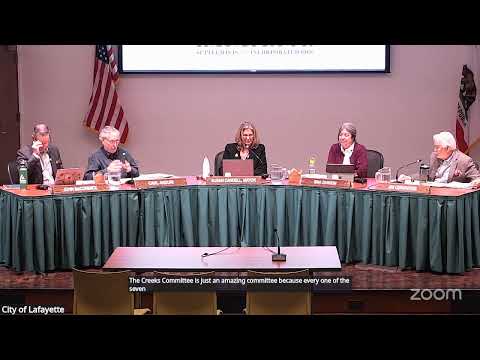
City staff, the city attorney and the Lafayette Police Department briefed the City Council on April 14 about protests that have occurred near Lafayette Elementary School and Stanley Middle School during morning pickup and drop‑off periods. The session included several hours of public comment, police statistics, legal analysis and council direction to gather more safety data and research other municipalities’ approaches.
City Attorney Mall (surname in record) framed the legal constraints, telling the council that local rules must be “content neutral” and satisfy the time, place and manner test. Mall said the city’s potential regulations must be “narrowly tailored to serve the city's significant interest in ensuring safety and convenience of the community members that are using the public forum,” and must “leave open alternative channels for the message to be communicated.” Mall advised caution about broad protest‑free zones and said a bubble‑zone ordinance modeled on the Supreme Court’s health‑care‑facility precedent has been adopted in San Diego but is subject to litigation.
Police Chief James Williams provided enforcement context and statistics. “The police department received about 170 phone calls for service in the vicinity of Lafayette Elementary School … over the last year. … Only 30 were related to protest‑related calls for service. Only 3 of them happened this year in March, none of which generated a police report,” Williams said. He added that of the calls logged the prior year most occurred in March and April and that three incidents generated police reports, including a battery and a theft.
Residents, school staff and volunteers described safety concerns during public comment. A crossing guard at Brook Street and Moraga Road told the council she has witnessed distracted drivers, people using phones to take pictures and drivers slowing to engage with protesters, and described the intersection as “very unsafe and dangerous.” Several parents and residents said signs and protesters have forced pedestrians to step into the street and that children and parents have been videotaped without consent. Speakers on both sides of the protest described verbal encounters and cited anxieties over content and safety.
A petition delivered to the council asked the city to “create a citywide ordinance that 1) establishes a protest free zone extending 2 blocks in all directions from any school and 2) enforces this zone 1 hour before and 1 hour after school starts and ends.” Petition organizers reported 387 signatures at the time they presented it to the council.
Councilmembers asked detailed questions about legal precedents and alternatives. Vice Mayor Enduring and others asked whether the San Diego approach — which bans approaching a person within an eight‑foot radius without consent while otherwise allowing stationary signage — would be applicable. Mall said San Diego’s ordinance is being litigated and counseled observing those legal developments before adopting a similar local law. Multiple councilmembers said they want to protect students but also avoid a litigation‑risk approach that could be costly for the city.
After public comment the council gave staff several follow‑up directions: 1) ask the police department to gather and report more systematic safety data for school drop‑off and pick‑up periods (including a request for intermittent observational patrols), 2) direct the city attorney to research buffer and bubble‑zone ordinances adopted elsewhere and advise on narrow, defensible options, and 3) request increased patrols during drop‑off and pickup periods to the extent staffing permits. The police chief said he would ask officers to increase patrol visibility at the school during those peak times.
No ordinance was introduced or adopted at the meeting. City staff said they will return with the requested data and legal assessment so the council can consider whether a narrowly tailored, content‑neutral restriction is feasible and defensible under federal law.