Get Full Government Meeting Transcripts, Videos, & Alerts Forever!
Get email alerts on the Public Safety Enforcement topic
No spam. Unsubscribe anytime.
SFPD says Market/Van Ness operation disrupted large open-air drug market; 41 arrested
Summary
Police Chief William Scott updated the Police Commission on crime trends and a large Market/Van Ness enforcement operation that led to 41 arrests and numerous citations. Commissioners and community groups discussed coordination with the district attorney, public health and other agencies.
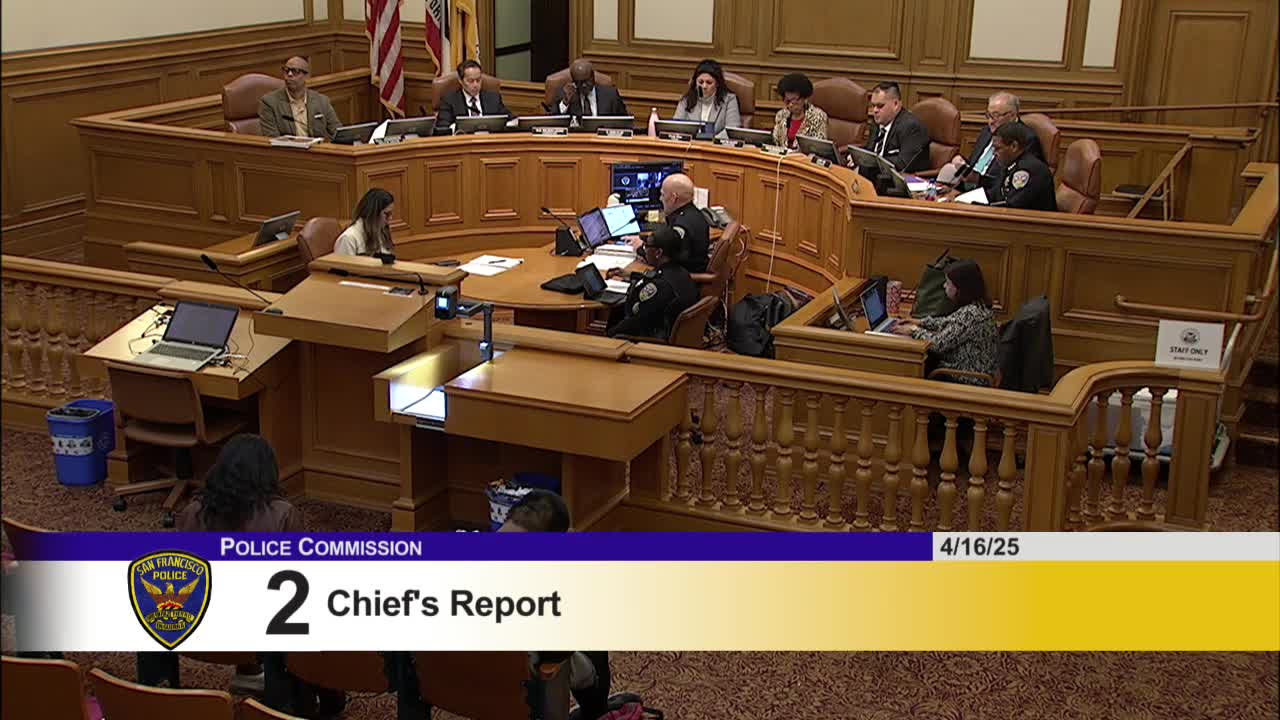
SAN FRANCISCO — The San Francisco Police Department told the Police Commission on April 16 that a recent large enforcement operation at Market and Van Ness arrested 41 people and seized drug paraphernalia as part of broader efforts to disrupt open-air drug markets.
SFPD Chief William Scott gave the report and said the department remains “down 30% in part 1 crimes,” with violent crime down about 15% and property crime down about 32% compared with the same time last year. Scott said the Market/Van Ness operation followed several days of surveillance and drone footage showing “people slumped over” and what officers believed were open drug transactions. He said officers counted in excess of 90 people at the site and arrested 41 of them.
The department’s use of a concentrated enforcement response seeks to make a visible change in locations that have persistent drug activity. “There were in excess of of 90 people out there. 41 of them were arrested,” Scott said. He added that many arrestees either had open warrants or were found with narcotics paraphernalia.
Commissioners pressed the department about whether the SFPD coordinates sufficiently with the San Francisco District Attorney’s office to increase the likelihood that arrests result in charges. Scott said the standards differ: officers arrest based on reasonable suspicion and probable cause, while the DA evaluates whether a case can be proved beyond a reasonable doubt. He said the department has been meeting with DA staff and that some recent smaller operations produced charges.
Why it matters: Commission members, neighborhood business groups and community benefit districts said large-scale actions are one tool to clear locations where drug dealing and open use make sidewalks unsafe for residents, commuters and merchants. Several public commenters representing the Civic Center Community Benefit District and the Tenderloin Community Benefit District urged continued DMACC (Drug Market Abatement and Coordination) operations and multiagency responses.
What the department reported
- Arrests and evidence: Scott said 41 arrests were made during the Market/Van Ness operation; he counted roughly 90 people in drone footage. The operation yielded narcotics paraphernalia, medical interventions for people at risk of overdose, and several people with outstanding warrants. SFPD noted that officers deployed with narcotics units, district officers and a motorcycle unit, and that fire department paramedics were present because some people required medical assistance.
- Crime trends: Scott said the department is seeing five homicides for the year compared with nine at the same point last year, and that shooting incidents were up (28 this year compared with 23 last year). He said weapons seizures for 2025 total 312, including 41 ghost guns.
- Tactics and technology: Scott described pre-operation surveillance, drone footage, and body-worn cameras as tools used to identify suspected dealers and people under the influence. He said drone footage showed “furtive transactions” and people who appeared to be under the influence.
Community reaction and next steps
Representatives from the Civic Center Community Benefit District and the Tenderloin Community Benefit District spoke in favor of the operations, saying the actions disrupted visible drug markets and improved conditions for residents, merchants and school groups. Kalen McEldowney, head of security for the Asian Art Museum, said the area around the museum has become more walkable as the multiagency approach has taken effect.
Commissioners asked the department to continue working with the DA and public health partners to reduce the cycle of arrests and rapid returns to the street. Scott said the department will keep refining protocols, surveillance use and evidence collection so it can provide prosecutors with what they need to charge cases when appropriate.
Ending note: Commissioners and the chief agreed the operations are resource intensive and must balance enforcement with medical and social-service responses. Several commissioners suggested environmental fixes — brighter lighting, music or sanctioned programming — as complementary strategies to reduce drug market activity and stabilize public spaces.