Get Full Government Meeting Transcripts, Videos, & Alerts Forever!
Get email alerts on the Zoning Live Work Definition topic
No spam. Unsubscribe anytime.
Planning commission discusses live-work definition, council moratorium and next steps
Summary
At the April 16 work session, the Planning Commission discussed staff’s draft definition of "live work" after a city-council moratorium and asked staff to return with a revised ordinance approach at the May work session.
At the April 16, 2025 work session the Cottonwood Heights Planning Commission discussed a staff-proposed definition and administrative approach to "live work" units after the city council adopted a moratorium on new live-work approvals.
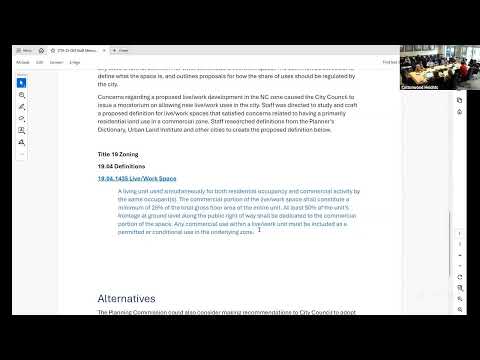
Staff said the council placed a moratorium on live-work land-use approvals on Feb. 18, 2025, and directed staff to draft a codified definition. Staff presented a working definition that would require the commercial portion of a live-work unit to constitute at least 25% of the unit’s gross floor area and for at least 50% of the unit’s ground-level frontage along the public right of way to be dedicated to commercial activity. Staff also said the commercial portion must be an allowed nonresidential use in the underlying zone. Alternatives discussed included setting a hard minimum square footage for commercial space (staff cited a figure near 350 square feet as a possible example), restricting or removing live work from certain zones, and treating the commercial requirement as a development standard rather than a definition.
Commissioners and staff reviewed a map showing that "neighborhood commercial" zoning where live work is presently listed is limited to small pockets across the city, including corridors along Fort Union Boulevard, parts of Highland Drive and a small town-center parcel. Staff noted mixed-use developments elsewhere in the city had previously used live-work language to meet mixed-use goals (examples cited in discussion included Union Lofts and other mixed-use projects). Commissioners emphasized the city’s broader neighborhood-node and form-based-code goals and said the definition should preserve visible, ground-level commercial activity to support walkable neighborhood centers.
Several commissioners raised legal and administrative concerns about handling live work as a conditional use. A speaker summarized guidance from the Utah League of Cities and Towns that conditional uses must be tied to ordinance standards and that courts review conditional-use decisions as administrative acts, limiting political discretion; commissioners discussed whether development standards (for example, a required percentage of commercial floor area or required ground-level frontage) belong in the zoning development standards rather than the dictionary definition of "live work." Several commissioners also noted potential loopholes in existing code language — for example, home office and home-based uses — and suggested staff consider consolidating or clarifying overlapping residential/commercial uses so live-work rules cannot be easily circumvented.
Staff and commissioners agreed more work was needed. The commission asked staff to refine a consolidated residential/mixed-use land-use category (likely to remain called live work for drafting purposes), move percentage requirements into development standards where appropriate, and evaluate which ancillary residential home-based uses should be adjusted to avoid loopholes. The commission directed staff to return with revised language at the May work session and to be prepared to finalize recommendations to the city council before the moratorium expires (six months from Feb. 18, 2025, i.e., on or about Aug. 18, 2025). No formal vote to change code was taken at the April 16 meeting.