Get Full Government Meeting Transcripts, Videos, & Alerts Forever!
Get email alerts on the Workforce Training topic
No spam. Unsubscribe anytime.
Austin Water outlines staffing progress, training expansion and an apprenticeship-style TAP program
Summary
Austin Water presented progress on reducing vacancy rates, new operational training capacity, and a TAP (training-apprenticeship program) aimed at recruiting young adults into water operations with an eight-week academy and temporary placement opportunities.
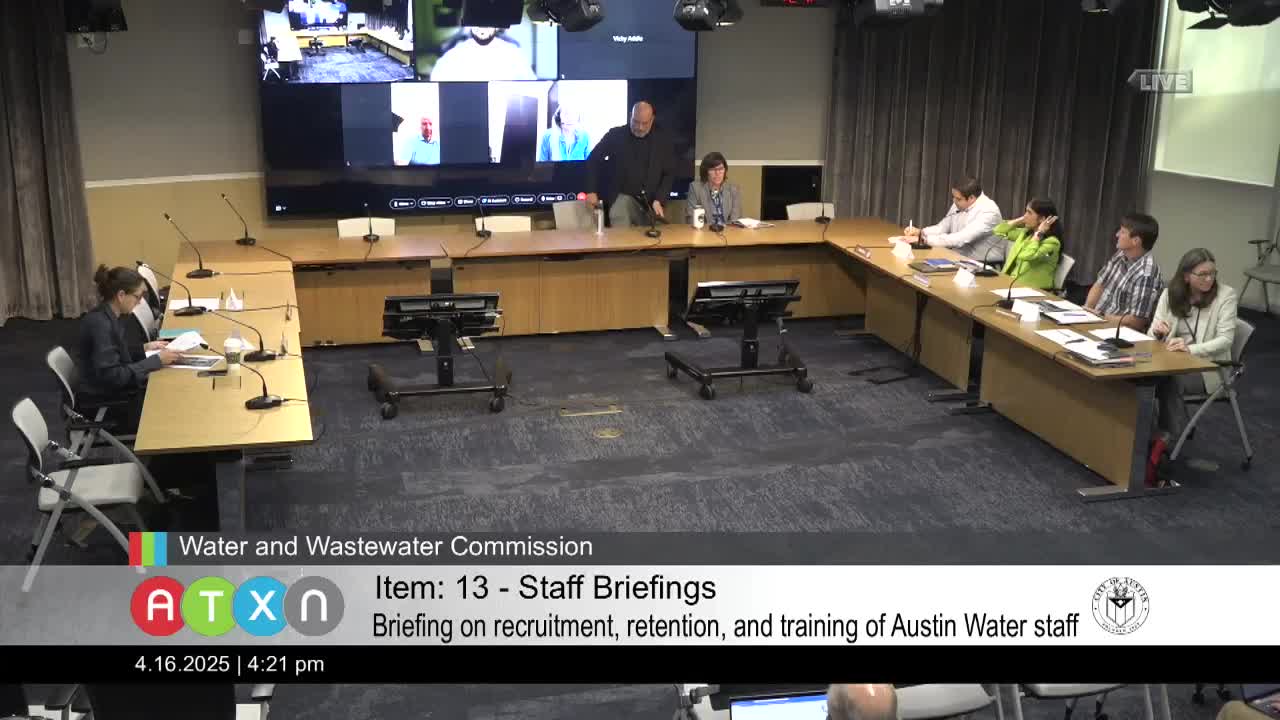
Austin Water staff briefed the Water and Wastewater Commission on April 16 about progress in recruitment, retention and training, including a new operational training division and a pilot TAP (training-academy program) that aims to recruit and train young adults for water-operations roles.
Shay Rolston, Austin Water director, introduced the briefing and Israel Custodio, interim assistant director of employee leadership development, presented staffing and training metrics. Custodio said Austin Water employs about 1,400 people and is aiming to fill roughly 100 positions before the end of the fiscal year. He highlighted a decline in the utility's vacancy rate from a post-pandemic peak (14.56%) to about 8.16% and said that the utility's median time-to-fill approaches industry averages.
Custodio described the creation of an operational training division that consolidates existing training units, increases cross-training depth, and expands onboarding. He said the division will grow a trainer-led onboarding program that began with three trainers at water treatment plants and will extend training across water, wastewater and distribution operations. Custodio explained the use of knowledge-transfer "KMKT blocks" for hands-on learning and retention.
On recruitment, staff discussed the TAP program in partnership with local partners (transcript references coordination with "Seth and Texas AEWA"). Custodio described the TAP program as an eight-week academy for high-school seniors and young adults, intended to produce candidates who can obtain a D operator license; "we will pay them, to attend an 8 week program," he said. Custodio said the initial target was about 20 spots and Austin Water received more than 100 applications; staff said they plan to start the pilot in June and expect to offer temporary employment to graduates, with up to a year of temporary placement to help transition successful participants into full-time roles.
Commissioners asked about career pathways and whether employees are shown promotion routes. Custodio said some job families have defined progression; staff aim to expand career-path communications across the organization so employees understand opportunities beyond their immediate facility. Staff also noted a 22% reduction in voluntary resignations in 2024 compared with prior years.
Why it matters: Austin Water faces industry-wide recruitment and retention challenges. The training and TAP efforts are intended to build pipeline capacity, retain institutional knowledge and produce licensed operators who can stabilize service delivery for water and wastewater systems.
Next steps: Staff will begin the TAP pilot in June, continue to fill current vacancies, and expand the operational training division. Staff said they will report back on the TAP program's early outcomes.