Get Full Government Meeting Transcripts, Videos, & Alerts Forever!
Get email alerts on the Outdoor Dining Nightlife Zoning topic
No spam. Unsubscribe anytime.
Supervisors allow extended hours for Casements patio with required sound‑mitigation and deadlines
Summary
The Board of Supervisors granted an appeal by Casements bar to extend its outdoor patio hours — from the Planning Commission’s 10 p.m. limit to 11 p.m. Sunday–Thursday and midnight Friday–Saturday — provided the owners install specific sound‑mitigation measures by set deadlines and obtain any required permits.
San Francisco — The Board of Supervisors on April 2 approved an appeal by Casements, a Mission Street bar and restaurant, to operate its outdoor patio later than the Planning Commission allowed, provided the business implements a three‑part sound‑mitigation plan and meets permit and construction deadlines.
Supervisor Ronan moved to reverse the Planning Commission’s January decision and approve the conditional use authorization with amended hours; Supervisor Mandelmann seconded. The board voted to table the motion to affirm the commission’s decision and approved the board motion to grant the appeal as amended and to direct the preparation of findings. The action amends the commission's condition that the patio close at 10 p.m., allowing operations until 11 p.m. Sunday through Thursday and midnight on Fridays and Saturdays, contingent on mitigation steps and a permit timeline.
The amendment requires Casements to implement three mitigation measures recommended by an acoustic consultant: increase the height of the surrounding wall and address sound transmission; add sound‑absorbing materials inside the patio; and reconfigure the sound system (bandwidth limiting, a limiter, and re‑aiming speakers) so sound is directed inward. The owners must file complete permit applications for any physical alterations by July 1, 2024, and install the higher fencing and other mitigation by Jan. 1, 2025. If the mitigation is not installed by that date, the patio hours automatically revert to the 9 a.m.–10 p.m. schedule until the work is completed.
"These sound mitigation measures will make a difference to the neighborhood," Supervisor Ronan said when she offered the amended motion. "I believe these owners have shown they intend to operate in good faith and are trusted community partners."
Owners and business representatives told the board that the 10 p.m. curfew imposed by the Planning Commission amounted to a steep financial hit. Sean Donovan, identified in the hearing as one of Casements' owners, said the curfew resulted in a 30.6% drop in sales after 10 p.m., and that weekend late‑night sales fell by more than two‑thirds. "This 10 p.m. closure really puts the future of our business — makes it uncertain," Donovan said.
Chris Hastings, another co‑owner, told supervisors that the nine additional hours they requested would recoup roughly 92% of the lost sales and prevent staff reductions. "These additional 9 hours are literally the difference between profitability and losing money," Hastings said, citing data showing a nearly 19% decline in tips and an 18% reduction in staff hours since the 10 p.m. rule.
The Planning Department recommended upholding the commission's 10 p.m. restriction. "While promoting small business is indeed a priority, the commission must weigh this against the welfare of the surrounding community," Aaron Starr, manager of legislative affairs at the Planning Department, told the board. Starr said the department concluded that the site's physical characteristics and proximity to residences supported the 10 p.m. limit.
A sound consultant who tested the site at the department's request told the board that measured sound at a nearest corner rose by 4 decibels above ambient when the bar's house system was at full volume — half the 8 dB level the Entertainment Commission recommends as an acceptable threshold. The consultant recommended the three mitigation steps that the board incorporated into its conditions.
Neighbors and residents offered sharply divided testimony. Many Mission District residents and neighborhood business owners described Casements as a community asset, crediting the patio with providing an inclusive, visible, safe gathering place that helped the business and surrounding corridor recover after the pandemic. Several city and nightlife advocates, including Tom Temprano and Ben Blyman of the Entertainment Commission, urged supervisors to support the appeal.
Opposing speakers — including at least one resident who said she has lived across the parking lot for more than 60 years — said noise from patrons, amplified sound and late‑night yelling carried across the unbroken parking lot and harmed residents' sleep and quality of life. "I really do. However, when the music stops, the noise doesn't stop," one resident said. Several neighbors urged the board to keep the 10 p.m. restriction.
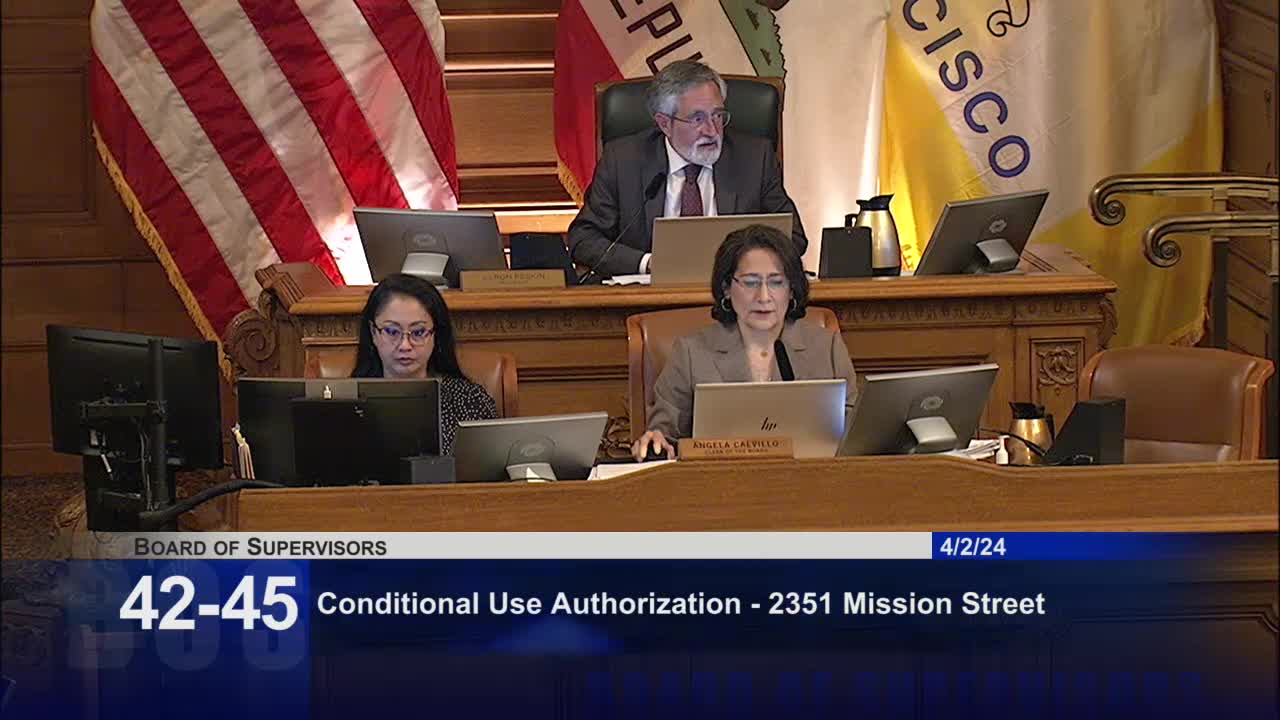
The board's action included administrative deadlines and a reversion provision to ensure the mitigation is completed within a specified period. The clerk recorded the item as: item 42–45 (2351 Mission Street conditional use authorization); the motion to disapprove the Planning Commission decision and approve the conditional use authorization was approved as amended; the Commission’s original approval motion was tabled. The planning department and the project sponsor were instructed to prepare findings consistent with the board's action.
The decision seeks to balance the economic viability of a small business that hosts neighborhood groups and nightlife with nearby residents’ complaints about late‑night noise. The board's vote allows Casements to continue operating while mandating physical and operational changes intended to limit sound transmission to adjacent homes.
City records and the planning file for 2351 Mission Street will reflect the board's amended conditions and the timelines for permits and construction. The board also directed that, should the mitigation not be installed by Jan. 1, 2025, the patio hours will revert to a 9 a.m.–10 p.m. schedule until the work is complete. The item requires the project sponsor to submit permit applications by July 1, 2024.
Casements' owners said they are willing to implement the mitigation steps and continue working with neighbors; several neighborhood supporters and arts and nightlife advocates urged the board to give the business a chance to remain viable. Planning staff said they will monitor permitting and compliance and report out as needed.
The hearing included dozens of public speakers on both sides; after motions were approved the board adjourned. The Planning Department and the Office of the Clerk will post the adopted findings and the finalized set of conditions to the planning file for 2351 Mission Street.