Get Full Government Meeting Transcripts, Videos, & Alerts Forever!
Get email alerts on the Chinatown Restaurant Relief topic
No spam. Unsubscribe anytime.
Board approves $1.9 million from COVID contingency reserve to aid Chinatown restaurants and food-service businesses
Summary
The San Francisco Board of Supervisors on Jan. 19 passed on first reading an ordinance appropriating $1,900,000 from the city—s COVID contingency reserve to the Human Services Agency to provide relief to restaurant and food-service businesses in Chinatown.
The San Francisco Board of Supervisors on Jan. 19 passed on first reading an ordinance appropriating $1,900,000 from the city—s COVID contingency reserve to the Human Services Agency to provide relief to restaurant and food-service businesses in Chinatown.
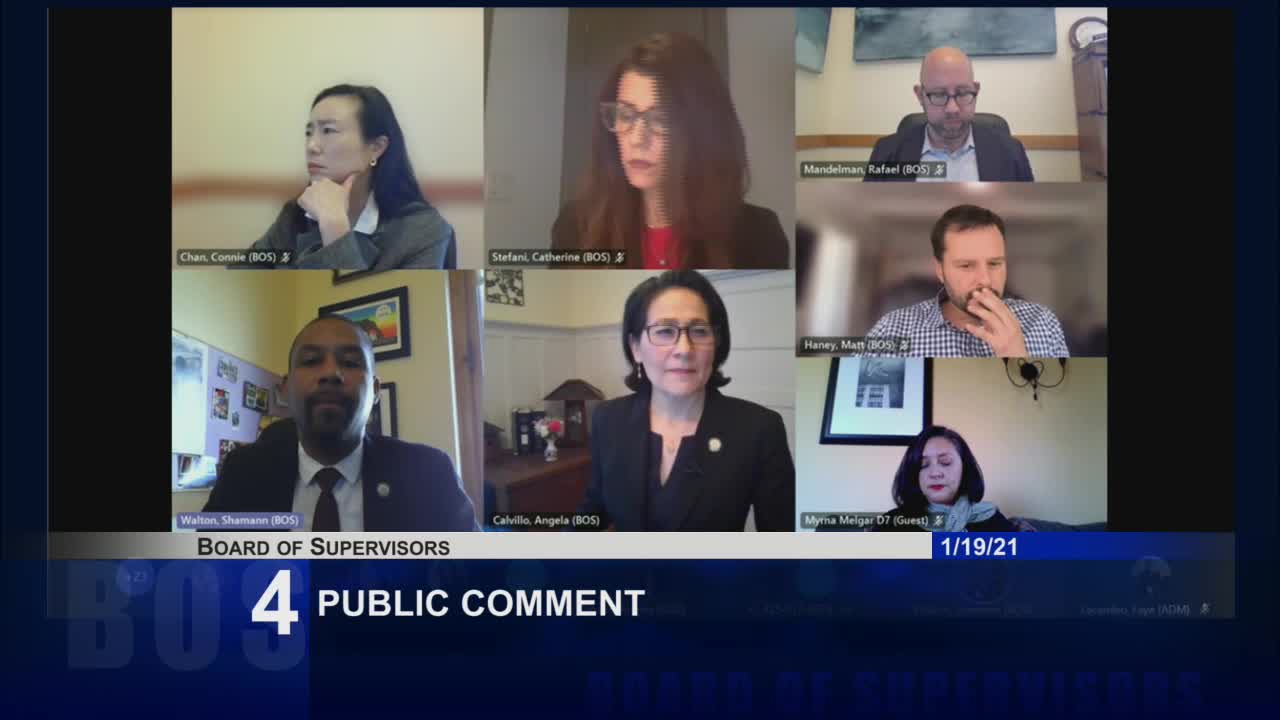
Supervisor Peskin introduced the ordinance and proposed a non-substantive amendment that adds language allowing the controller to reduce the appropriation and return funds to the contingency reserve to the extent state or federal funds are available for reimbursement, and to permit reprogramming of other local funds for the program. Supervisor Mandelmann seconded the amendment; the board adopted it by roll call vote and then approved the ordinance as amended on first reading, by unanimous vote.
The ordinance directs the city to use the appropriation to support restaurants and food-service businesses in Chinatown and authorizes the controller to reduce appropriations and return funds to the COVID contingency reserve to the extent reimbursement is available. Supervisor Peskin said the measure was designed to respond to "the very real threat of losing not only one of the last intact Chinatowns in the United States" and to address acute harms to seniors and residents of single-room-occupancy (SRO) housing who share communal kitchens.
Public commenters representing community organizations urged swift implementation. Malcolm Young of the Chinatown Community Development Center said the timing was critical with Chinese New Year approaching and described the relief as a "lifeline". Shifan Lu of the Chinese Progressive Association said the ordinance was an investment in Chinatown—s long-term future and would help employers retain staff. Multiple neighborhood and merchant organizations, including the Chinatown Merchants Association and Chinatown Community Development Center, spoke in favor during the public-hearing portion of the meeting.
Supervisor Peskin said at least $230,000 of the appropriation should be reimbursable by FEMA and noted additional philanthropic and agency contributions: Peskin thanked Chinatown Community Development Center for committing $100,000 and noted a separate $500,000 commitment from the Department of Human Services (as represented at the hearing), describing a combined relief package of about $2.5 million from public and philanthropic sources. The ordinance text as amended preserves the controller—s authority to reduce the city appropriation to reflect reimbursements.
The ordinance passed on first reading by unanimous roll call with 11 ayes. Supervisors recorded voting yes were Mandelmann, Mar, Melgar, Peskin, Preston, Ronan, Safai, Stephanie, Walton, Chan and Haney.
The board held the hearing and voted at a special meeting convened to expedite relief; staff said the Department of Human Services and the Office of Economic and Workforce Development will administer and support outreach for the program. Specific program rules, application timelines and administrative details were not specified in the hearing and will be determined in subsequent administrative guidance and program materials.