Get Full Government Meeting Transcripts, Videos, & Alerts Forever!
Get email alerts on the Autonomous Delivery Devices topic
No spam. Unsubscribe anytime.
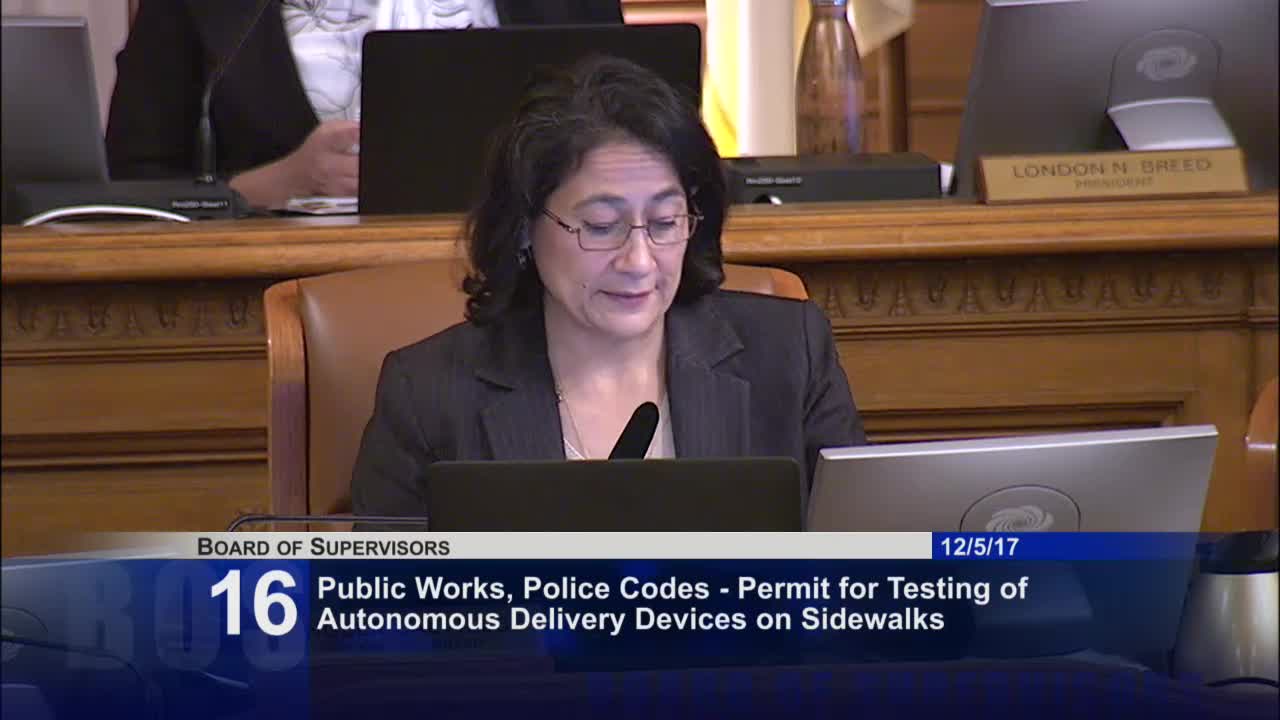
Board approves ordinance to ban autonomous delivery devices on sidewalks, creates narrow R&D permit path
Summary
The San Francisco Board of Supervisors on Dec. 5 approved a first-reading ordinance restricting autonomous delivery devices on sidewalks and right-of-ways while establishing a limited research-and-development permitting path and data-sharing requirements for trials in industrial PDR zones.
The San Francisco Board of Supervisors on Dec. 5 approved an ordinance that prohibits autonomous delivery devices from operating on sidewalks and public right-of-way while creating a tightly controlled permitting route for limited research-and-development (R&D) testing in parts of the city zoned for production, distribution and repair.
Supporters said the ordinance balances pedestrian safety with support for local innovation. Sponsor Supervisor Yee said the goal is to “keep our sidewalks for pedestrians” while allowing a small number of R&D permits so startups can test devices in low‑pedestrian corridors.
The ordinance follows months of committee work and multiple amendments negotiated with technology operators, neighborhood advocates and city departments. It bars full commercial sidewalk operations and provides a permit pathway for up to a small number of R&D devices at a time, restricted to mapped PDR blocks that exclude high‑injury transit corridors and require minimum effective sidewalk widths. Permit holders must report collisions and incidents, share testing data with the Department of Public Works (DPW), and follow city accessibility standards.
Department of Public Works staff told supervisors they had mapped about 236 streets and 1,048 blocks within PDR zoning; after removing high‑impact corridors DPW identified roughly 30 streets and 761 blocks available for testing. DPW staff also said they have not defined a standard “testing footprint” (for example number of consecutive blocks required) and have not done a formal assessment of how many consecutive blocks a test might use; that technical work remains with DPW and the permitting process.
Supervisors pressed for a permit and appeal process rather than simply setting an administrative quota on companies. Supervisor Cohen and others argued for a more comprehensive policy to address other emerging sidewalk devices and to avoid picking winners among startups. Supervisor Peskin and several colleagues urged action now to avoid repeating past patterns of “regulate too little, too late.”
The ordinance requires permit applicants to: limit active units while under R&D permits (city materials discussed a limit of three participating companies under the R&D framework), carry insurance, provide incident reports, implement privacy‑sensitive data collection and share specified data with DPW, and submit an odor/accessibility and security plan. The Office of Cannabis and the city administrator were discussed as partners for longer‑term policy and a proposed task force; Supervisor Yee said she will bring follow‑up legislation to create a city task force to address emerging technologies.
The measure passed its first reading unanimously earlier in the meeting; the ordinance will return to the board for second reading and final adoption after the usual notice and committee steps.
Why it matters: The ordinance aims to head off pedestrian safety problems on narrow urban sidewalks while allowing a narrowly defined testing program for local companies. The decision frames San Francisco’s policy direction on a class of robotic delivery devices that several companies are already testing or proposing to deploy.
Looking ahead: Supervisors and staff said further work is needed on DPW’s mapping, the specifics of permit conditions, enforcement authority and how collected test data will be used. Supervisor Yee said she expects followup legislation to create a cross‑departmental task force next year.