Get Full Government Meeting Transcripts, Videos, & Alerts Forever!
Get email alerts on the Telecommunications Siting topic
No spam. Unsubscribe anytime.
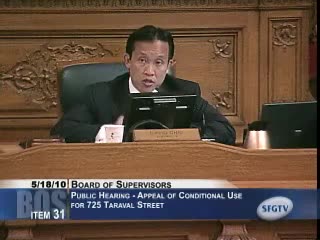
Board reverses Planning Commission, denies T‑Mobile rooftop antennas at 725 Taraval
Summary
After an extended hearing with multiple public speakers, the Board of Supervisors voted to reverse the Planning Commission approval and deny a conditional-use authorization for rooftop wireless antennas proposed by T‑Mobile at 725 Taraval Street.
The Board of Supervisors reversed a Planning Commission decision and denied a conditional-use authorization for a wireless telecommunications installation proposed by T‑Mobile at 725 Taraval Street.
The appeal centered on whether the carrier had demonstrated that the rooftop installation was “necessary and desirable” and compatible with the surrounding neighborhood under San Francisco Planning Code Section 303(c)(1). Residents from the Sunset and Parkside neighborhoods testified in opposition, citing aesthetic concerns, cumulative site saturation and health worries (health concerns are not a permissible basis for disapproval under the federal Telecommunications Act if facilities comply with FCC limits). Several residents presented field-test signal-strength readings and argued existing nearby sites gave adequate coverage.
T‑Mobile representatives presented radio-frequency coverage studies and “before/after” visual simulations showing screened antenna enclosures on roof penthouses; company engineers said the site filled coverage gaps and increased in-building and in-vehicle capacity. Planning staff and the Department of Public Health had reviewed the application and reported the proposed installation would operate well below FCC exposure limits and that the site met the city’s wireless siting guidelines for a mixed-use building in a neighborhood commercial district.
After public comment and rebuttal the board moved to table the motion to affirm the Planning Commission decision and instead approved the motion reversing the Planning Commission (Item 33) and directing the Clerk to prepare findings (Item 34). The board recorded the vote approving the reversal and the preparation of findings as 11 ayes.
The board’s action requires the Clerk to prepare detailed findings explaining the basis for reversal. The decision underscores that even when a project meets technical safety thresholds and planning guidelines, local elected officials may overturn Planning Commission approvals when neighbors present evidence bearing on necessity, compatibility or impacts that meet the planning code standard.