Get Full Government Meeting Transcripts, Videos, & Alerts Forever!
Get email alerts on the Infrastructure topic
No spam. Unsubscribe anytime.
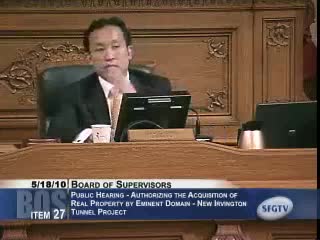
Board adopts resolution of necessity for Irvington Tunnel easements after hearing
Summary
Following a public hearing, the Board of Supervisors adopted a resolution of necessity allowing the San Francisco Public Utilities Commission to pursue eminent-domain authority to acquire temporary construction easements and a small permanent subsurface easement in Alameda County for the New Irvington Tunnel project.
The Board of Supervisors, sitting as a committee of the whole, adopted a resolution of necessity enabling the San Francisco Public Utilities Commission to proceed with eminent-domain authority if voluntary agreements cannot be reached for property rights needed to construct the New Irvington Tunnel as part of the Water System Improvement Program.
Julie Labonte, director of the Water System Improvement Program (Julie Labonte, director of the Water System Improvement Program), told the board the Irvington Tunnel is a critical seismic- and reliability-related project that will run roughly 3.5 miles between portals near Mission San Jose (Fremont) and the Sunol Valley in Alameda County. Labonte said the existing tunnel, built in the 1920s, lacks redundancy and carries a large share of the system’s supply; the new tunnel alignment was constrained by preexisting subsurface easements and required property access for construction staging, dewatering and a small, permanent shoring structure at one portal. “We need permission to use three privately owned properties,” Labonte said in presentation materials and remarks, adding the project requires a combination of temporary construction easements and, at one property, a small permanent subsurface easement.
Property owners and their counsel raised objections during the hearing. Michael Kyle, counsel for property owner Carolyn Garcia, argued procedural defects in a summary appraisal and urged the board not to move forward as to the Alameda West Portal parcel without correcting what he called a deficiency in the appraisal documentation. Another owner, Kenneth Paul Mackin, said proposed compensation was inadequate for expected impacts and expressed concern about hazardous material handling and use of the site for spoils and staging. PUC staff told the board the agency had continued negotiations with the property owners, had secured voluntary agreements for two of the needed parcels (and learned during the meeting that a third had signed), and emphasized the resolution preserves the ability to seek a court order of possession if negotiations fail while staff continues to pursue voluntary settlements.
The resolution approved the acquisition of three temporary construction easements and one small permanent subsurface easement: the Vergas shaft working area (temporary easement, approximately 2.5 acres, 51 months), the Sheridan Valley work area (temporary easement, approximately 1.9 acres, 24 months for groundwater wells), and the Alameda West Portal work area (temporary easement, approximately 2.9 acres, 51 months, plus a permanent subsurface easement limited to about a 30-by-35-foot triangle to permit a shoring structure). The board adopted the resolution by roll call (10 ayes, 0 noes recorded in the transcript at the time of vote), allowing the PUC to proceed with either negotiated purchases or, if necessary, eminent-domain proceedings to secure the property interests described in staff reports.
The PUC said the schedule is constrained by construction sequencing tied to a winter shutdown window; staff asked the board to act so the commission could award a construction contract and meet the timeline for early contractor work. The board’s approval does not excuse continued negotiation; PUC staff emphasized its preference for voluntary agreements.