Get Full Government Meeting Transcripts, Videos, & Alerts Forever!
Get email alerts on the Voting Access topic
No spam. Unsubscribe anytime.
Supervisors approve SRO visitor policy changes aimed to ease get-out-the-vote outreach
Summary
The Board passed an ordinance requiring single-room occupancy (SRO) properties to adopt visitor policies that facilitate voter-registration and GOTV efforts. The measure drew extended debate over access rights, privacy and potential city involvement in campaign activities.
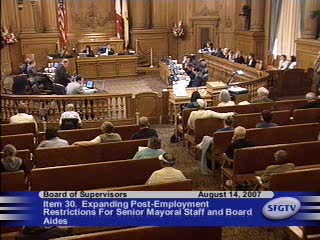
The Board of Supervisors on Aug. 14 passed on first reading an ordinance changing visitor-access rules for single-room occupancy (SRO) properties to make it easier for voter-registration and get-out-the-vote (GOTV) activities to reach SRO residents.
The ordinance amends the San Francisco Administrative Code to require SROs to adopt visitor policies that permit occupants and their guests to bring in people conducting voter registration and outreach. Supporters said the change will remove barriers that have long kept many SRO residents — a population estimated in the hearing to number roughly 30,000 across some 500 facilities — from participating fully in civic life. Opponents warned the change could create a slippery slope that lets outside organizers enter buildings and bring in further guests, raising privacy and safety concerns.
Supervisor Jake McGoldrick and other supporters noted that the measure grew from conversations with SRO managers, tenants and advocates; proponents argued the regulation addresses a unique access problem in SROs where front-desk controls have impeded outreach. Deputy City Attorney Cheryl Adams told the board the ordinance applies only to SROs and requires modifications to visitor policies; it does not change city funding rules or authorize government-run GOTV drives.
Supervisor Chris Ellsburn (transcript spelling) and others dissented, arguing that the measure could allow guests to bring additional guests, and could enable third parties to circulate or distribute campaign materials without proper controls. Some supervisors sought assurances that city funds would not be used for partisan GOTV activity; makers of the ordinance emphasized it does not direct spending by the City and County of San Francisco.
Vote: The ordinance passed on first reading by a roll call recorded as seven ayes and three noes; the board noted the measure will return for final reading.
Why it matters: SRO residents are one of the city’s most hard-to-reach constituencies; the ordinance aims to lower procedural hurdles that have blocked voter-registration and outreach in a housing type with restricted access. Supporters say it levels the playing field for historically underrepresented residents; critics want clearer protections for tenants’ privacy and limits on how far guests may bring in subsequent guests.
What remains: Legal questions about how the rule applies to multiunit buildings beyond SROs were raised during debate. The board’s deputy city attorney said the ordinance applies only to SROs. The measure will return for second reading per the city’s ordinance schedule. Supervisors also urged outreach by the Department of Elections and SRO managers to coordinate practical details of implementation.
Evidence from the meeting: The matter was introduced as item 31 on the agenda; detailed debate occupied much of the afternoon session. The board recorded multiple amendments and clarifying exchanges, and ultimately passed the ordinance on first reading.