Get Full Government Meeting Transcripts, Videos, & Alerts Forever!
Get email alerts on the Community Solar topic
No spam. Unsubscribe anytime.
BZA approves 2-MW Preston community solar special use with conditions, limits construction hours
Summary
The Board approved Preston Community Energy Initiative LLC’s special-use application for a 2-megawatt community-scale solar facility on Dover Bridge Road with staff conditions, a 30-foot planted buffer, a 7-foot security fence with screening mesh, and limits on construction working hours and pile driving.
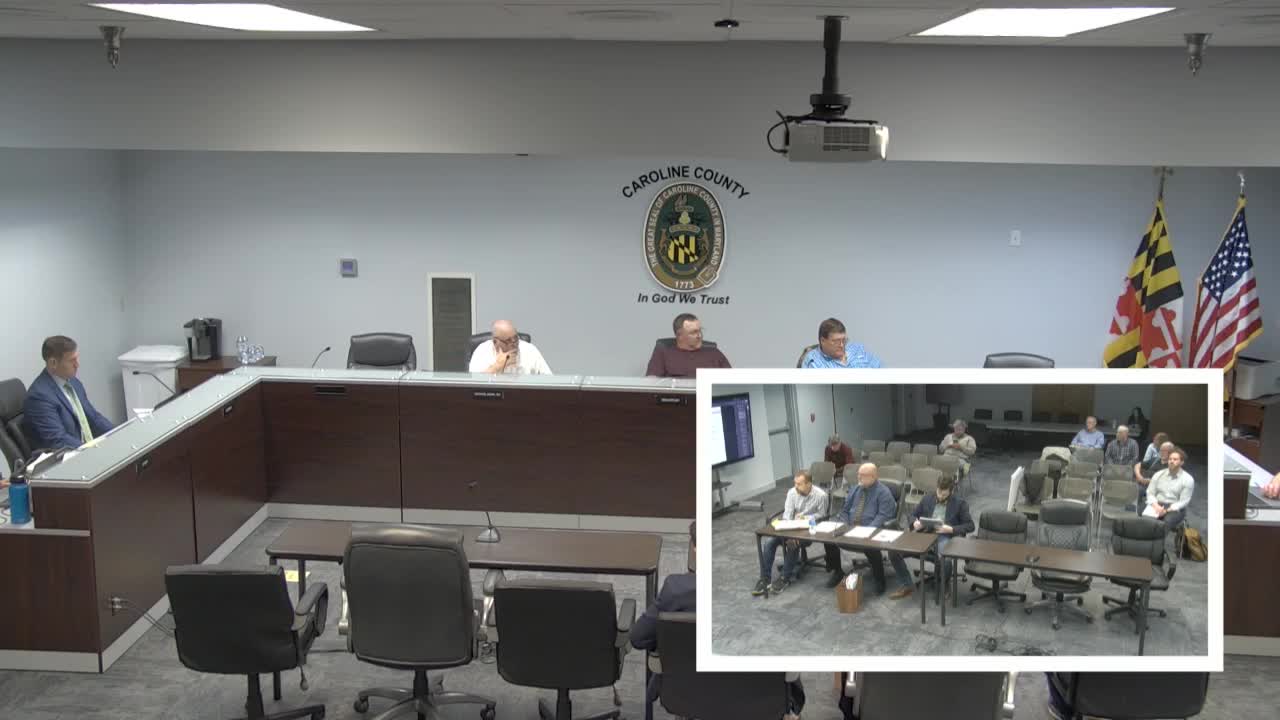
The Caroline County Board of Zoning Appeals on April 15 approved a special-use exception for a 2-megawatt AC commercial community-scale solar facility proposed by Preston Community Energy Initiative LLC on a roughly 12.5-acre area at 22945 Dover Bridge Road, Preston.
The board’s approval is conditional on completion of outstanding items in the staff report and compliance with the county’s solar design standards: a 200-foot setback from residences, 30-foot planted screening buffers to be reviewed by a licensed landscape architect at applicant expense, a 7-foot secure chain-link fence with privacy mesh, underground electrical runs where required by the utility, and a county-approved decommissioning plan. The board also required that the full exhibit package and the BZA decision be transmitted to the planning commission as part of the final site-plan review.
Project presenters described the 2 MW single-axis tracker array, a 16-foot-wide gravel access road and remote monitoring and telemetry for operations. Ted Hastings of Becker Morgan Group, the civil engineer for the applicant, said the design follows the National Electric Code and National Fire Protection standards and that stormwater management will treat the two- and ten-year storms for the disturbed acreage. “This facility will be designed in accordance with the National Electric Code and National Fire Protection Act,” Hastings said during his presentation.
Jack Rollin, the applicant’s development manager, said the project is intended to participate in Maryland’s permanent community solar program and that about 40% of customer subscriptions will be reserved for low- and moderate-income customers who would receive a guaranteed minimum discount on their electricity credits. “The purpose of community solar is really just making it possible for everyone to support local solar power and receive some guaranteed savings on their electric bill,” Rollin said.
Several neighbors spoke in opposition and raised concerns about drainage in a low-lying area, visual impact, and community engagement. One nearby landowner described local drainage patterns and urged that an alternative location or a grass waterway be considered to avoid redirecting flow; the applicant and county staff responded that the stormwater report shows the site will meet county stormwater design standards and that the project’s post-construction runoff will meet required treatment levels.
Construction-hour limitations were added as conditions: weekdays 7 a.m.–7 p.m., Saturdays 8 a.m.–5 p.m., no construction on Sundays; pile-driving operations were specifically limited to 8 a.m.–5 p.m. on weekdays and Saturdays. The board included standard staff recommendations in the approval and required that the outstanding staff-review items be resolved before the application proceeds to planning commission for major site-plan review.
Motion and vote: The board moved and seconded approval of application 24-0043 with the conditions described above, including transmission of exhibits to the planning commission and the construction-hour limits; the motion passed with the board recording at least a majority in favor and one recorded dissent.
Next steps: The applicant must address outstanding items listed in the staff review (landscape maintenance agreement, financial securities for plantings and decommissioning, and outstanding plan details), submit the final site plan to the planning commission, and secure any required utility interconnection approvals before construction.