Get Full Government Meeting Transcripts, Videos, & Alerts Forever!
Get email alerts on the Ebikes Scooters Regulation topic
No spam. Unsubscribe anytime.
Colleyville council directs staff to draft e-bike ordinance after safety discussion
Summary
City leaders agreed to move a draft ordinance to first reading after a lengthy work-session on electric bicycles, scooters and mini motorbikes, focusing on age, speed, equipment and enforcement tools.
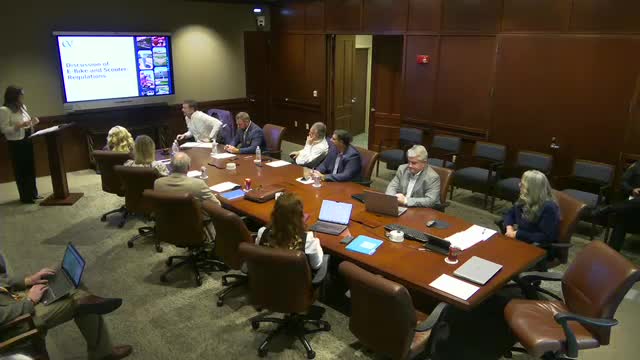
Colleyville City Council directed staff on April 15 to prepare a draft ordinance for first reading and public comment that would regulate electric bicycles, electric scooters and pocket/mini motorbikes, after a lengthy work-session focused on safety and enforcement.
Traffic-advisory committee staff member Adrienne Lofree opened the discussion, saying, “there have been concerns from community members about e bikes and just general safety for citizens,” and reviewed device classifications and a suite of proposed restrictions and permissions. Council members debated age limits, speed caps for sidewalks and trails, helmet and equipment requirements, and enforcement tools including registration stickers and progressive penalties.
The draft framework discussed would treat class 1 and class 2 electric bicycles similarly to traditional bicycles in many respects, allow them on designated local streets, paved trails and sidewalks under specified speed limits, and prohibit pocket motorbikes/mini motorbikes from public property. Council members expressed particular concern about class 3 e-bikes and non‑pedal motorized devices that can reach higher speeds: participants proposed that class 3 machines be treated more like motor vehicles — requiring age and licensing restrictions, visible identification and, if used on public streets, registration and insurance — or be barred from public right-of-way.
Participants discussed specific controls that staff included in the presentation: a minimum sidewalk/trail speed (the traffic committee initially proposed 5 mph on sidewalks and 15 mph on wider regional trails such as the Cotton Belt Trail), a minimum operator age of 10 for some uses (with higher minimums discussed for motorized scooters on roads), helmet requirements for minors, and an equipment standard requiring front lights and rear reflectors after dusk. Council members debated raising the sidewalk speed from 5 to 10–12 mph for practical enforcement and public safety reasons; by the end of the session council direction favored treating class 1 and 2 like bicycles with a higher sidewalk speed limit than originally proposed and prohibiting class 3 from sidewalks.
The council also discussed enforcement approaches. Staff proposed civil infractions with a nominal fine and a progressive structure intended to be an annoyance more than a heavy financial penalty. Members proposed a step-up approach during the discussion (examples mentioned in the meeting included a first offense fine plus a required safety class, a larger fine and judge appearance on subsequent offenses, and possible impoundment for repeat violations), but the council did not adopt final penalty amounts or impoundment language during the work session. Council members asked staff and the police department to consider a visible identification mechanism (stickers or tags affixed while the device is present for inspection) to help officers differentiate classes and to deter mislabeling.
Council members also raised operational restrictions that staff should draft into the ordinance: a ban on passengers on e-bikes/scooters (with a possible narrow exemption discussed for child seats), prohibitions on listening devices for younger riders (proposed: no earbuds/AirPods for riders 16 and under), and parent/guardian responsibility for minors who violate the ordinance. Several members urged education and public outreach — including safety classes, open houses and materials on the city website — as part of implementation.
Because state law constrains some local regulation (Lofree noted state provisions that generally require e-bikes to be treated like bicycles for many purposes), members emphasized that certain restrictions may be limited or require careful statutory review. Staff will refine the draft to reflect legal limits and council feedback.
Next steps: staff were directed to prepare ordinance language incorporating the edits discussed, circulate it to staff (Adrian) for legal review within about a week, and present the draft as a first reading at the next meeting with opportunity for public comment. Council members also supported additional community outreach events to explain classifications, equipment differences and enforcement plans before or during the formal ordinance process.