Get Full Government Meeting Transcripts, Videos, & Alerts Forever!
Get email alerts on the Police Staffing topic
No spam. Unsubscribe anytime.
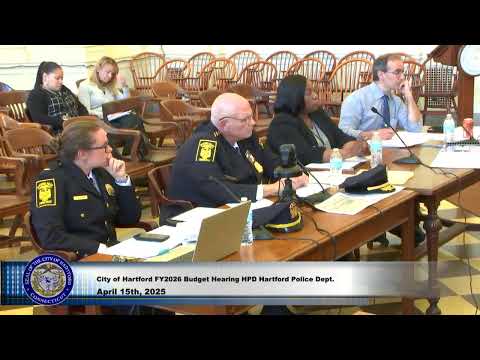
Hartford interim police chief warns staffing shortfalls persist as budget holds steady
Summary
Interim Police Chief James Rovella told the Hartford City Council's operations management budget committee on Monday that the Hartford Police Department is operating well below authorized strength and that the recommended fiscal 2026 budget holds mostly flat while shifting some grant-funded posts into the city's general fund.
Interim Police Chief James Rovella told the Hartford City Council's operations management budget committee on Monday that the Hartford Police Department is operating well below authorized strength and that the recommended fiscal 2026 budget holds mostly flat while shifting some grant-funded posts into the city's general fund.
'We're down 31 officers since this time last year,' Rovella said, describing current staffing of 347 sworn officers, about 44 short of full staffing. He said the shortfall has driven higher-than-normal overtime and contributed to gaps in patrol coverage.
The presentation to the committee, chaired by Councilman Amirca Hernandez, reviewed crime statistics, recruitment outcomes and a small net budget increase. City data presented at the hearing showed a 2% decrease in overall crime for calendar 2024, a 16% year-to-date decrease in 2025 compared with the same date in 2024, and a 20% decline over a two-year look-back. The department also reported an increase in larceny incidents.
Rovella and his staff emphasized recruiting and retention as top priorities. The department reported two small academy classes in the current fiscal year: one that graduated in September and one in March, with several recruits still in satellite academies. The department reiterated a standing goal of running two academy classes of about 25 recruits each.
To broaden outreach, Rovella said the department will increase digital recruitment and expand outreach to Hartford high schools, aiming to restore cadet and pro-cadet positions. Sergeant Steve Austin, who leads recruitment work, was singled out as a frequent community presence. Council members urged the department to publish clear starting-pay information to help recruiting.
The recommended budget changes are modest: overall a 0.3% increase reflecting contractual salary steps and the movement of some positions from expiring COPS grants into the general fund. Rovella said the department currently manages two separate COPS grants; one is concluding and its positions will be carried on the general fund, and the department is monitoring the other to avoid supplanting concerns.
The budget includes $64,000 for a 'drone first responder' program intended to place drone assets at a station on Trumbull Street. Rovella said the department expects to collect operational data roughly six months after deployment and believes drones could reduce certain calls for on-scene officer responses and assist with vehicle pursuits.
On workforce composition, the department reported that roughly 5% of employees live in Hartford and 95% live outside the city. Demographics shown in the presentation listed 23% Hispanic, 12% African American, 63% white and 2% other; 15% of sworn officers were female. Rovella noted the department has lost officers in recent years for a mix of retirements and moves to smaller departments.
Committee members asked about academy staffing and how vacancies were displayed in the budget. Pam Mendez, the department's finance officer, and Lieutenant Trusinski said many vacancy positions were consolidated in the academy line for budget visibility even when the underlying personnel had worked in other divisions.
Committee members also asked about response times. The department reported average waiting times for priority calls as presented at the hearing: an A call averaged about six minutes, a B call about 47 minutes and a C call about 18 minutes. Rovella said hiring more officers would allow modest expansion of patrol coverage and civilian service roles but that improvements would be gradual.
On compensation, the committee received a clarification late in the hearing: starting pay for patrol officers was stated as $69,000 with a top step of about $80,000 after four years; annual step increases apply in the first four years in addition to contractual raises.
Several council members expressed support for the mayor's recommended budget, offered to assist with recruitment outreach and sought more regular reporting on hiring, retention and overtime costs. The department said it would provide the council a spreadsheet comparing Hartford's pay and benefits with neighboring departments and follow up on specific data requests.
The presentation also highlighted community partnerships (the HEART team, Interval House, Mobile Crisis, an auto-theft task force with state police) and several officer awards from community organizations. Department leaders said those partnerships help divert non-police matters to service providers.
No formal motions or votes on budget lines were taken during the hearing; the committee signaled general support for the mayor's recommendation and asked the department for follow-up material.